

New figures show councils have worked hard to bring atmospheric pollution in line with government requirements, but this emphasises the disconnect between ‘better’ and ‘best’.
New figures show councils have worked hard to bring atmospheric pollution in line with government requirements, but this emphasises the disconnect between ‘better’ and ‘best’.
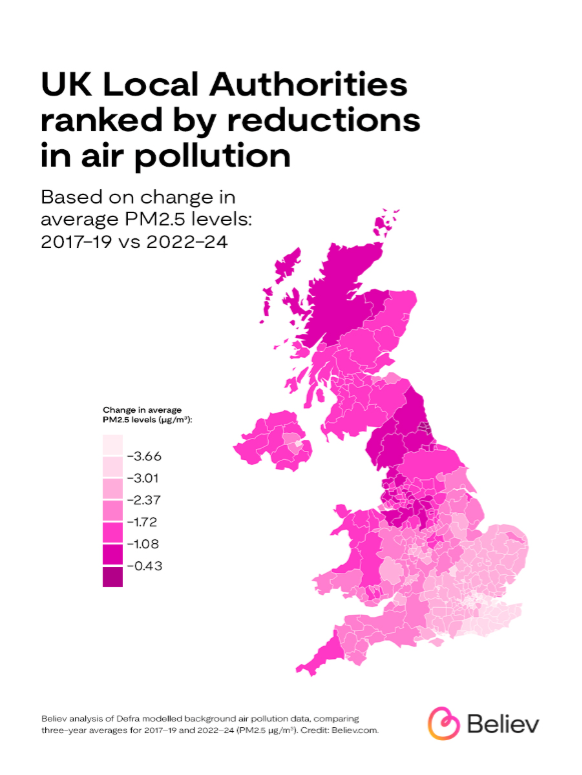
Data published by electric vehicle charge point operator Believ shows that 34% of English and Welsh local authorities have brought fine particulate matter to within levels stipulated by Downing Street. This adds to the 65% that had already met this standard, meaning almost all authorities are now compliant with air quality ambitions four years ahead of schedule.
Councils that have performed particularly well in the latest data set — recording the greatest level of reduction — include Portsmouth, Brighton & Hove, and a number of London boroughs. However, despite the significant steps taken, 80% of all English and Welsh constituencies still record air pollution levels above World Health Organisation (WHO) guidelines.
|
Across the UK, there are stark regional differences. Every local authority within Scotland and Northern Ireland, for example, now meets WHO maximum limits for PM2.5. In contrast, no London authority does, nor do any in the South East, Yorkshire & the Humber, East Midlands, or East of England.
‘[PM2.5] accelerates ageing in all organs within the human body, and 700 diseases, from osteoporosis to dementia, are linked to pollution,’ said Professor Stephen Holgate, Professor of Immunopharmacology from the University of Southampton. ‘This is no longer just an environmental issue. It is a public health issue. It is going to be important to further educate local authorities and the wider public that this is a problem that impacts the entire life course, so there is even more incentive to make further improvements.’
‘It’s positive to see the progress that local authorities are making in reducing air pollution. This shows local action on cleaner transport, energy and planning can deliver real results. But with 95% of neighbourhoods still above the WHO guideline, we cannot afford to slow down,’ added Guy Bartlett, Believ CEO. ‘At Believ, we are focused on helping councils build sustainable transport infrastructure to help accelerate progress towards cleaner air in local communities. Clean air should not be postcode lottery. Every community deserves air that is safe to breathe. So it is crucial that we don’t lose this momentum and continue to strive for cleaner air for all.’
Charts & Maps: Believ
Image: Yucong Cai / Unsplash
More Pollution, Waste & Recycling:
Another royal scandal: Duchy of Lancaster ‘owns’ Wigan illegal waste dump


