Mapped: Which Gulf States Depend Most on Tourism?
This was originally posted on our Voronoi app. Download the app for free on iOS or Android and discover incredible data-driven charts from a variety of trusted sources.
Key Takeaways
- Bahrain and the UAE are the Gulf’s most tourism-dependent economies, with tourism receipts equal to more than 10% of GDP.
- That puts them in the same range as major global tourism markets like Greece and Thailand.
- As regional tensions rise, that reliance could become an economic vulnerability.
Bahrain and the UAE stand out as the Gulf’s most tourism-reliant economies, with visitor spending playing a much larger role in their economies than in neighboring states.
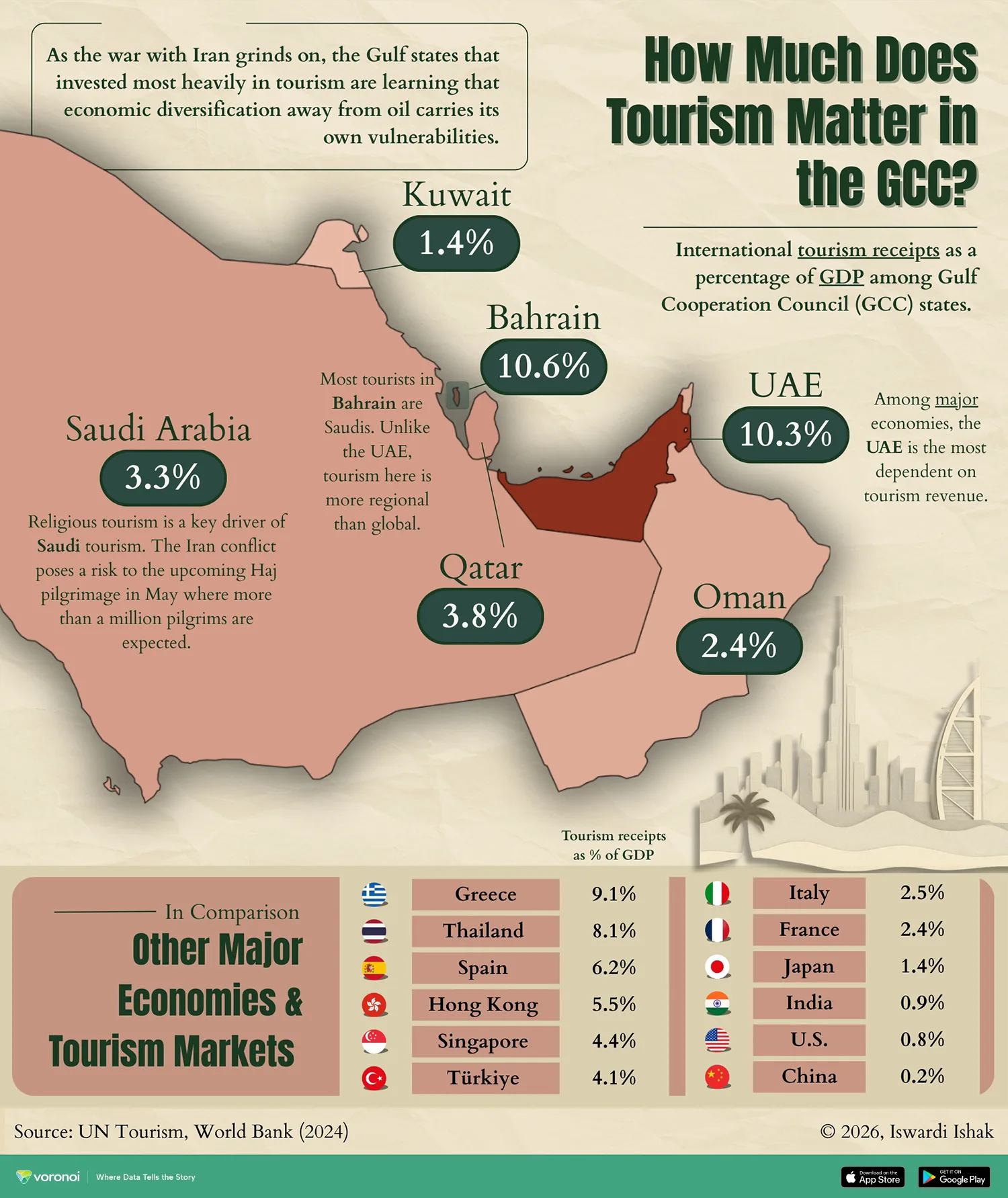
This map by Iswardi Ishak breaks down international tourism receipts as a share of GDP across Gulf Cooperation Council (GCC) economies based on UN Tourism data, revealing which economies are most exposed to swings in global travel demand.
Tourism’s Role Across Gulf Economies
Below, we break down tourism receipts as a share of GDP in GCC economies, as well as others for comparison:
| Country/Territory | Int’l Tourism Receipts as % of GDP | Total Int’l Tourism Receipts (USD Billions) |
|---|---|---|
 Bahrain Bahrain |
10.6% | 5 |
 United Arab Emirates United Arab Emirates |
10.3% | 57 |
 Greece Greece |
9.1% | 23.4 |
 Thailand Thailand |
8.1% | 42.7 |
 Spain Spain |
6.2% | 106.5 |
 Hong Kong Hong Kong |
5.5% | 22.5 |
 Singapore Singapore |
4.4% | 23.8 |
 Türkiye Türkiye |
4.1% | 56.3 |
 Qatar Qatar |
3.8% | 8.4 |
 Saudi Arabia Saudi Arabia |
3.3% | 41 |
 Italy Italy |
2.5% | 58.7 |
 Oman Oman |
2.4% | 2.6 |
 France France |
2.4% | 77 |
 Kuwait Kuwait |
1.4% | 2.3 |
 Japan Japan |
1.4% | 54.7 |
 India India |
0.9% | 35 |
 U.S. U.S. |
0.8% | 214 |
 China (Mainland) China (Mainland) |
0.2% | 39.7 |
The UAE and Bahrain each derive more than 10% of GDP from international tourism, placing them among the most tourism-exposed economies globally. Meanwhile, Kuwait and Oman remain far less dependent on international visitors.
Tourism as a Diversification Strategy
Across the Gulf, tourism has been central to economic diversification strategies aimed at reducing reliance on oil. The UAE stands out as the region’s most tourism-dependent major economy, with Dubai in particular positioning itself as a global travel hub.
Bahrain, while smaller, also leans heavily on tourism, though much of it is regional, with visitors frequently arriving from neighboring Saudi Arabia. In contrast, Saudi Arabia’s tourism sector is anchored by religious travel, particularly the Hajj and Umrah pilgrimages.
Countries like Qatar and Oman fall somewhere in between, investing heavily in tourism infrastructure but still deriving a relatively modest share of GDP from the sector.
Rising Risks from Regional Conflict
However, the region’s growing reliance on tourism also introduces new vulnerabilities. As tensions escalate in the Middle East, recent strikes on infrastructure and explicit warnings that tourist sites could be targeted have raised concerns across global travel markets.
Industry analysts warn that prolonged conflict could have a chilling effect on international travel demand, particularly in perceived high-risk regions. This creates a direct economic risk for countries like the UAE and Bahrain, where tourism is a key pillar of growth.
Even Saudi Arabia faces potential disruption, especially if instability affects major religious gatherings that attract millions annually.
How the GCC Compares Globally
Globally, tourism-dependent economies vary widely. Countries like Greece (9.1%) and Thailand (8.1%) derive significant shares of GDP from tourism, while larger economies like the U.S. (0.8%) and China (0.2%) are far less reliant.
The GCC’s top performers now rival established tourism markets, but with geopolitical risks rising, that reliance could quickly turn into a vulnerability.
Learn More on the Voronoi App 
Explore more data on global tourism trends in this post: Which Country Gains The Most From Tourism?