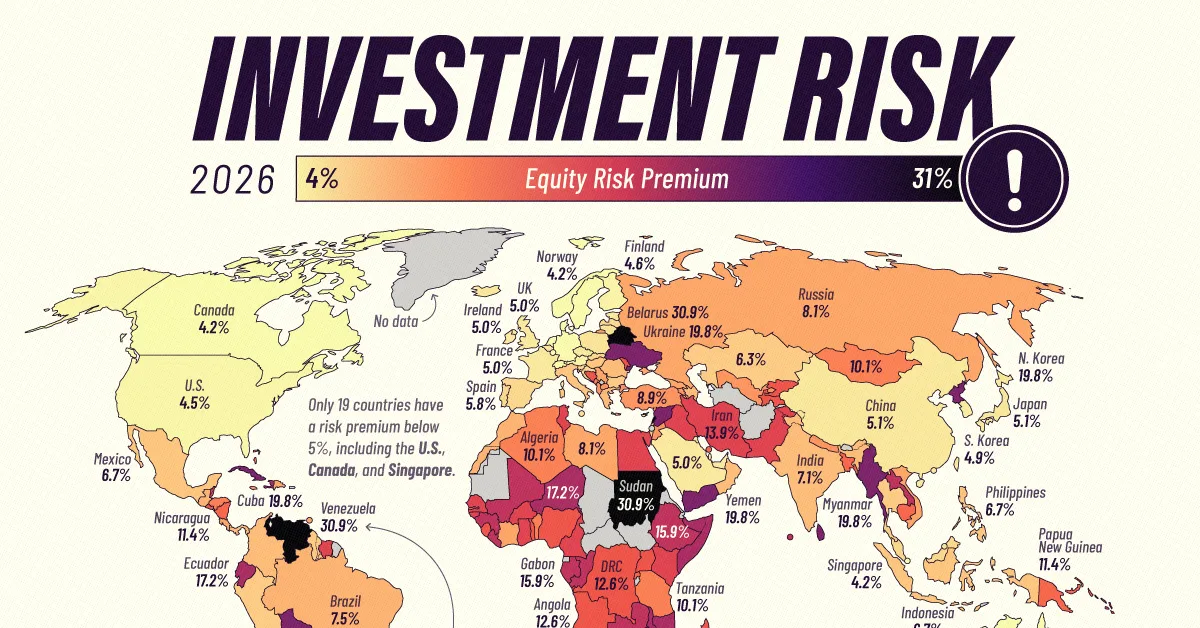
 Click to view this graphic in higher-resolution.
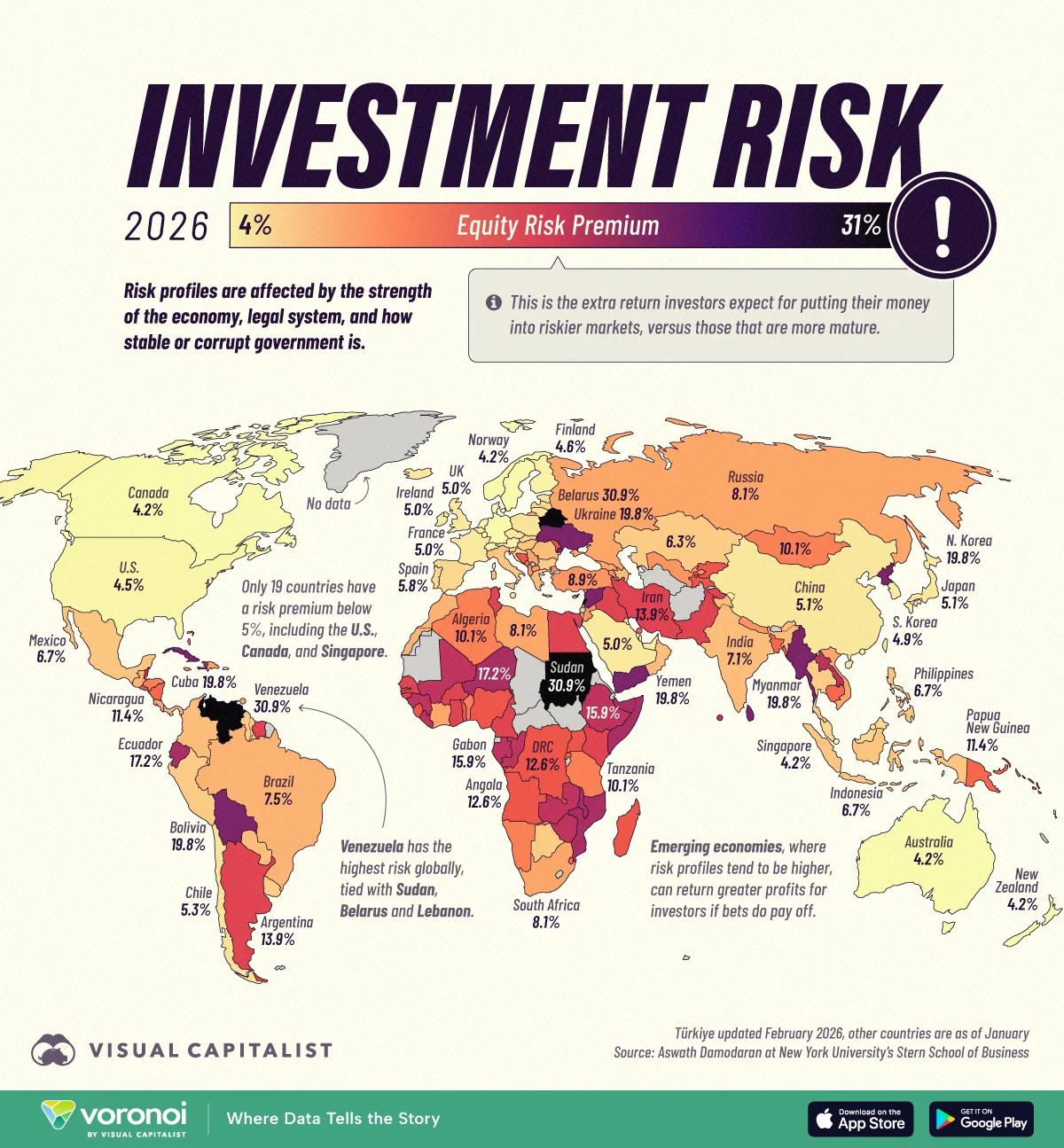
Mapped: The World’s Riskiest Markets in 2026
See visuals like this from many other data creators on our Voronoi app. Download it for free on iOS or Android and discover incredible data-driven charts from a variety of trusted sources.
Key Takeaways
- Four countries—Belarus, Lebanon, Sudan, and Venezuela—top the global risk ranking at 30.9%.
- The U.S. sits at 4.5%, higher than several developed peers.
- Only 19 countries globally have risk premiums below 5%.
Not all markets offer the same tradeoff between risk and return.
This map shows equity risk premiums around the world—based on estimates from NYU professor Aswath Damodaran. These premiums reflect the extra return investors demand to invest in each country, with higher values signaling greater perceived risk.
The gap is stark. While a handful of stable economies sit near 4–5%, countries facing conflict or economic collapse can exceed 30%, highlighting how dramatically risk perceptions diverge across global markets.
The World’s Riskiest Countries
Check out the data, which is as of January 2026, although Türkiye was updated in February:
| Country | Equity Risk Premium |
|---|---|
 Belarus Belarus |
30.9% |
 Lebanon Lebanon |
30.9% |
 Sudan Sudan |
30.9% |
 Venezuela Venezuela |
30.9% |
 Bolivia Bolivia |
19.8% |
 Cuba Cuba |
19.8% |
 Myanmar Myanmar |
19.8% |
 North Korea North Korea |
19.8% |
 Sri Lanka Sri Lanka |
19.8% |
 Syria Syria |
19.8% |
 Ukraine Ukraine |
19.8% |
 Yemen Yemen |
19.8% |
 Ecuador Ecuador |
17.2% |
 Haiti Haiti |
17.2% |
 Malawi Malawi |
17.2% |
 Mozambique Mozambique |
17.2% |
 Niger Niger |
17.2% |
 Somalia Somalia |
17.2% |
 Ethiopia Ethiopia |
15.9% |
 Gabon Gabon |
15.9% |
 Guinea Guinea |
15.9% |
 Laos Laos |
15.9% |
 Liberia Liberia |
15.9% |
 Maldives Maldives |
15.9% |
 Mali Mali |
15.9% |
 Republic of Congo Republic of Congo |
15.9% |
 Zambia Zambia |
15.9% |
 Zimbabwe Zimbabwe |
15.9% |
 Argentina Argentina |
13.9% |
 Belize Belize |
13.9% |
 Burkina Faso Burkina Faso |
13.9% |
 Cameroon Cameroon |
13.9% |
 Egypt Egypt |
13.9% |
 Ghana Ghana |
13.9% |
 Guinea-Bissau Guinea-Bissau |
13.9% |
 Iran Iran |
13.9% |
 Iraq Iraq |
13.9% |
 Kenya Kenya |
13.9% |
 Pakistan Pakistan |
13.9% |
 Senegal Senegal |
13.9% |
 Solomon Islands Solomon Islands |
13.9% |
 Suriname Suriname |
13.9% |
 Tunisia Tunisia |
13.9% |
 Angola Angola |
12.6% |
 Bosnia and Herzegovina Bosnia and Herzegovina |
12.6% |
 DRC DRC |
12.6% |
 El Salvador El Salvador |
12.6% |
 Kyrgyzstan Kyrgyzstan |
12.6% |
 Madagascar Madagascar |
12.6% |
 Moldova Moldova |
12.6% |
 Nigeria Nigeria |
12.6% |
 Sierra Leone Sierra Leone |
12.6% |
 St. Vincent & the Grenadines St. Vincent & the Grenadines |
12.6% |
 Tajikistan Tajikistan |
12.6% |
 Togo Togo |
12.6% |
 Uganda Uganda |
12.6% |
 Bahrain Bahrain |
11.4% |
 Bangladesh Bangladesh |
11.4% |
 Barbados Barbados |
11.4% |
 Cambodia Cambodia |
11.4% |
 Cape Verde Cape Verde |
11.4% |
 Gambia Gambia |
11.4% |
 Nicaragua Nicaragua |
11.4% |
 Papua New Guinea Papua New Guinea |
11.4% |
 Rwanda Rwanda |
11.4% |
 Swaziland Swaziland |
11.4% |
 Algeria Algeria |
10.1% |
 Bahamas Bahamas |
10.1% |
 Benin Benin |
10.1% |
 Cook Islands Cook Islands |
10.1% |
 Fiji Fiji |
10.1% |
 Honduras Honduras |
10.1% |
 Mongolia Mongolia |
10.1% |
 Montenegro Montenegro |
10.1% |
 Namibia Namibia |
10.1% |
 Tanzania Tanzania |
10.1% |
 Albania Albania |
8.9% |
 Armenia Armenia |
8.9% |
 Jamaica Jamaica |
8.9% |
 Jordan Jordan |
8.9% |
 Macedonia Macedonia |
8.9% |
 Nepal Nepal |
8.9% |
 Türkiye Türkiye |
8.9% |
 Uzbekistan Uzbekistan |
8.9% |
 Costa Rica Costa Rica |
8.1% |
 Côte d’Ivoire Côte d’Ivoire |
8.1% |
 Dominican Republic Dominican Republic |
8.1% |
 Georgia Georgia |
8.1% |
 Libya Libya |
8.1% |
 Russia Russia |
8.1% |
 Serbia Serbia |
8.1% |
 South Africa South Africa |
8.1% |
 St. Maarten St. Maarten |
8.1% |
 Trinidad and Tobago Trinidad and Tobago |
8.1% |
 Vietnam Vietnam |
8.1% |
 Brazil Brazil |
7.5% |
 Guatemala Guatemala |
7.5% |
 Morocco Morocco |
7.5% |
 Sharjah Sharjah |
7.5% |
 Aruba Aruba |
7.1% |
 Azerbaijan Azerbaijan |
7.1% |
 Colombia Colombia |
7.1% |
 Curacao Curacao |
7.1% |
 Greece Greece |
7.1% |
 India India |
7.1% |
 Mauritius Mauritius |
7.1% |
 Montserrat Montserrat |
7.1% |
 Oman Oman |
7.1% |
 Panama Panama |
7.1% |
 Paraguay Paraguay |
7.1% |
 Romania Romania |
7.1% |
 Hungary Hungary |
6.7% |
 Indonesia Indonesia |
6.7% |
 Italy Italy |
6.7% |
 Mexico Mexico |
6.7% |
 Philippines Philippines |
6.7% |
 Andorra Andorra |
6.3% |
 Botswana Botswana |
6.3% |
 Bulgaria Bulgaria |
6.3% |
 Guyana Guyana |
6.3% |
 Israel Israel |
6.3% |
 Kazakhstan Kazakhstan |
6.3% |
 Peru Peru |
6.3% |
 Thailand Thailand |
6.3% |
 Turks and Caicos Islands Turks and Caicos Islands |
6.3% |
 Uruguay Uruguay |
6.3% |
 Croatia Croatia |
5.8% |
 Cyprus Cyprus |
5.8% |
 Latvia Latvia |
5.8% |
 Malaysia Malaysia |
5.8% |
 Portugal Portugal |
5.8% |
 Slovakia Slovakia |
5.8% |
 Slovenia Slovenia |
5.8% |
 Spain Spain |
5.8% |
 Bermuda Bermuda |
5.3% |
 Chile Chile |
5.3% |
 Lithuania Lithuania |
5.3% |
 Malta Malta |
5.3% |
 Poland Poland |
5.3% |
 China China |
5.1% |
 Estonia Estonia |
5.1% |
 Guernsey Guernsey |
5.1% |
 Iceland Iceland |
5.1% |
 Japan Japan |
5.1% |
 Kuwait Kuwait |
5.1% |
 Belgium Belgium |
5.0% |
 Brunei Brunei |
5.0% |
 Cayman Islands Cayman Islands |
5.0% |
 Czechia Czechia |
5.0% |
 France France |
5.0% |
 Hong Kong Hong Kong |
5.0% |
 Ireland Ireland |
5.0% |
 Isle of Man Isle of Man |
5.0% |
 Jersey Jersey |
5.0% |
 Macao Macao |
5.0% |
 Saudi Arabia Saudi Arabia |
5.0% |
 Taiwan Taiwan |
5.0% |
 United Kingdom United Kingdom |
5.0% |
| Abu Dhabi |
4.9% |
 South Korea South Korea |
4.9% |
 Qatar Qatar |
4.9% |
| United Arab Emirates |
4.9% |
 Austria Austria |
4.6% |
 Finland Finland |
4.6% |
 United States United States |
4.5% |
 Australia Australia |
4.2% |
 Canada Canada |
4.2% |
 Denmark Denmark |
4.2% |
 Germany Germany |
4.2% |
 Liechtenstein Liechtenstein |
4.2% |
 Luxembourg Luxembourg |
4.2% |
 Netherlands Netherlands |
4.2% |
 New Zealand New Zealand |
4.2% |
 Norway Norway |
4.2% |
 Singapore Singapore |
4.2% |
 Sweden Sweden |
4.2% |
 Switzerland Switzerland |
4.2% |
To estimate the investment risk premium, Damodaran looked at each country’s credit rating and how much extra interest investors want when lending to it. For countries where government bonds aren’t available or traded, he based his estimate on the differences in equity returns of two emerging markets indices.
As a last step, he added that country risk premium to his estimate of a mature market equity risk premium.
The riskiest countries are those that experience war, sanctions, and economic collapse. Belarus, Lebanon, Sudan, and Venezuela each have the highest equity risk premiums of 30.9%.
Belarusians have faced intense political repression as they responded to the contested re-election of Alexander Lukashenko in 2020. Lebanon is considered a failed state as governance and the economy have collapsed, while armed groups are present on the streets.
There has been a civil war in Sudan since 2023, causing a devastating humanitarian crisis. Meanwhile, Venezuela has a long history of instability; the mismanagement of its oil industry and the economy sent the once-prosperous nation into disarray.
Cuba, Ukraine, Syria, and Yemen, which have also experienced conflict or sanctions, are among a cluster of countries with risk premiums of 19.8%.
Countries Considered Safer Investment Bets
Some of the safest countries include Canada, Germany, Switzerland, Singapore, Sweden, and the Netherlands, with risk premiums at 4.2%. Investors likely treat them interchangeably.
The U.S. has a slightly higher premium at 4.5%, which may reflect recent political polarization and higher equity volatility. Indeed, “Sell America” dominated investor conversations earlier this year amid economic uncertainty, questions around the independence of the Federal Reserve, and the depreciation of the dollar.
Still, it is one of just 19 countries that have risk premiums below 5%.
Europe is not homogeneous. Southern countries, where economies were hit by the 2009 debt crisis, have higher risk premiums. Spain and Portugal sit at 5.8%, Italy at 6.7%, and Greece is 7.1%.
How Investors Back Riskier Markets
Only certain kinds of investors are willing to place risky bets.
Pension funds, for instance, tend to have a low risk tolerance as they are using the public’s pension savings to invest. Investment mandates can also limit how much a fund is allowed to allocate to emerging markets or high-risk strategies. In practice, they can access riskier markets indirectly via diversified funds, where they are able to hedge their bets.
No matter the size of the reward, emerging markets investors tend to focus on countries showing signs of stability, economic and business reform, and an alignment with global long-term themes.
Learn More on the Voronoi App
To learn more about investment in emerging markets, check out this graphic, which ranks foreign direct investment scores.