
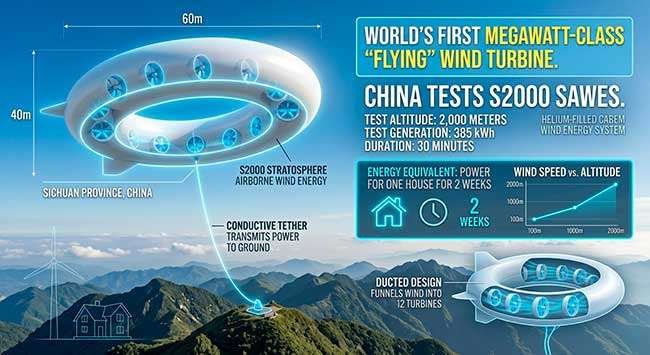
For decades, the holy grail of wind energy has been floating just out of reach—literally. While conventional turbines are limited to the heights of their towers, the strongest, most consistent winds howl thousands of feet above our heads. We’ve finally found a way to go get them. As an expert following renewable energy breakthroughs, I can say that China’s recent successful test of the S2000, a megawatt-class airborne wind turbine, is not just an incremental step; it is a paradigm shift that could redefine how we think about clean energy generation.
In January 2026, a collaboration spearheaded by Beijing Linyi Yunchuan Energy Technology, along with Tsinghua University and Peking University, achieved a world first: they flew a massive, helium-filled aerostat to an altitude of 2,000 meters (6,600 feet), generated electricity, and successfully fed it into the national power grid . The S2000 Stratosphere Airborne Wind Energy System (SAWES), a 60-meter-long behemoth, produced 385 kilowatt-hours of electricity during its 30-minute test flight—enough to power the average American home for nearly two weeks . But the numbers, while impressive, only hint at the deeper significance of this achievement.
The Physics of Possibility
To understand why this matters, we have to look up. The energy available in wind is proportional to the cube of its speed. This means that a site with winds just twice as fast can generate eight times the power . Conventional turbines, even the gargantuan 260-meter-tall offshore models, are stuck in the planetary boundary layer, where winds are turbulent and fickle.
The S2000 is designed to escape that. By rising to where wind speeds are consistently higher, these systems promise a capacity factor—the measure of actual output over time—that could dwarf traditional farms. The SAWES system uses its helium-filled envelope to lift a ring-shaped duct containing 12 turbines. As CTO Weng Hanke explained, the duct acts to concentrate wind, forcing more air through the blades and drastically increasing efficiency . This isn’t just a wind turbine; it’s a high-altitude power station tethered to the earth by a conductive cable.
A Lighter Footprint on the Ground
From a green technology perspective, the most compelling argument for airborne wind energy is its minimalism. Traditional wind farms require enormous concrete foundations, heavy-duty cranes for installation, and massive steel towers. They carve roads through pristine landscapes and disrupt soil ecosystems.
According to Professor Jianxiao Wang of Peking University, who is involved in the project, the SAWES system flips that model on its head. “We use up to 90% less material than traditional wind turbines,” he stated . Because the structure is buoyant, it eliminates the need for the massive foundations that make conventional wind power so carbon-intensive in its construction phase.
Furthermore, the system addresses two of the most common complaints about wind farms: noise and visual pollution. At ground level, the S2000 is virtually silent. Its ground station is a fraction of the size of a traditional turbine base, and while the airship itself is large, its elevated position and smooth surfaces are argued to be less of a visual blight and safer for birds, who are more likely to avoid a stationary, blimp-like object than the whirling blades of a 200-meter tower .
More Than Just Megawatts
What excites me most about this platform is its potential for multifunctionality. We are moving toward an economy that demands not only clean energy but also ubiquitous connectivity. The S2000 is being designed as an “AeroMatrix”—a high-altitude platform that can serve as a cell tower, an observation post, or a disaster-relief hub .
Imagine a natural disaster striking a coastal region, knocking out power lines and cell towers. A fleet of these aerostats could be deflated, transported, launched, and tethered within hours, providing both emergency power and a 5G network to coordinate rescue efforts. Because the system can be stowed in a small space and flown where needed, it offers a level of energy mobility that ground-based renewables simply cannot match . It turns energy infrastructure from a permanent monument into a deployable asset.
The Headwinds Ahead
Before we declare victory over the jet stream, we must acknowledge the significant challenges that remain. As an expert, I view this test as a brilliant proof of concept, but the path to commercialization is fraught with technical and regulatory turbulence.
First, there is the issue of the tether. The cable that transmits power and data must withstand immense constant stress, oscillation, and extreme weather at 2,000 meters. Materials science is being pushed to its limit to prevent fatigue and failure . Second, there is airspace integration. Keeping a 60-meter-long object in the sky permanently requires sophisticated collision-avoidance systems and coordination with aviation authorities, which currently restrict such activities .
Finally, there is the question of maintenance. If a gearbox fails on a conventional turbine, a technician takes an elevator up the tower. If it fails on the S2000, the entire 20,000-cubic-meter airship must be carefully reeled back to the ground for repairs . Proving that this can be done reliably and cost-effectively will be the difference between a niche novelty and a mainstream solution.
Conclusion
The successful grid connection of China’s S2000 is a watershed moment. It validates a concept that engineers have dreamed about for a century. While experts like Mark C. Kelly of the Technical University of Denmark rightly caution that we need independently verified data on its long-term performance, the potential is undeniable .
For nations with dense urban populations, remote island communities, or protected environmental zones, airborne wind energy offers a path to decarbonization that doesn’t require covering the landscape in concrete and steel. China has shown the world that the future of wind power may not be rooted in the ground, but floating among the clouds. The age of airborne renewables has officially taken flight.
The post Harvesting the Jet Stream: Why China’s Flying Wind Turbine is a Potential Game-Changer first appeared on Green Tech Gazette.


