
A United Kingdom-based agri-tech startup is bringing a new approach to dairy herd management that looks beyond traditional genetics to understand why animals perform the way they do.
The technology, called EpiHerd, is now being piloted in Canada after a Manitoba dairy farmer reached out to Antler Bio seeking solutions for his crossbred herd — animals that often fall outside the scope of traditional genomic testing programs.
WHY IT MATTERS: Tools that help farmers pinpoint ways they can increase productivity while reducing health issues could offer new options for improving farm profitability.
Antler Bio, founded in 2020, uses blood testing and advanced gene expression analysis to identify environmental and management factors, including stressors and nutritional deficiencies that could be affecting herd health and performance.
While conventional genomic tools examine the genes an animal carries, EpiHerd focuses on epigenetics, which looks at how active those genes are and how they respond to the animal’s environment.
“We measure about 27,000 individual genes, not just whether they’re present, but how active they are,” says Andrew Lessey, chief operating officer for Antler Bio.
“That allows us to see what signals the animal’s biology is giving us about what’s holding it back or where it may be deficient.”
The company collects blood samples from about 10 per cent of a herd. They’re analyzed alongside a farm’s production and health data, and, using artificial intelligence and machine learning, EpiHerd develops practical recommendations for farmers to implement.
Dairy demand offered opportunity
Antler Bio traces its roots to the horse racing industry, notes Lessey, but co-founders Maria Jensen and Nathalie Conte soon realized the larger opportunity was in livestock, where improvements in efficiency and animal welfare could have broader impact.
Within 18 months of launch, the company secured initial funding support and completed a proof-of-concept study identifying key biological markers in dairy cattle linked to health and productivity.
Today, Antler Bio works with more than 130 dairy farms across five countries, with strong adoption in Finland and growing interest in the U.K. and Scandinavia.
Early results suggest the company’s insights can translate into measurable improvements on farm, according to Lessey.
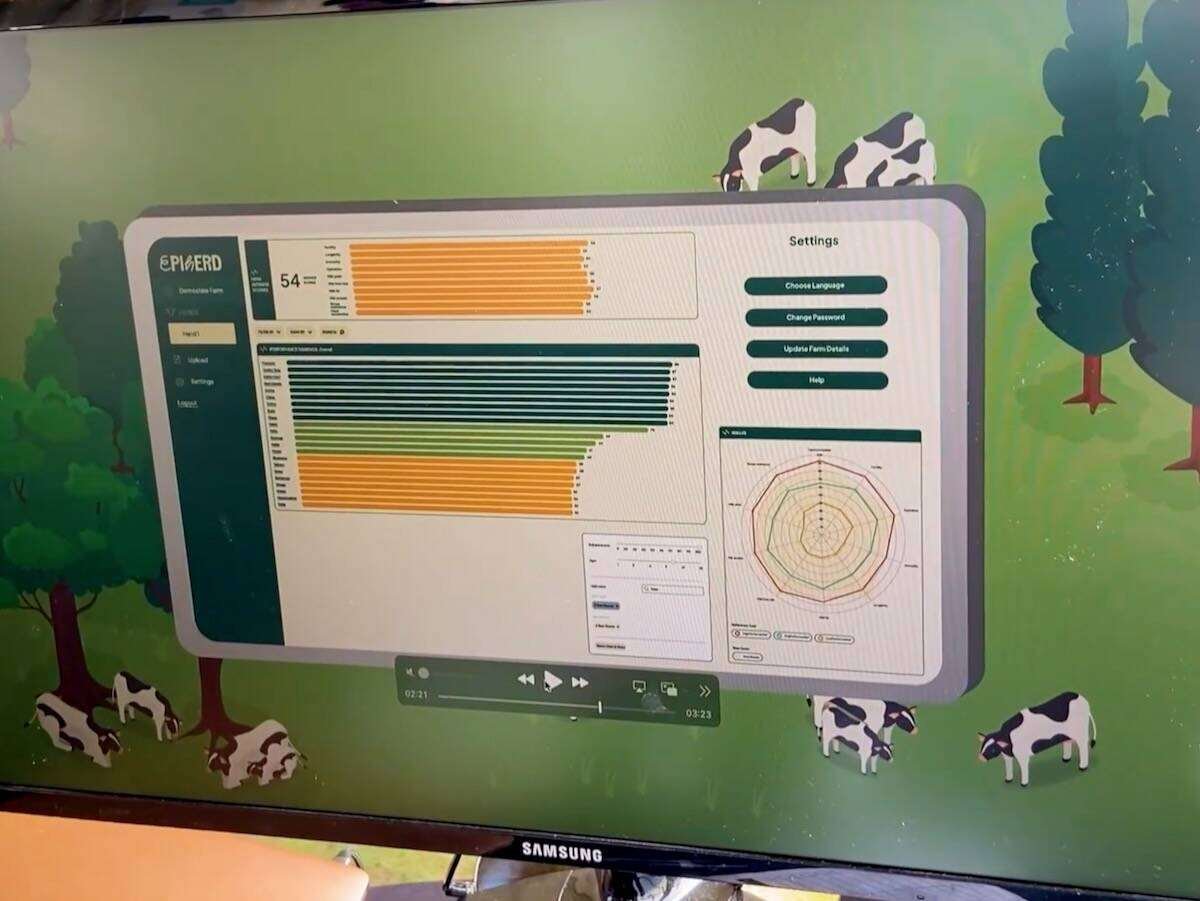
In one dairy farm example he cites, gene expression analysis revealed several management issues, including selenium and vitamin D imbalances, dehydration signals and underlying metabolic stress within the herd.
“The farmer made changes around improving selenium and vitamin D, changed feed sources to improve metabolic stress and added more water facilities — changes that were relatively straight-forward,” Lessey says.
“The outcome was a significant uplift in milk yield that translated into an additional €30,000 (about $47,000 CDN) per year in profit on 100 head.”
The improvements also extended to animal health. Mastitis dropped by 95 per cent and ketosis and milk fever disappeared, reducing veterinary costs and production losses.
Canadian early-adopters wanted
The technology itself is not entirely new. Similar gene expression testing has been widely used in human medicine, particularly in advanced cancer diagnostics. Antler Bio’s innovation lies in adapting the approach for livestock and integrating it with farm management data.
It was through Innovate U.K.’s Global Business Innovation Program that Antler Bio landed a spot in a recent cohort of the Cultivator incubator in Saskatchewan and started to make connections to Canadian agriculture — including with the Manitoba dairy farm where they’re starting their first project in North America.
Although a rapid expansion into Canada isn’t in the immediate plans, Lessey says they hope to recruit a small number of early-adopter farms to build local data and validate the technology under Canadian conditions. Canadian dairy farmers interested in participating in pilot programs are encouraged to contact the company directly.
Long term, Antler Bio hopes its platform will help dairy farmers worldwide improve herd health, profitability and environmental performance.
“If farmers can produce the same amount of milk with fewer animals and the same inputs, that’s good for the farm business and it also reduces the environmental footprint,” Lessey says.
Although currently focused on dairy, the platform could also be adapted for other livestock species or even companion animals in the future.
The post Epigenetics startup brings new insights to dairy herd performance appeared first on Farmtario.


