Ranked: Currencies Soaring Against the U.S. Dollar
Key Takeaways
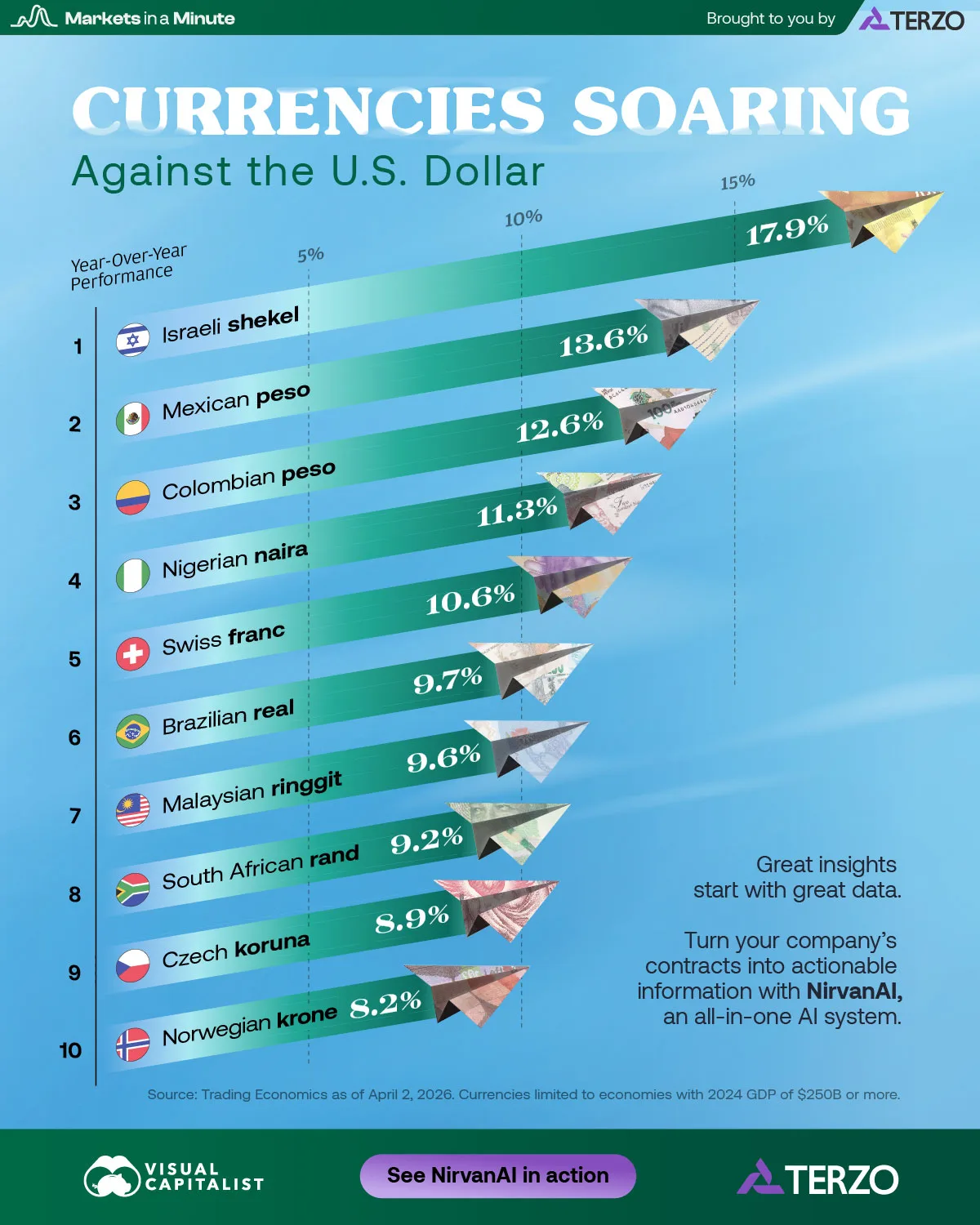
- When comparing the currencies of large countries against the U.S. dollar, the Israeli Shekel has risen the most, soaring 20.2% higher in the last year.
- The Colombian Peso ranks second, rising 19.70% against the U.S. dollar, followed by the South African Rand at 16.43%.
Over the past year, several global currencies have posted double-digit gains against the U.S. dollar. Shifting capital flows, changing monetary policy expectations, and improving domestic fundamentals have all played a role.
Created in partnership with Terzo, this graphic shows which currencies have seen the largest gains against the U.S. dollar. It’s part of our Markets in a Minute series, which delivers quick economic insights for executives.
Currencies Seeing the Biggest Gains
We analyzed countries with annual GDP of $250 billion or more, and ranked the performers of their currencies against the U.S. dollar in the last year.
Leading the pack is the Israeli Shekel, up 20.2% year-over-year versus the dollar. The Bank of Israel governor attributes this to the resilience of the Israeli economy amid conflict and solid export performance. Israel has also seen strong foreign direct investment, driving demand for the Shekel.
| Currency | Year-Over-Year Performance |
|---|---|
 Israeli shekel Israeli shekel |
20.2% |
 Colombian peso Colombian peso |
19.7% |
 South African rand South African rand |
16.4% |
 Mexican peso Mexican peso |
16.4% |
 Australian Dollar Australian Dollar |
14.8% |
 Brazilian real Brazilian real |
14.5% |
 Nigerian naira Nigerian naira |
13.5% |
 Norwegian krone Norwegian krone |
12.7% |
 Kazakhstani tenge Kazakhstani tenge |
12.3% |
 Malaysian ringgit Malaysian ringgit |
11.2% |
Source: Trading Economics. Year-over-year performance as of April 6, 2026.
The Colombian Peso and South African Rand have also posted strong gains, rising 19.7% and 16.4% respectively against the U.S. dollar over the past year. The Mexican Peso follows closely behind, up 16.4%, supported by higher rates relative to the U.S., record foreign direct investment, and a booming tourism sector.
A Weaker U.S. Dollar vs. Global Currencies
Of course, a major reason currencies across the globe are gaining value against the U.S. dollar is because the American currency itself is weakening.
Analysts say the drop is partly due to market concern about the U.S. administration’s unpredictable policies. Earlier in 2025, the anticipation of more Federal Reserve rate cuts, which caused investors to look for higher returns elsewhere, also pushed the dollar lower.
What It Means for Global Markets
When the U.S. dollar gets weaker, it changes how money and trade flow around the world.
For example, U.S. products become cheaper for other countries to buy, which can help American exporters. At the same time, companies in other countries (with stronger currencies) may find it harder to compete with U.S. goods.
For investors, a weaker dollar can boost the value of investments in other countries. Even if those investments don’t grow much, they can still be worth more when converted back into U.S. dollars simply because the currency exchange rate improved.
When markets move fast, timely access to the right data makes all the difference. NirvanAI is an all-in-one AI system that helps finance leaders turn complex contracts into clear, actionable insights—so they can make smarter decisions with confidence.

See NirvanAI in action and learn how it helps you make decisions with confidence.
-
 Money3 weeks ago
Breaking Down the $417 Billion Sports Industry
At an estimated $417 billion in total value today, the sports market continues to expand rapidly. What are the top revenue streams?
-

 Business1 month ago
Ranked: The World’s Top Startup Hubs
Startup ecosystems are emerging around the world, but a small group of countries continues to lead the charge.
-

 Inflation1 month ago
Ranked: The Biggest Price Shocks Businesses Are Facing
Wholesale turkey prices have gone up a whopping 70%. Where else are businesses being hit by high inflation?
-

 Business2 months ago
What a CFO’s Hour is Worth: Ranking the Top Earners
Top CFOs are earnings thousands per hour in compensation. Who’s leading the pack, and how much are they making?
-

 Markets3 months ago
Breaking Down America’s $13 Trillion ETF Market
This visualization breaks down the U.S. $13.4 trillion ETF market by asset class, showing how ETFs allocate capital across equities, bonds, and more.
-
 Markets4 months ago
2025 in Review: The Ups, Downs, and Returns of Global Markets
Which country led stock markets in 2025? See the biggest shocks, rebounds, and year-end returns in this global recap.
-

 Markets4 months ago
Mapped: The Biggest Housing Bubble Risks Globally
Which global cities are most at risk of a housing bubble? This new map ranks the world’s most overheated real estate markets.
-

 Technology4 months ago
Ranked: The Top Factors That Build AI Trust
Want AI your team will trust? Pull back the curtain on the top factors that make people believe in artificial intelligence.
-

 Technology4 months ago
Ranked: AI Hallucination Rates by Model
Find out how common AI hallucination is for leading models, and what that means for the businesses that rely on them.
-

 Technology4 months ago
The Dangers of AI: Visualizing the Top Risks Companies Face
Among the dangers of AI, one stands apart as causing trouble for almost a third of companies. What do leaders need to know?
-

 Business5 months ago
Ranked: Which Universities Build the Most Entrepreneurs?
Which university has had the most alumni become entrepreneurs in the last decade? Hint: its not Stanford or Harvard.
-
 Economy5 months ago
Mapped: Where Workers Are Supporting the Most Seniors
In many advanced economies, the number of retirees is climbing while the working-age population shrinks. What are the countries where workers are supporting the most seniors?
-
 Economy5 months ago
The United States of Unemployment
The national unemployment rate for the U.S. rose to 4.3% in August 2025. But that figure masks vast differences in local labor market health across states.
-
 Markets5 months ago
Ranked: The Economies Most Dependent on International Trade
A trade war has threatened economic ties in 2025. Which economies are most exposed to these shifts in international trade?
-
 Economy6 months ago
Top Countries Behind U.S. Tariff Revenue
Tariff rates vary by country, as does the value of goods each nation exports to the U.S. Which countries contribute the most?
-

 Business6 months ago
Industries Hiring and Firing the Most Employees
As the U.S. labor market cools, which industries are still hiring—and which are cutting back their workforces?
-

 Markets6 months ago
The $150T Global Debt Market
Global debt continues to climb, reaching $150T in Q1 2025. Which countries carry the heaviest burdens?
-
 Money7 months ago
NEW: Fed Rate Cuts vs. Other G7 Countries
How do Fed rate cuts in the U.S. compare with the interest rate changes in other G7 countries, and what does it mean for business?
-
 Jobs7 months ago
Ranked: The Fastest Growing Jobs (2024-2034)
Explore the fastest growing jobs by projected growth rate, plus salary insights, in a rapidly changing job market.
-

 Investor Education7 months ago
The $127 Trillion Global Stock Market in One Giant Chart
This graphic pieces together the $127T global stock market to reveal which countries and regions dominate—and how much equity they control.
-

 Personal Finance8 months ago
Late to the Ladder: The Rise in First-Time Home Buyers’ Age
The median age of first-time home buyers has reached a historic high. See just how long it’s taking people to get on the property ladder.
-

 Markets8 months ago
Unpacking Real Estate Ownership by Generation (1991 vs. 2025)
The Silent Generation’s share of real estate has dropped dramatically as people age, but how have Baby Boomers, Gen X, and Millennials fared?
-

 Business8 months ago
America’s Economic Engines: The Biggest Industry in Every State
Real estate is the biggest industry by GDP in 26 states. Find out why it dominates—and what fuels the rest of the country.
-
 Maps9 months ago
Mapped: Manufacturing as a Share of GDP, by U.S. State
Tariffs are rising to boost American-made goods. Which states gain the most—and least—from manufacturing today?
-

 Technology9 months ago
Profit Powerhouses: Ranking The Top 10 U.S. Companies by Net Income
Collectively, the ten most profitable U.S. companies have a net income of $684 billion—more than the entire GDP of Belgium.
-

 Money10 months ago
Millionaire Hubs: Mapping the World’s Wealthiest Cities
New York City has the highest millionaire population globally. Which other cities attract the world’s wealthiest?
-
 Economy10 months ago
Tomorrow’s Growth: GDP Projections in Key Economies
The global economy is expected to have slighter slower growth going forward. Which countries are on track to have the biggest GDP increases?
-
 Money11 months ago
Mapped: Interest Rates by Country in 2025
The U.S. has kept their target rate the same at 4.25-4.50%. What do interest rates look like in other countries amid economic uncertainty?
-
 Markets12 months ago
U.S. Housing Prices: Which States Are Booming or Cooling?
The national housing market saw a 4.5% rise in house prices. This graphic reveals which states had high price growth, and which didn’t.
-

 Investor Education1 year ago
The Silent Thief: How Inflation Erodes Investment Gains
If you held a $1,000 investment from 1975-2024, this chart shows how the inflation rate can drastically reduce the value of your money.
-

 Politics1 year ago
Trade Tug of War: America’s Largest Trade Deficits
Trump cites trade deficits—the U.S. importing more than it exports—as one reason for tariffs. Which countries represent the largest deficits?