The Fastest-Growing and Shrinking Populations (2000-2025)
See visuals like this from many other data creators on our Voronoi app. Download it for free on iOS or Android and discover incredible data-driven charts from a variety of trusted sources.
Key Takeaways
- Qatar’s population grew by over 400%, the fastest increase globally since 2000.
- Ukraine’s population fell by roughly one-third, the steepest decline.
- A clear divide is emerging: rapid growth in the Gulf and Africa vs. shrinking populations in Eastern Europe.
Over the past 25 years, some countries have more than tripled their populations, while others have seen sharp declines that are reshaping their economies and societies.
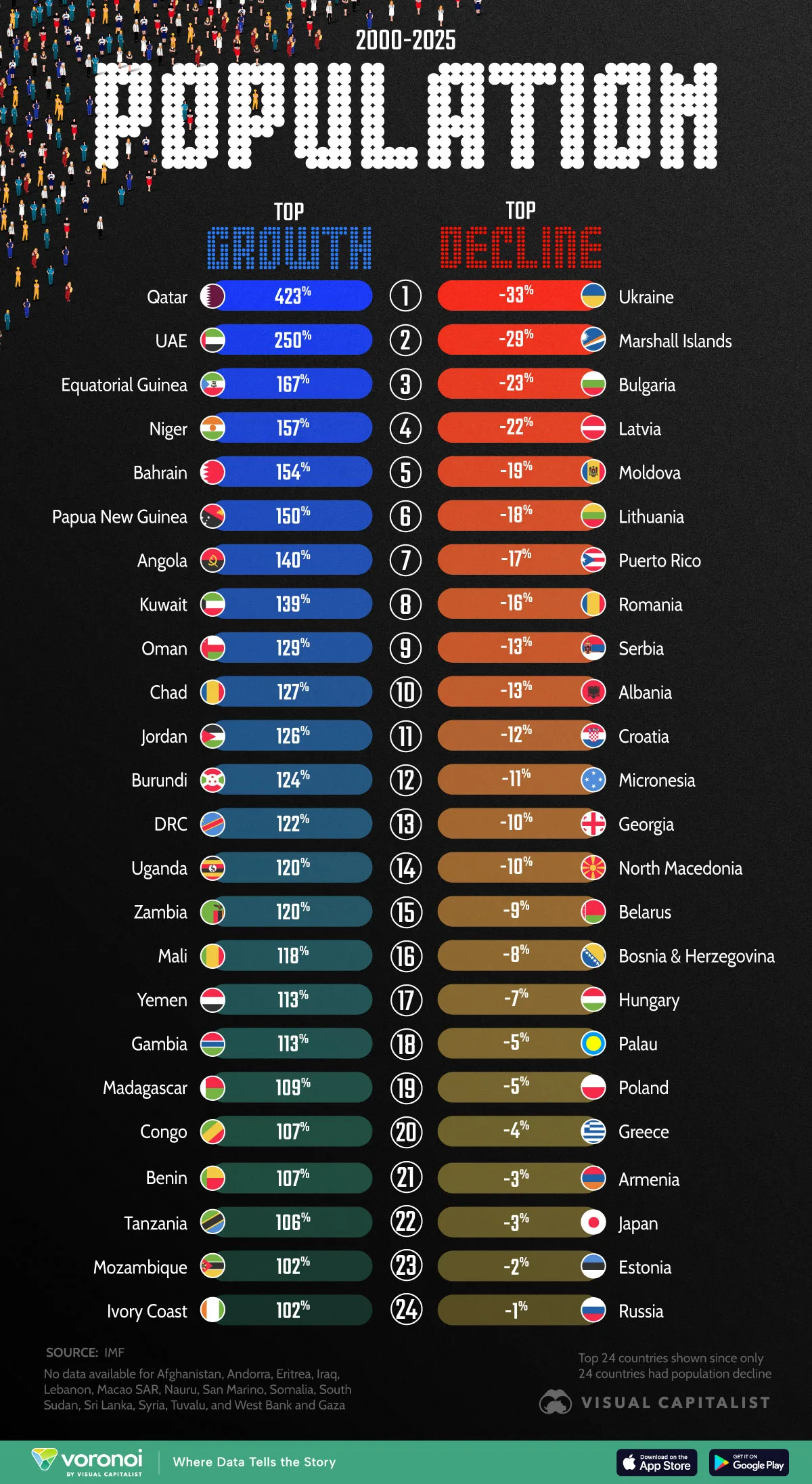
This graphic uses IMF data to rank the 24 countries with the fastest population growth and decline since 2000, measured by total percentage change.
Gulf States Lead the World in Population Growth
The Persian Gulf dominates the growth rankings—but not because of high birth rates.
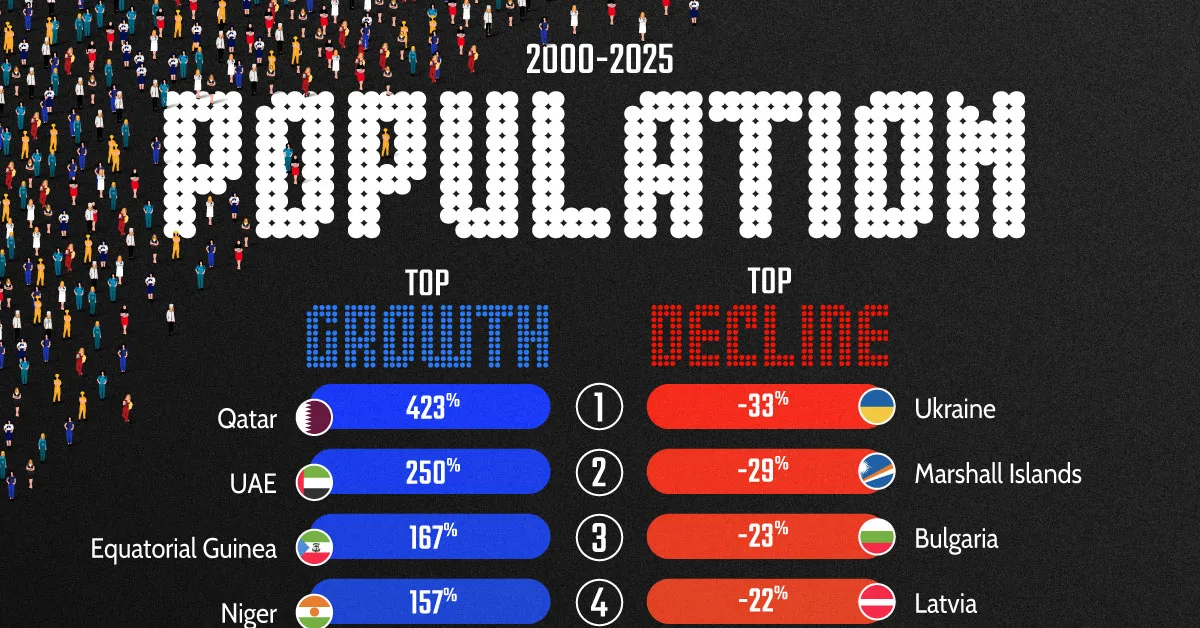
Qatar leads the world with a staggering 423% population increase, growing from roughly 594,000 to 3.1 million. The UAE follows at 250%, while Bahrain (+154%), Kuwait (+139%), and Oman (+129%) also rank among the top 10.
The data table below shows the top 24 countries by population growth from 2000 to 2025:
| Rank | Country | Population Growth 2000–2025 |
|---|---|---|
| 1 |  Qatar Qatar |
423.4% |
| 2 |  United Arab Emirates United Arab Emirates |
249.7% |
| 3 |  Equatorial Guinea Equatorial Guinea |
166.6% |
| 4 |  Niger Niger |
157.0% |
| 5 |  Bahrain Bahrain |
153.9% |
| 6 |  Papua New Guinea Papua New Guinea |
149.6% |
| 7 |  Angola Angola |
139.7% |
| 8 |  Kuwait Kuwait |
139.1% |
| 9 |  Oman Oman |
129.1% |
| 10 |  Chad Chad |
126.9% |
| 11 |  Jordan Jordan |
126.3% |
| 12 |  Burundi Burundi |
123.6% |
| 13 |  Democratic Republic of the Congo Democratic Republic of the Congo |
121.8% |
| 14 |  Uganda Uganda |
120.1% |
| 15 |  Zambia Zambia |
119.5% |
| 16 |  Mali Mali |
118.4% |
| 17 |  Yemen Yemen |
112.9% |
| 18 |  Gambia Gambia |
112.8% |
| 19 |  Madagascar Madagascar |
108.7% |
| 20 |  Republic of Congo Republic of Congo |
107.0% |
| 21 |  Benin Benin |
106.6% |
| 22 |  Tanzania Tanzania |
106.4% |
| 23 |  Mozambique Mozambique |
102.3% |
| 24 |  Ivory Coast Ivory Coast |
102.3% |
These surges are almost entirely driven by imported labor migration. Massive construction projects, oil and gas expansion, and broader economic diversification efforts drew millions of foreign workers to the region over the past two decades.
Outside the Gulf, the fastest-growing populations are concentrated in sub-Saharan Africa. Equatorial Guinea (+167%), Niger (+157%), and Papua New Guinea (+150%) round out the top five.
Angola (+140%), Chad (+127%), the Democratic Republic of the Congo (+122%), Burundi (+124%), Uganda (+120%), and Zambia (+120%) all more than doubled their populations. High fertility rates and gradually improving healthcare have sustained rapid growth across the region.
Eastern Europe’s Population Collapse
In contrast, much of Eastern Europe is experiencing sustained population decline. Bulgaria (-23%), Latvia (-22%), Moldova (-19%), and Lithuania (-18%) have all lost roughly a fifth or more of their populations since 2000.
Ukraine stands apart with the steepest decline at -33%, losing roughly 16 million people—from 48.7 million in 2000 to an estimated 32.9 million in 2025. Along with long-term economic factors, the war with Russia has accelerated Ukraine’s population decline.
The data table below shows the top 24 countries by population decline from 2000 to 2025:
| Rank | Country/Territory | Population Decline 2000–2025 |
|---|---|---|
| 1 |  Ukraine Ukraine |
-32.5% |
| 2 |  Marshall Islands Marshall Islands |
-29.4% |
| 3 |  Bulgaria Bulgaria |
-23.2% |
| 4 |  Latvia Latvia |
-21.6% |
| 5 |  Moldova Moldova |
-18.8% |
| 6 |  Lithuania Lithuania |
-17.5% |
| 7 |  Puerto Rico Puerto Rico |
-16.7% |
| 8 |  Romania Romania |
-16.1% |
| 9 |  Serbia Serbia |
-13.1% |
| 10 |  Albania Albania |
-12.8% |
| 11 |  Croatia Croatia |
-12.0% |
| 12 |  Micronesia Micronesia |
-11.2% |
| 13 |  Georgia Georgia |
-10.3% |
| 14 |  North Macedonia North Macedonia |
-10.0% |
| 15 |  Belarus Belarus |
-9.0% |
| 16 |  Bosnia and Herzegovina Bosnia and Herzegovina |
-8.2% |
| 17 |  Hungary Hungary |
-6.5% |
| 18 |  Palau Palau |
-5.3% |
| 19 |  Poland Poland |
-4.6% |
| 20 |  Greece Greece |
-3.7% |
| 21 |  Armenia Armenia |
-3.3% |
| 22 |  Japan Japan |
-2.8% |
| 23 |  Estonia Estonia |
-1.6% |
| 24 |  Russia Russia |
-0.7% |
The pattern is consistent: after EU accession opened borders to higher-wage Western European economies, working-age emigration accelerated. This compounded an already-low birth rate across the region, creating a demographic squeeze that has left many of these countries with aging, shrinking populations.
Puerto Rico (-17%), Romania (-16%), and Serbia (-13%) follow a similar trajectory. Even larger countries like Poland (-5%) and Japan (-3%) saw population declines, though at more modest rates relative to their size. Russia rounds out the list, with its population falling by just under 1% since 2000.
Learn More on the Voronoi App 
If you enjoyed today’s post, check out The World’s Largest Countries by Population (2025) on Voronoi.
- Source: https://www.visualcapitalist.com/ranked-countries-fastest-population-growth-decline-2000-2025/