Mapped: Where Does Eastern Europe Begin and End?
Key Takeaways
- There is no single definition of Eastern Europe. Its borders vary depending on historical, political, and cultural context.
- Russia, Ukraine, and Belarus are almost always included, forming the region’s “core.”
- The eastern boundary is widely agreed upon, but the western edge shifts significantly across definitions.
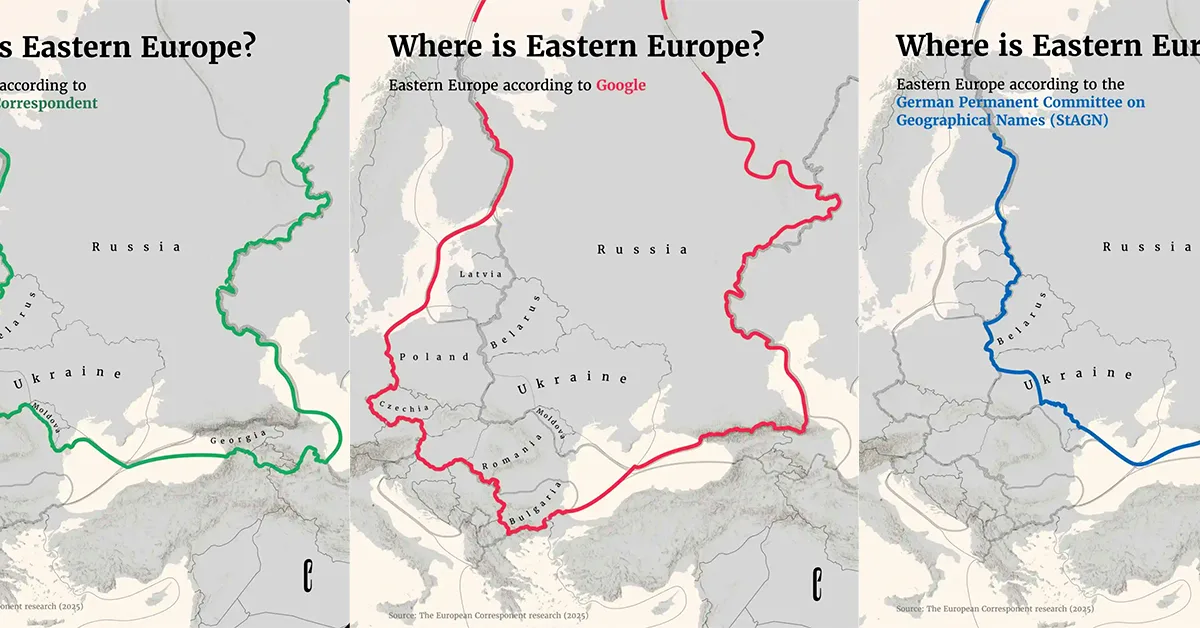
The animated map above uses data from various organizations to highlight interpretations of Eastern Europe’s geographical extent.
At a glance, the visualization shows a tight core centered on Russia, Ukraine, and Belarus, with boundaries stretching eastward into Russia and stopping along a debated western frontier that cuts through Central Europe.
Eastern Europe’s Borders, Defined
Below are major groupings from the UN, CIA World Factbook, StAGN (Germany’s committee on geographical names), and The European Correspondent, the creator of the map.
| Country | UN (Regional) | UN (M49) | CIA World Factbook | Euro. Correspondent | StAGN |
|---|---|---|---|---|---|
 Belarus Belarus |
✓ | ✓ | ✓ | ✓ | ✓ |
 Russia Russia |
✓ | ✓ | ✓ | ✓ | ✓ |
 Ukraine Ukraine |
✓ | ✓ | ✓ | ✓ | ✓ |
 Moldova Moldova |
✓ | ✓ | ✓ | ✓ | |
 Bulgaria Bulgaria |
✓ | ✓ | |||
 Czechia Czechia |
✓ | ✓ | |||
 Hungary Hungary |
✓ | ✓ | |||
 Poland Poland |
✓ | ✓ | |||
 Romania Romania |
✓ | ✓ | |||
 Slovakia Slovakia |
✓ | ✓ | |||
 Estonia Estonia |
✓ | ✓ | |||
 Latvia Latvia |
✓ | ✓ | |||
 Lithuania Lithuania |
✓ | ✓ | |||
 Albania Albania |
✓ | ✓ | |||
 Azerbaijan Azerbaijan |
✓ | ✓ | |||
 Georgia Georgia |
✓ | ✓ | |||
| Albania |
✓ | ||||
 Bosnia & Herz. Bosnia & Herz. |
✓ | ||||
 Croatia Croatia |
✓ | ||||
 Montenegro Montenegro |
✓ | ||||
 N. Macedonia N. Macedonia |
✓ | ||||
 Serbia Serbia |
✓ | ||||
 Slovenia Slovenia |
✓ |
A Region Defined by Perspective
Unlike continents or countries, Eastern Europe is not a fixed geographic entity. Instead, its definition has evolved over time, shaped by empires, ideology, and institutions. According to various modern definitions, the region can include anywhere from a handful of countries to over a dozen.
Historically, the term gained prominence during the Cold War, when it often referred to Soviet-aligned nations. This political framing still influences perceptions today.
The Core vs. the Fringe
Despite disagreements, some countries are almost always included:
- Russia
- Ukraine
- Belarus
These nations form the “core” of Eastern Europe across most academic and institutional definitions. Beyond them, the picture becomes less clear. Countries like Poland, Hungary, and the Czech Republic are sometimes included, but are often classified as Central Europe instead.
Research from institutions like the University of Basel highlights how these shifting classifications reflect cultural identity as much as geography.
How Far Does It Stretch?
At its maximum extent, Eastern Europe can span from Germany’s eastern border all the way to the Ural Mountains in Russia. This broader definition may include the Balkans and parts of Central Europe.
At its minimum, however, the region shrinks to just a few countries in Eastern Slavic territory. That these narrower definitions often reflect cultural or linguistic commonalities.
Ultimately, where Eastern Europe “begins” and “ends” depends on who you ask, which makes it less of a place on a map and more of an idea shaped by history and geopolitics.