
As Extended Producer Responsibility (EPR) programs ramp up across states, we could be entering the most significant expansion of packaging collection investments since curbside recycling scaled nationally in the 1970s–1990s.
Yet collection methods aren’t one-size-fits-all, especially for materials like films that aren’t collected in most curbside U.S. programs but still move through multiple collection pathways.
To meet the expanding collection potential for materials like films, How2Recycle commissioned the Sustainable Packaging Coalition (SPC) to explore how the program’s label suite could evolve to reflect multiple collection pathways, including municipal drop-off and subscription services. SPC surveyed 1,000 U.S. consumers to test how people interpret label designs, iconography, and language for these expanded instructions.
Here’s what we found:
Our baselines: Current film collection systems and consumer recycling behaviors
Today, retailer collection programs for films, sometimes called Store Drop-off collection sites, remain the most accessible recycling pathway for many flexible packaging formats. According to new SPC research, while participation in curbside recycling programs is often routine, participation in film collection pathways depends on awareness and access, with clear labeling connecting consumers to the right options.
To start our research, we first wanted to understand the baseline for recycling engagement across consumers. The results were promising: About 68% of respondents reported that they always or often look for recycling information or make an effort to recycle before disposing of an item, with 31% reporting that they recycle daily.
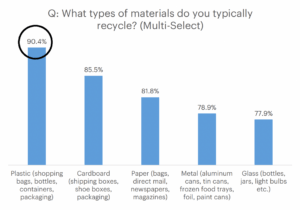
Across these behaviors, consumers are recycling a wide range of materials today. Plastic leads the way, with 90% of respondents reporting they recycle plastic items such as bottles, bags, and containers, followed by cardboard (85%), paper (82%), metal (79%), and glass (78%).
Established collection pathways are sticky, but emerging ones struggle with awareness
When it comes to film recycling specifically, our research made it clear that participation hinges on awareness, and — perhaps less surprisingly — access. Established pathways like retail film collection sites (Store Drop-off) and municipal drop-off are both widely known and used:
- 62% of consumers reported that they were aware they had access to store collection sites for films, a finding further substantiated in our research demonstrating that 92% of Americans live within a 10-mile driving radius of a collection site.
- 61% of consumers reported awareness that they had access to municipal drop-off collection sites
When access and awareness coalesce, participation follows. Our research found that among those who know they have access, about 85% use Store Drop-off and 84% use municipal programs, pointing to strong engagement once the pathway is clear.
Across the full population, participation is lower. About 42% of consumers report recycling materials at retail locations, with plastic bags making up the majority of those returns (73%).
And newer collection pathways tell a different story. Interest is strong, with ~39% of consumers saying they would use subscription pickup or mail-back options if they were available. But awareness is scarce:
- 65% are unaware or unsure if they have access to subscription recycling
- 74% are unaware or unsure about mail-back programs
To close this gap for newer collection methods, industry will need clear communications.
Communicating multiple film collection pathways: Label research findings
With research on participation, awareness, and access in tow, we turned to communication: How do we communicate newer pathways in a way that creates awareness and comprehension while inspiring action?
Our research made one thing clear: The most effective labels quickly show both what the material is and what to do with it.
Label design takeaway 1: Consumers want to see the material
Across multiple design tests, combinations that included a recognizable material tended to perform well.
Labels that included both a plastic bag and/or a hand were more consistently understood. Designs that suggested movement or action appeared to help signal that the item should be taken somewhere else for recycling, rather than placed in a curbside bin.

Labels that clearly featured a recognizable material, like a plastic bag, tested well among U.S. consumers.
These findings suggest that showing both what the item is and excluding traditional curbside visual cues improve clarity, especially for materials like films and flexible packaging that don’t follow typical curbside rules.
Label design takeaway 2: Consumers need familiar, action-oriented language
Early results suggest that consumers tend to respond well to language that is direct and action-oriented. In testing, terms that emphasized what to do with an item, rather than more abstract or technical phrasing, were generally better understood.
For example, “Return” emerged as the most widely understood instruction, with most consumers associating it with bringing an item back to a store or dropping it off at a location, rather than mailing it. Similarly, when describing the end user, “Customer drop-off” (44%) was preferred over “Consumer drop-off” (32%), suggesting that more familiar, everyday language may help improve clarity.
Label design takeaway 3: Directional cues communicate multiple options
As recycling systems continue to evolve, another question is how labels might reflect the reality that some materials can be recovered through more than one pathway.
In testing, designs that incorporated directional cues, such as arrow-based elements, helped communicate the idea of multiple options. Of course, there’s a trade-off: While more complex visuals helped communicate multiple pathways, simpler symbols were generally easier for consumers to interpret quickly.

Directional icons helped signal that films and flexible packaging may have multiple recovery pathways, including subscription, mail-back, and drop-off options.
What’s next for film packaging labeling
As film packaging collection evolves, clear on-pack communications will play a critical role in connecting consumers to the right recovery pathways.
These findings offer an early look at how labeling can support that shift, and during SPC Impact, we’ll dive deeper into these insights and what’s next for the How2Recycle label suite during the “New day, New Label: The Newest H2R Label for Other Collection Modalities” Main Stage Session.
The post What Do Consumers Think About Film Recycling? Consumer Research Findings to Expand the How2Recycle Label Suite appeared first on GreenBlue.


