
As machinery returns to rural roads, experts are calling on farmers and their non-farming neighbours to be aware of the increase in activity.
The most common injury, according to OPP statistics, is rollovers when entering, exiting or crossing roadways. These accidents can also occur when vehicles veer off the shoulder.
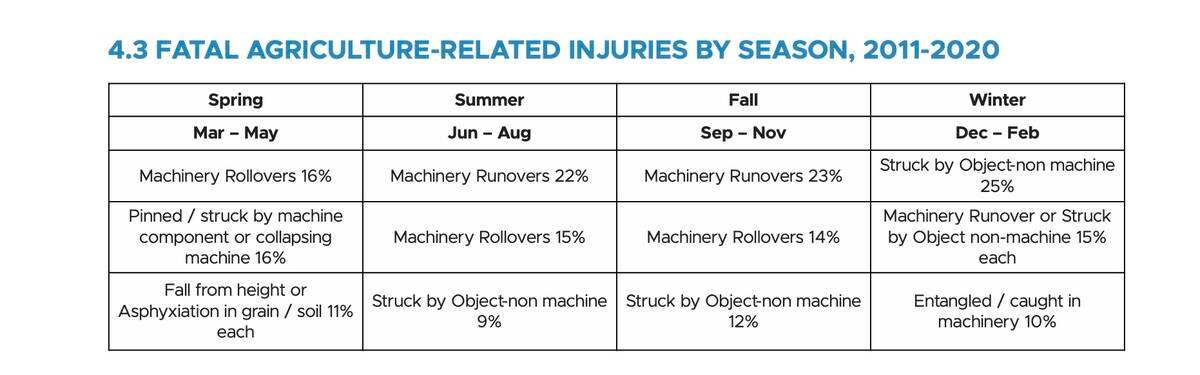
According to the report Agriculture-related Fatalities in Ontario 1990–2020, produced by Workplace Safety and Prevention Services, from 2011 to 2020 there were 156 agriculture-related fatalities in Ontario, averaging 16 deaths per year.
WHY IT MATTERS: Recent statistics show that slow-moving vehicles are 3.8 to 4.8 times more likely to be involved in a fatal collision per kilometre than other motor vehicles.
The average annual fatality rate over that 10-year period was 8.5 fatalities per 100,000 farm population.
The report also shows the oldest age group (80+ years) had the highest fatality rate at 50.1 per 100,000 farm population.
The top mechanisms of injury accounted for 70 per cent of spring agriculture-related deaths.
To help reduce accidents and injuries, the Wellington County OPP is focusing on a collaborative approach, partnering with local organizations to promote farm safety through events and presentations. The detachment will also share safety information on social media and through local media partners.
“Equipment accidents are common for a variety of reasons. To reduce the risk, ensure you are properly trained to operate machinery, stay focused on the task at hand, and routinely check that all equipment is in safe working condition,” Carly McKeown, media coordinator for the Wellington County Ontario Provincial Police, told Farmtario.
She said officers regularly conduct proactive enforcement on rural roads to help protect both farmers and motorists. This can include laying charges or issuing warnings when appropriate.
Statistics show that eight out of 10 accidents occur during the day and seven out of 10 occur on dry road conditions.
McKeown encourages farmers to ensure their tractors are equipped with proper lighting and signage, especially when travelling at night.
“Motorists should give farm equipment plenty of space and avoid passing when it isn’t safe. Educating community members on safely sharing the road with slow-moving vehicles is an important part of our efforts to help reduce collisions,” she said.
On-farm safety
McKeown said accidents involving children are especially common because farms serve as both homes and workplaces. She said it is important to establish a designated area for children to play away from farm operations and ensure they are always supervised.
In his role with Wellington County Farm and Home Safety Association, Walter Grose has seen firsthand the consequences of ignoring farm safety guidelines.
In recent years, he said both experts and law enforcement have encountered growing challenges when it comes to safety compliance.
“They think they can use their cell phone and they think they can drink and drive the tractor,” said Grose, adding that some farmers believe that removing the slow-moving vehicle sign allows them to travel at any speed they want.
Grose said he has seen incidents involving farmers new to Canada who have not taken the time to learn local rules. He recalled a conversation with a farmer from the Netherlands who was spreading manure dangerously and said he believed Canadian rules were less strict.
A costly mistake
Grose reminds farmers that failing to follow the rules of the road can be expensive. He recalled a woman who was moving bales between farms without proper signage, travelling too fast and with an unsecured load.
The subsequent fines totalled more than $3,000.
“She said, ‘You’re just out looking for work,’ and he said, ‘We’ll see you in court,’” Grose recalled. “You don’t have a leg to stand on because every one of those things was wrong.”
ATV safety on the roads
With more farmers using recreational vehicles as part of daily operations, Grose says ATVs have become a growing safety concern, particularly among children.
A study published in Paediatrics & Child Health revealed 181 serious or fatal ATV-related injuries, including six deaths, over a 12-month period in 2017. Children aged 10 to 14 represented 45.3 per cent of cases, followed by youth aged 15 to 19 at 26.5 per cent. Most cases occurred in July and August.
“They’re creeping up to be the most dangerous thing on the farm,” Grose said.
He explained that ATVs must follow the same rules as other vehicles, including licensing and carrying separate insurance to cover injuries. He added that ATV operators should be mindful of dust and visibility hazards for other drivers.
Grose says his organization tries to reach approximately 3,000 people per year within Wellington County. He and his team visit schools, fairs and industry events to promote farm safety.
He believes there needs to be stronger industry-wide education through safety days, school programs and media outreach to prevent injuries and fatalities.
The post Spring surge in farm traffic sparks renewed safety warnings appeared first on Farmtario.


