
UPDATED April 21
Ontario will introduce legislation to limit the foreign ownership of farmland in the province.
Trevor Jones, Ontario’s minister of agriculture, food and agribusiness made the announcement April 21, 2026, in King City, north of Toronto. Jones said if the proposed legislation is passed it will increase Ontario’s self-reliance in the face of trade disruptions and global uncertainty.
WHY IT MATTERS: Farmland value has been growing significantly in Ontario in the past decade, some of that driven by speculation and there is concern that some of that speculation could be by foreign buyers.
“Now more than ever we need to protect and grow our agri-food sector,” said Jones. “These proposed changes will protect local food production, grow our economy and keep our farmland under domestic ownership for future generations.”
Aligning with other provinces
The province says the legislation will align Ontario with other Canadian jurisdictions like Alberta and Quebec by creating “significant” restrictions on foreign ownership of farmland. The province says it will consult with farmers, municipalities and industry on implementation and exemptions.
“I don’t want our farmland, our farm systems, production areas to be some ledger line on some company overseas balance sheet.”
Trevor Jones
Ontario minister of agriculture, food and agribusiness
“Ontario farmland is an important, limited resource and it should be owned by Ontario farmers,” said Jones, adding while there is anecdotal evidence of foreign ownership the government wants to be proactive before it becomes a problem.
Foreign ownership could result in food production land remaining idle and the value of the crop leaving the country instead of benefiting Ontario farmers and families.
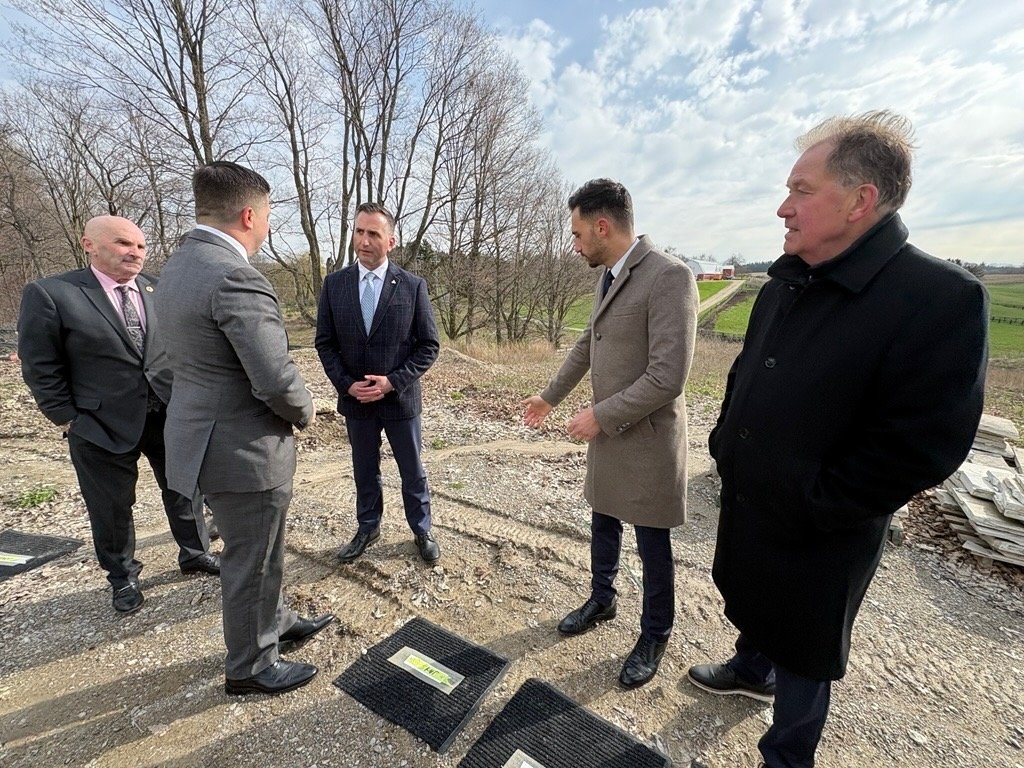
“What we can’t have is someone just to land bank,” he stressed. “I don’t want our farmland, our farm systems, production areas to be some ledger line on some company overseas balance sheet.”
From Southern Ontario through to the Holland Marsh holds some of the best production land in the world, said Jones.
A broader economic argument
Stephen Lecce, minister of energy and mines and MPP for King-Vaughan said the Oak Ridge Moraine and the Greenbelt are vital elements the province is here to help protect and scale to produce nutritious food for Canada.
“We are in a broader economic war, and when it comes to building resilience, we’ve got to produce more at home and be less reliant on Americans or others,” said Lecce. “King Township, like much of our province, is a producer, an exporter and an innovator.”
Haven Greens as case study
Lecce pointed to Haven Greens as “the ultimate case study of the intersection of all three.” The site supports horse breeding, an apiary, and a rapidly expanding, state-of-the-art, pesticide-free leafy green production facility that fills a void in Canadian-grown produce. The one-to-40-acre production ratio on class five farmland has already outpaced its original annual 100 kilograms per square metre production model, aimed at boosting domestic greens production and food sovereignty.
“We’re all on the same mission,” Lecce said. “Which is to make sure our farmers are protected. Our land is protected and maintained in Canadian hands for the benefit of Canadian families.”
OFA to study legislation impact
Drew Spoelstra, Ontario Federation of Agriculture president, said it’s too early to determine the impact of the proposed legislation, but the organization’s bottom line is making sure farmland remains in the hands of farmers.
“I think that (the Ontario government) looked at this as a priority in terms of alignment with our provinces,” Spoelstra told Farmtario. “And, given the times we’re in, the importance of that discussion around Canada and Ontario first.”
OFA membership has raised specific concerns about Chinese investment in Ontario farmland, as well as investment from other nations, but the organization hasn’t made it a top priority.
He said the legislation requires further study to discern the potential impacts on Ontario agriculture, but keeping “land in the hands of farmers that are here in Ontario and Canadian-based – I think that’s a positive thing for the industry.”
Clay Belt opening
The government also announced it will be expanding Northern Ontario agricultural production by streamlining access to Crown land in the Clay Belt region.
The changes would make leasing and accessing arable land within the Clay Belt easier for farmers, unlocking new agricultural opportunities, creating jobs and protecting Ontario’s food security and food production.
George Pirie, Minister of Northern Economic Development and Growth, said the Clay Belt region is primed for agricultural investment, development and growth, which is why the province is removing barriers to accomplish those.
“This will continue to our shared vision of expanding the Northern Ontario agricultural footprint and improving economic diversification and competitiveness, said Pirie. “As stated earlier, Ontario has what the world needs.”
The post Ontario proposes restrictions on foreign farmland ownership appeared first on Farmtario.


