
Everyone in manure management knows about the Chesapeake Bay, where for decades, nutrient run-off from farming has been a contentious issue. Large algae blooms and oxygen-starved ‘dead zones’ in the Bay have caused alarm among the public and government officials alike.
All stakeholders have therefore searched hard for solutions. For their part, farmers have adopted practices like streamside buffers, cover crops and no-till farming. But even with these changes in place, there is still progress to be made for improving water quality in the Bay.
About 20 years ago, manure injection was confirmed as a very promising way to keep excess nutrients out of the Bay’s waterways. Low-disturbance injection of manure into fields reduces nitrogen losses from ammonia volatilization, which in turn reduces the amount of N fertilizer a farmer needs to apply to ensure good crop yield. The most-recent numbers provided by experts from regional universities and the USDA Agricultural Research Service (ARS) estimate that manure injection, coupled with advanced nitrogen management on fields receiving liquid manure, reduces N losses by 27 percent to 37 percent. Phosphorus losses decrease similarly, by 22 percent to 36 percent.
But has manure injection been adopted widely at this point? First, let’s go back in time.
Origins of a strategy
It was over 20 years ago in the early 2000s when regional research was done on how much manure injection could displace the use of fertilizer. Dr. Curtis Dell, Dr. Pete Kleiman and colleagues at USDA-ARS obtained very exciting results – but it wasn’t as simple as that.
“The injection equipment back then, even up to around 2015 or so, was clunky, slow and also very expensive,” explains Kristen Hughes Evans, executive director of Sustainable Chesapeake.
Her organization leads The Manure Injection Partnership, which has been working collaboratively for over ten years to expand the adoption of manure injection and more-focused nutrient management planning in the region’s farming communities. Members include other non-governmental organizations, land-grant universities like Cornell and Penn State, agribusinesses, government agencies and farmers.
As Hughes Evans explains, farmers were not going to buy manure injection equipment. Besides the expense and slow speed, farmers just weren’t familiar yet with the concept, nor its merits. This situation spilled over into the perspective of custom applicators. As Sustainable Chesapeake Project Manager Natasha Rathlev explains, why would you buy expensive and clunky equipment for something that your clients may not want? Related to this, it was pretty much impossible back then to make a case for grant money to spur adoption.
But about 12 years ago, Dr. Rory McGuire at Virginia Tech had an idea: the government could incentivize investment in injection equipment through paying custom applicators on a per-acre basis. He approached an applicator in the Shenandoah Valley, who then invested in injection equipment…but the whole scheme flopped. “It looked like a failure, but we said ‘Rory, no, this is gold,’” says Hughes Evans. “It will work.” The trouble was, McGuire had approached a brand-new custom applicator, while what was needed were applicators who had been in business for quite a while. In partnership with the Catoctin Frederick Soil Conservation District and Sassafras River Association in Maryland, Sustainable Chesapeake found two such businesses – and as they had predicted, everything changed. “They went to their clients and said ‘Do you want to try manure injection?’”
Hughes Evans explains: “I can offer it to you for free during the life of this project, so you can see how it does. Why don’t I do this one field with manure injection, and I’ll do the rest of your fields like we normally manage them.’ And it worked beautifully. That model is what we have replicated across the watershed. It puts all the right incentives where they need to be.” She adds, “The success in Maryland helped us launch this effort in south central Pennsylvania. Injection is now a normal practice there, but it’s also moving up the watershed.”
More research
Before we look at further adoption progress, let’s dip into research. That is, while the per-acre-payments-from-grants was working well to spur some adoption, members of the Partnership continued doing studies to generate the evidence farmers need about the benefits of injection. One study on commercial dairy farms conducted by Penn State involved anaerobically digested dairy manure applied ahead of corn by injection and surface application. “As was the case with raw manure, we documented a reduction in the amount of side-dressed N with injection,” explains Ron Hoover, Penn State Department of Plant Science on-farm research coordinator.
Another four-year Penn State and ARS-USDA study from 2013 to 2017, measured overland and subsurface water flows during and after precipitation events for phosphorus and sediment losses on plots planted with corn in the summer and cereal rye as a winter cover crop. Dr. Jack Watson and his colleagues analyzed the data and found that compared to broadcast manure, shallow-disk injection was more effective in promoting dilution of dissolved P and to a lesser extent, total P. Water quality improvements were not consistent throughout the entire study. No-till farmers (about half of the dairy farmers in Pennsylvania) were interested to learn that shallow-disk injection did not cause sedimentation and muddying streams.
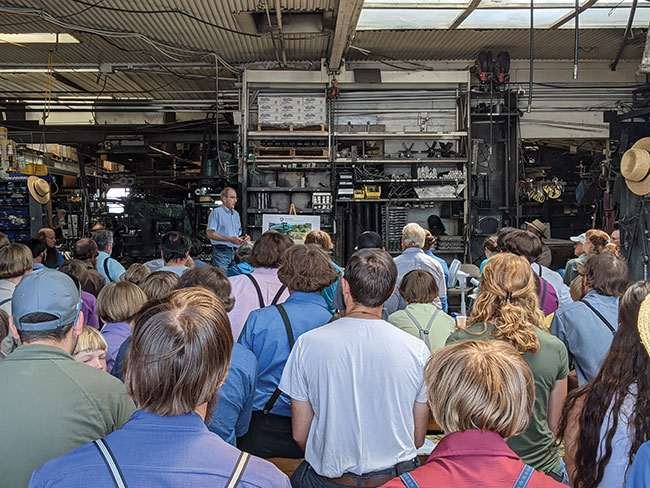
For area research and extension specialists, education for local producers has become key in spreading the practice.
Adoption progress
Also in Pennsylvania, for the last six years, Partnership member Lancaster County Conservation District has been working with Campbell Foundation funding to increase adoption through the same scheme mentioned previously – funding custom application. In terms of how much adoption has grown, there are only records of the acres covered by incentive payments. However, there are farmers using injection who aren’t taking incentive payments, says the District’s Agricultural Ombudsman Shelly Dehoff. “I hear the custom operators saying they are getting more requests all the time,” she reports. “I think some farmers are sold on it, some are not yet convinced but will do it if there’s funding available.” She and her colleagues are hopeful that farmers will continue with injection once the incentive payments come to an end.
However, among Amish farmers, there’s a stumbling block. Part of the Campbell Foundation funding has also gone towards the manufacture of a horse-drawn manure injection unit for the Amish of Lancaster County. The Amish farmers did like the concept (a drag line with pressure generated by a diesel motor), but it’s so heavy that it requires a team of eight horses. That and the cost of the fuel has therefore stymied Amish adoption.
There’s also a little stumbling block for some conventional farmers in Pennsylvania. Dr. Heather Karsten, associate professor at Penn State, first explains that farmers are trusting her team’s research results, that if they inject liquid dairy manure digestate, there’s often no need to apply side-dress N or they can significantly reduce side-dress N, depending on farming practices and soil N conditions. “Farmers have recognized the economic benefits of saving N, especially as input costs have gone up,” she explains. “They also recognize the environmental stewardship benefits to the practice. In addition, new technologies such as GPS-guided tractors and drag-hose systems have reduced the time required for manure injection and the risk of soil compaction, often reducing the cost of injection and enabling more timely field operations such as crop planting.”
However, the use of injection can often reduce the amount of manure that is applied. Under current Pennsylvania nutrient management regulations, one can apply the same amount of manure with the dribble bar or broadcasting, making the dribble barn more attractive than injection for some. “Depending on the farm type, some farmers prefer to keep applying the same amount of manure because otherwise they have to change their nutrient management plan and find new places for manure,” Karsten explains. “That can be a problem in Pennsylvania.” She also notes that studies are needed on how much N is lost through ammonia in dribble bar use in the Northeast climate – studies that could be important in further promoting injection.
More progress
Last year in New York, the Delaware County Soil and Water Conservation District and Cornell Cooperative Extension partnered with the New York City Watershed Agricultural Council, Cornell and Virginia Tech to implement a manure injection custom operator service and evaluate its impact on manure management in the New York City Watershed. “With funding from the Conservation Innovation Grants program at USDA’s Natural Resource Conservation Service, the team works with smaller farms to access manure injection services of the custom operator that won the competitive bid for the project,” explains Dr. Quirine Ketterings, professor of Nutrient Management at Cornell. “Manure injection started last spring and feedback so far has been very positive.”
She notes that within this project, farmers access to the latest in sustainable manure application tech (including shallow disc-coulter manure injection and precision ag tech) to manage application rates and record data. This helps alleviate nutrient deficiencies in fields farther away from the lagoon or digester that typically receive less manure, and also helps reduce applications on fields with a history of heavier manure rates.
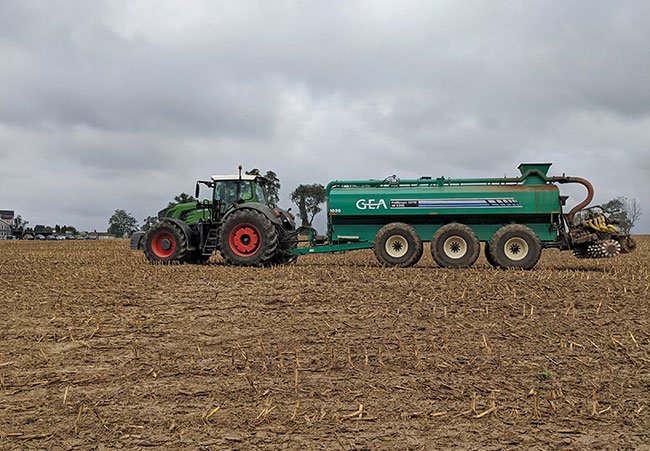
Manure injection from a liquid tanker on a Lancaster County field.
Looking forward
All this growth in adoption is sure to continue. The Partnership is using funding that was awarded in 2024 from the National Fish and Wildlife Foundation to continue building adoption of manure injection and nutrient management in the Chesapeake Bay watersheds, with a specific focus on the Susquehanna River Basin, which spans New York, Maryland and Pennsylvania.
Rathlev also reports that “we had a booth at the Pennsylvania Dairy Industry Summit last year, and we spoke with four or five farmers that have been injecting for years with their own equipment. And we talked to an equipment dealer who sold 10 injection units last year.” She notes that because injection costs a little more, it’s crucial to make the economic benefits clear to farmers. Still, “they are understanding that injection will enable them to reduce the amount of N they have to apply,” she says. “They also appreciate the odor reduction, because they’re always dealing with complaints from neighbors. In addition, for the applicators, the newer equipment designs are really moving the ball forward.”
Most of all, Rathlev credits the collective success to the dedicated teamwork of Partnership members. “We don’t just have a partnership, we have a collaboration,” she explains. “We’re all united in trying to help farmers realize the value of their manure, because every molecule of nitrogen that’s lost from a farm, whether it goes to the water or the air, that’s money out of the farmer’s pocket. We know what we are doing is working. We want injection to be a normal part of farming. We want to put ourselves out of the manure injection business as an organization, so to speak, and we are on our way.” •


