U.S. Birth Rates Still Haven’t Recovered From 2007
See visuals like this from many other data creators on our Voronoi app. Download it for free on iOS or Android and discover incredible data-driven charts from a variety of trusted sources.
Key Takeaways
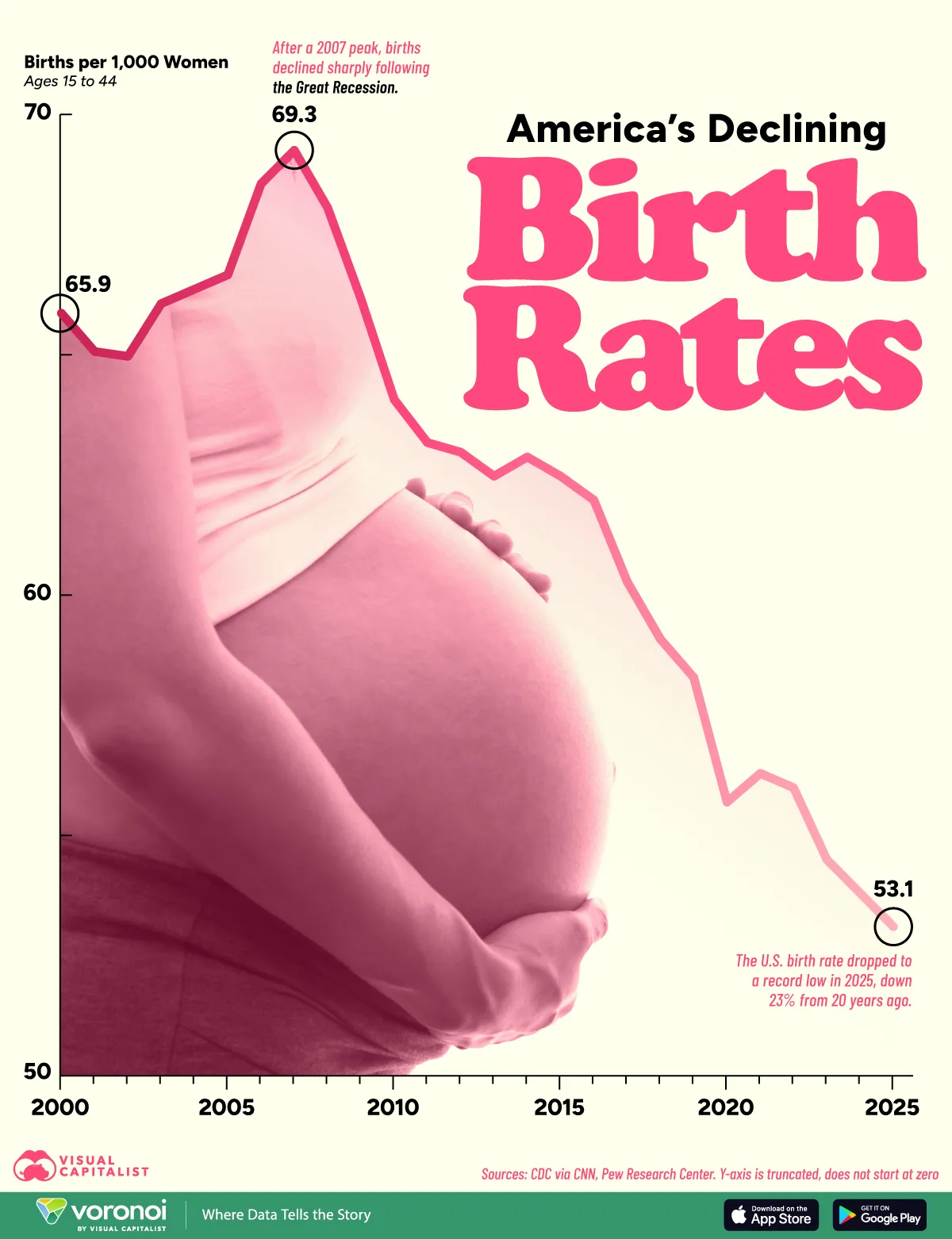
- U.S. birth rates hit a record low in 2025, down 23% from their recent local peak in 2007.
- The sharpest drop followed the 2008 financial crisis, and rates have never fully recovered.
- Short-lived rebounds, including after COVID-19, have not reversed the long-term decline.
The U.S. birth rate hit another record low in 2025.
This chart tracks births per 1,000 women ages 15–44 from 2000 to 2025, based on CDC data with additional reporting from CNN.
It highlights a clear turning point after 2007, when birth rates spiked, and shows how economic shocks like the Great Recession and COVID-19 accelerated a trend that has yet to reverse.
The Peak Before a Long Decline
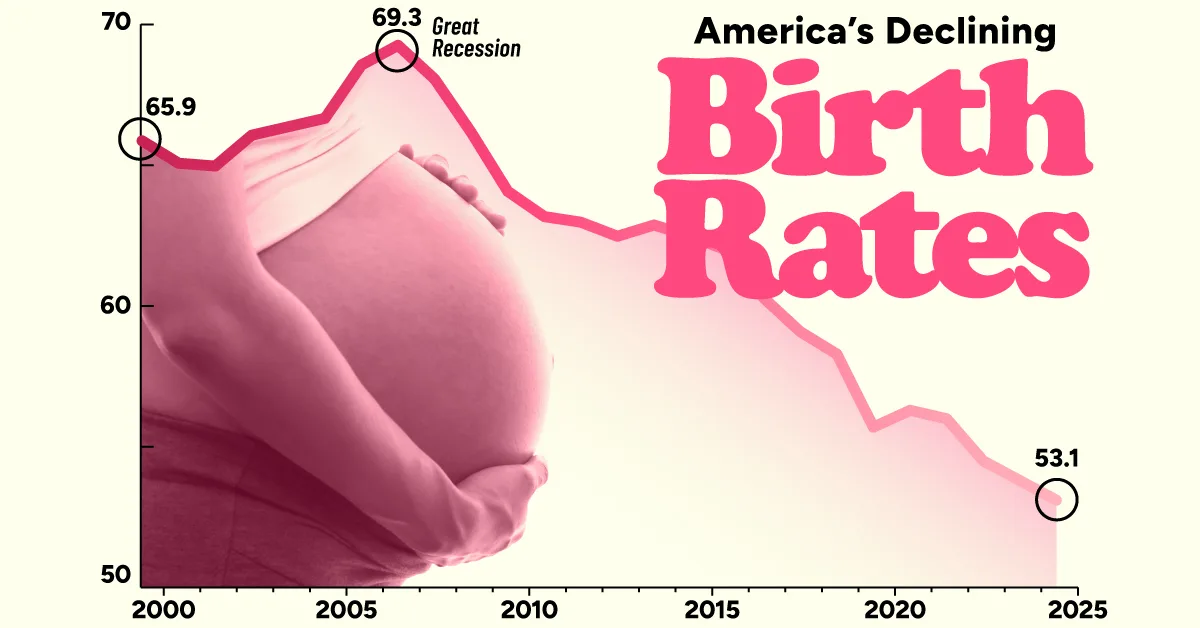
By 2007, U.S. birth rates reached 69.3 births per 1,000 women, the highest level in the dataset. This marked a clear inflection point. Birth rates then began a sustained decline that continues through 2025.
| Year | Births per 1,000 Women (ages 15 to 44) |
|---|---|
| 2000 | 65.9 |
| 2001 | 65.1 |
| 2002 | 65 |
| 2003 | 66.1 |
| 2004 | 66.4 |
| 2005 | 66.7 |
| 2006 | 68.6 |
| 2007 | 69.3 |
| 2008 | 68.1 |
| 2009 | 66.2 |
| 2010 | 64.1 |
| 2011 | 63.2 |
| 2012 | 63 |
| 2013 | 62.5 |
| 2014 | 62.9 |
| 2015 | 62.5 |
| 2016 | 62 |
| 2017 | 60.3 |
| 2018 | 59.1 |
| 2019 | 58.3 |
| 2020 | 55.7 |
| 2021 | 56.3 |
| 2022 | 56 |
| 2023 | 54.5 |
| 2024 | 53.8 |
| 2025 | 53.1 |
The Lasting Impact of the Great Recession
The 2008 financial crisis triggered the steepest sustained drop in modern U.S. birth rates. Between 2007 and 2013, the rate fell by nearly 10%, as economic uncertainty led many households to delay or forgo having children. Unlike previous downturns, this decline proved persistent, even after the economy recovered.
Part of this sustained decline was driven by falling birth rates among immigrant women, a group that had previously supported higher overall fertility levels.
Pandemic Dip and Record Lows
The continued decline has significant long-term implications. Fewer births today mean slower population growth and a smaller future workforce, trends that could reshape economic growth, entitlement systems, and demographic balance in the decades ahead.
Learn More on the Voronoi App 
If you enjoyed today’s post, check out U.S. Childcare Cost Higher Than In Other Developed Countries on Voronoi, the new app from Visual Capitalist.