Ranked: What Makes Europeans Most Proud of Their Country?
Key Takeaways
- Culture, people, and history are the top drivers of national pride across Europe.
- The UK (29%) and Hungary (23%) stand out for high levels of negative sentiment.
- Sweden is a major outlier, with 53% citing politics as a source of pride.
What people take pride in says a lot about how they see their country.
Across Europe, those sources range from culture and history to political systems and personal freedoms. But in some countries, a notable share of people say they feel little pride at all.
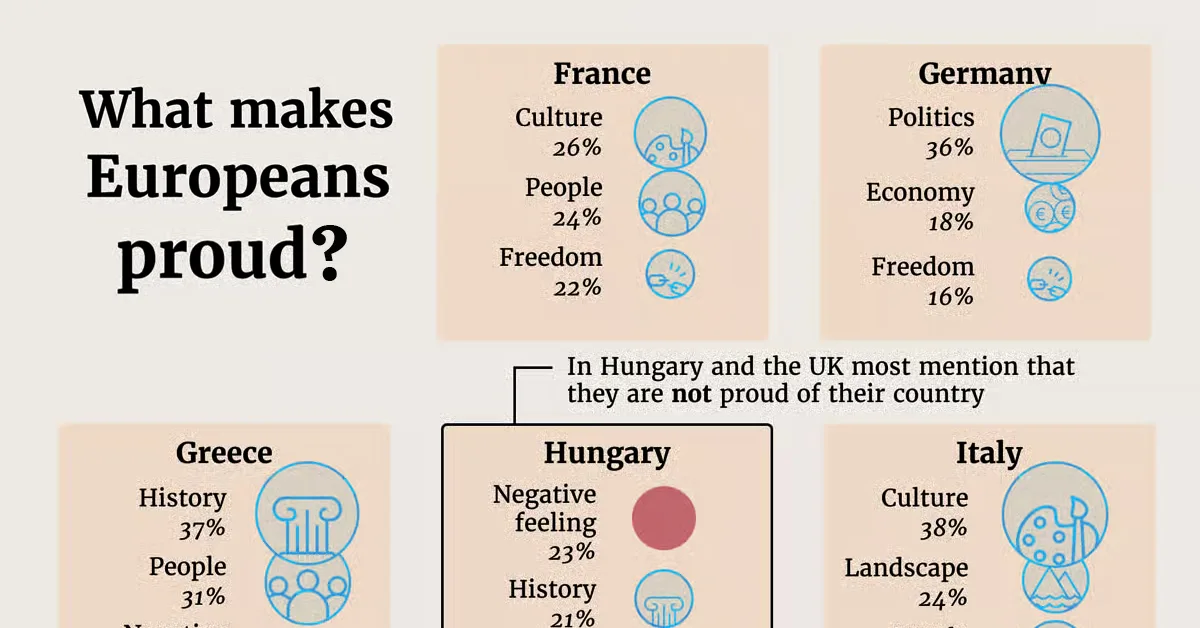
This visualization by The European Correspondent, based on Pew Research Center data, breaks down the top three sources of national pride in each country surveyed.
Top Sources of National Pride, by Country
Here’s a closer look at the top three sources of national pride cited by adults in each country:
| Country | Top Source | Second Source | Third Source |
|---|---|---|---|
 Sweden Sweden |
Politics (53%) | Landscape (32%) | People (26%) |
 Italy Italy |
Culture (38%) | Landscape (24%) | People (23%) |
 Greece Greece |
History (37%) | People (31%) | Negative feeling (19%) |
 Germany Germany |
Politics (36%) | Economy (18%) | Freedom (16%) |
 Spain Spain |
People (32%) | Negative feeling (25%) | Culture (16%) |
 UK UK |
Negative feeling (29%) | People (25%) | Politics (22%) |
 France France |
Culture (26%) | People (24%) | Freedom (22%) |
 Netherlands Netherlands |
Freedom (24%) | Economy (21%) | Politics (21%) |
 Hungary Hungary |
Negative feeling (23%) | History (21%) | People (20%) |
 Poland Poland |
Identity (21%) | History (20%) | People (18%) |
 Türkiye Türkiye |
People (20%) | History (12%) | Identity (10%) |
Culture dominates in countries like Italy (38%) and France (26%), while history plays a major role in Greece (37%). Meanwhile, Sweden stands out with 53% citing politics—by far the highest single-category share.
The Core Drivers of Pride Across Europe
In much of Europe, national pride is rooted in shared identity and heritage. Southern European countries like Italy and Greece emphasize culture and history, reflecting their deep historical legacies and global cultural influence.
Elsewhere, people themselves are a key source of pride. Spain (32%) and France (24%) rank highly in this category, suggesting a strong sense of national community and social cohesion.
Where National Pride Is Weakest
Not all sentiment is positive. In the UK, 29% of respondents cite “negative feeling” when describing their country, which is higher than any single positive category. Hungary (23%) and Spain (25%) also show notable shares of dissatisfaction.
This aligns with broader research. According to Pew, individuals who express less pride are often those who do not identify with the governing political parties. In the UK specifically, findings from British Social Attitudes surveys suggest national identity has become more fragmented in recent years, often tied to political divisions.
These dynamics help explain why politics can be both a source of pride—as in Sweden—and frustration, as seen elsewhere.
Politics as a Source of Pride—and Division
Sweden stands out sharply, with 53% of respondents citing politics as a source of pride, which is the highest share of any single category in the dataset.
Germany (36%) follows at a distance. Meanwhile, in other countries, political dissatisfaction helps explain rising negative sentiment, particularly among those who feel disconnected from leadership.