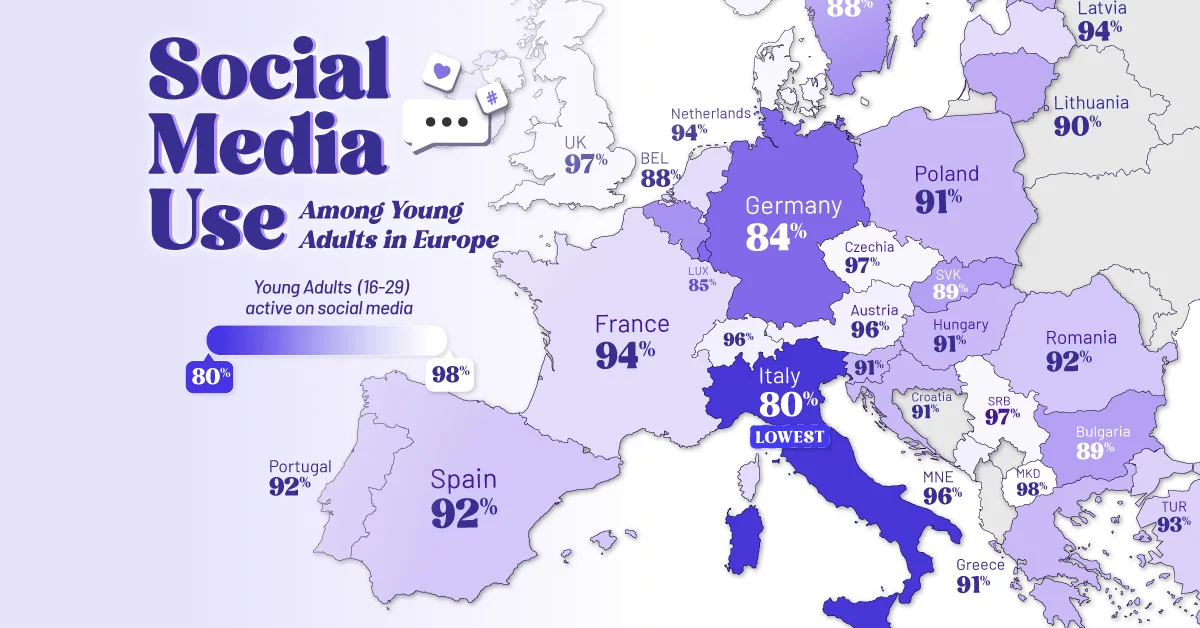
 See more visualizations like this on the Voronoi app.
Mapped: Where Young Adults Use Social Media Most in Europe
See visuals like this from many other data creators on our Voronoi app. Download it for free on iOS or Android and discover incredible data-driven charts from a variety of trusted sources.
Key Takeaways
- Social media use among Europe’s young adults is near-universal in many countries, often exceeding 95%.
- Italy (80.3%) and Germany (84.2%) have the lowest rates on the continent.
- Northern Europe and the Balkans lead, with several countries approaching full adoption.
Social media use among young adults (aged 16–29) in Europe is nearing saturation, with many countries approaching universal adoption.
But two of Europe’s largest economies stand apart.
Data from Eurostat and Ofcom shows a clear gap. While countries in Northern Europe and the Balkans lead, major economies like Germany (84.2%) and Italy (80.3%) lag behind their peers.
Nearly Universal Adoption With Two Exceptions
In countries like Denmark or Czechia, social media use is close to universal among young adults.
Germany and Italy break from this pattern, highlighting how cultural and structural factors continue to shape digital behavior.
Below is the full ranking of 34 European countries by social media use among young adults:
| Rank | Country | Use of Social Networks in 2025 among young adults |
|---|---|---|
| 1 |  Cyprus Cyprus |
98.3 |
| 2 |  North Macedonia North Macedonia |
97.7 |
| 3 |  Czechia Czechia |
97.2 |
| 4 |  Serbia Serbia |
97.2 |
| 5 |  UK UK |
97.0 |
| 6 |  Denmark Denmark |
96.9 |
| 7 |  Finland Finland |
96.6 |
| 8 |  Austria Austria |
96.1 |
| 9 |  Montenegro Montenegro |
96.1 |
| 10 |  Switzerland Switzerland |
95.8 |
| 11 |  Norway Norway |
95.7 |
| 12 |  Ireland Ireland |
94.4 |
| 13 |  Netherlands Netherlands |
94.2 |
| 14 |  France France |
93.9 |
| 15 |  Latvia Latvia |
93.8 |
| 16 |  Turkey Turkey |
93.4 |
| 17 |  Romania Romania |
92.1 |
| 18 |  Malta Malta |
91.9 |
| 19 |  Spain Spain |
91.6 |
| 20 |  Portugal Portugal |
91.6 |
| 21 |  Estonia Estonia |
91.4 |
| 22 |  Hungary Hungary |
91.1 |
| 23 |  Slovenia Slovenia |
91.0 |
| 24 |  Croatia Croatia |
90.7 |
| 25 |  Greece Greece |
90.6 |
| 26 |  Poland Poland |
90.5 |
| 27 |  Lithuania Lithuania |
89.8 |
| 28 |  Bulgaria Bulgaria |
89.4 |
| 29 |  Slovakia Slovakia |
88.7 |
| 30 |  Sweden Sweden |
88.4 |
| 31 |  Belgium Belgium |
88.3 |
| 32 |  Luxembourg Luxembourg |
84.8 |
| 33 |  Germany Germany |
84.2 |
| 34 |  Italy Italy |
80.3 |
| — | Average | 92.4 |
Cyprus and North Macedonia have the highest rates of young-adult social media use in Europe, followed closely by Czechia, Denmark, Finland, Serbia, and the United Kingdom.
In these countries, social media functions as essential infrastructure, used for everything from coordinating study groups to maintaining social circles. Being offline can make young people effectively invisible in networks that increasingly operate online.
Germany and Italy: The Exceptions
While social media use exceeds 90% across much of Europe, Germany and Italy stand apart.
Germany, Europe’s largest economy, has 84.2% of young adults on social media, well below many of its neighbors. Italy is lower still at 80.3%, meaning one in five young adults are not on any social platform, the highest share on the continent.
In Germany, stricter privacy norms shaped by GDPR have contributed to a more cautious approach to online presence. Policymakers are even considering restrictions on youth access, with leaders citing the dangers of online socialization.
In Italy, lower usage may reflect a stronger role for offline social life. Everyday interactions, from evening strolls to time spent in cafes, continue to provide alternatives to digital connection.
Migration’s Relationship With Social Media
High social media use in the Balkans is partly linked to emigration.
Roughly a quarter of Western Balkan citizens, for example, move abroad in search of higher wages and better job opportunities. For families split across different countries or even different continents, social media plays a key role in maintaining communication.
Diaspora has helped social media usage overcome the digital skepticism seen in countries like Germany or Italy.
Learn More on the Voronoi App
To learn more about this topic, check out the We’re Spending More Time Watching Videos on Social Media on Voronoi.