 See more visualizations like this on the Voronoi app.
Mapped: Europe’s Birth Rate Collapse
See visuals like this from many other data creators on our Voronoi app. Download it for free on iOS or Android and discover incredible data-driven charts from a variety of trusted sources.
Key Takeaways
- No country in Europe meets the 2.1 birth rate needed to sustain population levels.
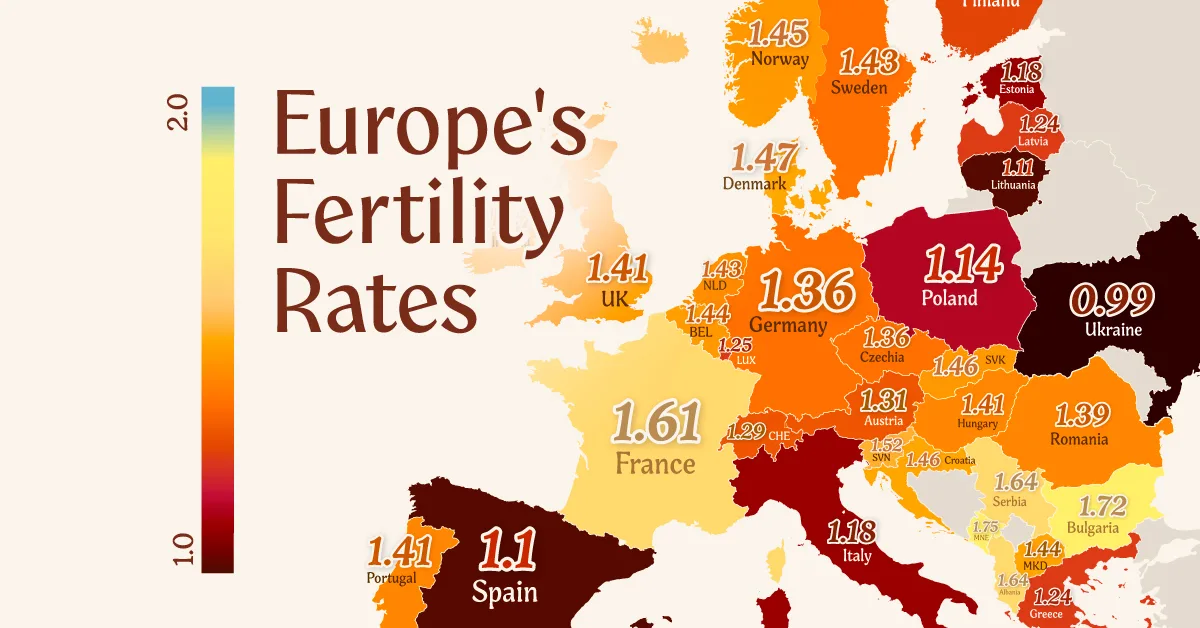
- Ukraine (0.99), Spain (1.1), and Poland (1.14) rank among the lowest.
- Even Europe’s highest rates, such as France (1.61), remain well below replacement.
Europe’s population is no longer replacing itself.
Across the continent, fertility rates have fallen below the 2.1 births per woman needed to maintain stable population levels, with no country meeting that threshold as of 2024.
This map shows the number of live births per woman across Europe using the most recent data from Eurostat, FRED, and the UK’s Office for National Statistics.
From Ukraine (0.99) to Spain (1.1), some of Europe’s largest countries now rank among those with the lowest birth rates, highlighting how widespread the decline has become.
Fertility Crisis in South and Eastern Europe
Europe’s lowest birth rates are concentrated in the east and south, where economic strain and geopolitical instability have accelerated long-term declines.
Ukraine has seen the sharpest drop. Its fertility rate, which last exceeded the replacement level in 1986, fell to 0.9 in 2022 before recovering slightly to 0.99 in 2024.
Among countries at peace, Malta has one of the lowest fertility rates at 1.01, followed by Spain (1.1) and Poland (1.14).
This data table lists European countries alongside their fertility rates as of 2024.
| Rank | Country | Fertility Rate (2024) |
|---|---|---|
| 1 |  Montenegro Montenegro |
1.75 |
| 2 |  Bulgaria Bulgaria |
1.72 |
| 3 |  Albania Albania |
1.64 |
| 4 |  Serbia Serbia |
1.64 |
| 5 |  France France |
1.61 |
| 6 |  Iceland Iceland |
1.56 |
| 7 |  Slovenia Slovenia |
1.52 |
| 8 |  Denmark Denmark |
1.47 |
| 9 |  Ireland Ireland |
1.47 |
| 10 |  Croatia Croatia |
1.46 |
| 11 |  Slovakia Slovakia |
1.46 |
| 12 |  Norway Norway |
1.45 |
| 13 |  Belgium Belgium |
1.44 |
| 14 |  North Macedonia North Macedonia |
1.44 |
| 15 |  Netherlands Netherlands |
1.43 |
| 16 |  Sweden Sweden |
1.43 |
| 17 |  Hungary Hungary |
1.41 |
| 18 |  Portugal Portugal |
1.41 |
| 19 |  UK UK |
1.41 |
| 20 |  Romania Romania |
1.39 |
| 21 |  Cyprus Cyprus |
1.38 |
| 22 |  Czechia Czechia |
1.36 |
| 23 |  Germany Germany |
1.36 |
| 24 |  Austria Austria |
1.31 |
| 25 |  Switzerland Switzerland |
1.29 |
| 26 |  Luxembourg Luxembourg |
1.25 |
| 27 |  Finland Finland |
1.25 |
| 28 |  Greece Greece |
1.24 |
| 29 |  Latvia Latvia |
1.24 |
| 30 |  Estonia Estonia |
1.18 |
| 31 |  Italy Italy |
1.18 |
| 32 |  Poland Poland |
1.14 |
| 33 |  Lithuania Lithuania |
1.11 |
| 34 |  Spain Spain |
1.10 |
| 35 |  Malta Malta |
1.01 |
| 36 |  Ukraine Ukraine |
0.99 |
| — | Replacement Rate | 2.1 |
Lower fertility in countries like Spain and Poland reflects a mix of economic pressures, including lower wages and the rising cost of raising children, alongside broader trends seen across developed economies.
Aging populations are already reshaping national priorities. As Poland seeks to build a larger military, its shrinking population presents a strategic vulnerability.
Europe’s Fertility Woes
This trend extends across the continent. Europe’s largest economies, including Germany (1.36), the UK (1.41), France (1.61), and Italy (1.18), all remain well below replacement levels.
Even countries with relatively higher fertility rates, such as Bulgaria (1.72) and Montenegro (1.75), are not producing enough births to stabilize their populations.
One response has been increased immigration. In Germany, migration policy in the mid-2010s was shaped partly by the need to support the country’s labor system. However, this approach has also fueled political backlash and the rise of anti-immigration parties.
Family Incentives As A Solution?
Some countries are attempting to boost birth rates through financial incentives. France, Hungary, and Poland have introduced tax credits, subsidies, and other programs aimed at encouraging larger families.
Hungary, for example, has spent over a decade expanding benefits for young couples, with the goal of reaching the 2.1 replacement rate by 2030.
So far, the results have been limited. Hungary’s fertility rate of 1.41 is similar to countries like the UK and Portugal, suggesting that financial incentives alone may not reverse the broader trend.
Learn More on the Voronoi App
To learn more about this topic, check out the Which European Nations Have the Best Fertility Treatment Policies? on Voronoi.