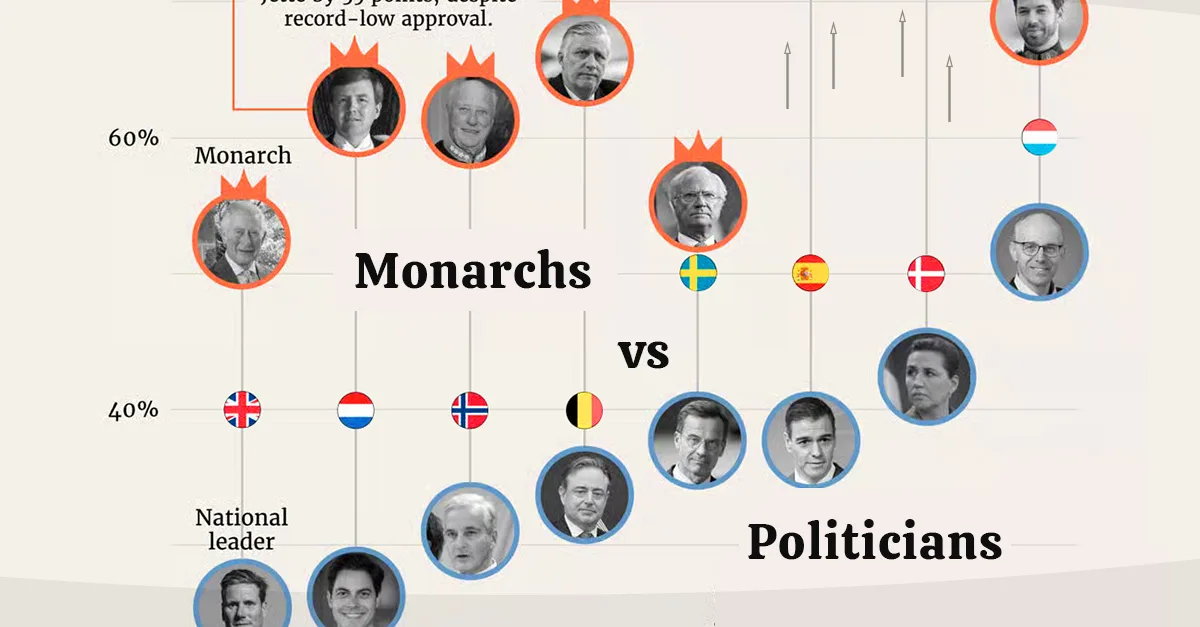
In Europe, Monarchs Are Far More Popular Than Politicians
Key Takeaways
- Monarchs in Europe have approval ratings nearly 30 points higher than elected leaders.
- The gap holds in every country analyzed, without exception.
- Spain shows the widest divide, with almost a 40-point difference.
In Europe, monarchs are far more popular than the politicians who govern.
Data from Morning Consult, visualized by The European Correspondent, shows that monarchs hold an approval advantage of nearly 30 points over national leaders. The gap appears in every country analyzed.
The pattern reveals a clear divide: leaders making policy decisions often face public backlash, while ceremonial figures largely avoid it.
Approval Ratings for Elected and Unelected Leaders
Below, we break down approval ratings across eight European countries.
| Name | Position | Country | Approval Rating (April 2026) |
|---|---|---|---|
| King Charles III |  Monarch Monarch |
 UK UK |
53% |
| Keir Starmer |  National leader National leader |
UK |
27% |
| King Willem-Alexander | Monarch |
 Netherlands Netherlands |
63% |
| Rob Jetten | National leader |
Netherlands |
28% |
| King Harald V | Monarch |
 Norway Norway |
61% |
| Jonas Gahr Støre | National leader |
Norway |
31% |
| King Philippe | Monarch |
 Belgium Belgium |
66% |
| Bart de Wever | National leader |
Belgium |
35% |
| King Carl XVI Gustaf | Monarch |
 Sweden Sweden |
55% |
| Ulf Kristersson | National leader |
Sweden |
38% |
| King Felipe VI | Monarch |
 Spain Spain |
76% |
| Pedro Sánchez | National leader |
Spain |
38% |
| King Frederik X | Monarch |
 Denmark Denmark |
80% |
| Mette Frederiksen | National leader |
Denmark |
43% |
| Grand Duke Henri | Monarch |
 Luxembourg Luxembourg |
69% |
| Luc Frieden | National leader |
Luxembourg |
49% |
From the UK to Luxembourg, monarchs outperform politicians across the board. Spain stands out with the largest gap, while even the narrowest differences still favor royalty.
Why Do Monarchs Poll Better?
One key explanation lies in the fundamentally different roles these figures play. Monarchs are typically nonpartisan, symbolic heads of state, largely removed from day-to-day political decision-making. This helps them avoid the scrutiny and backlash that elected leaders inevitably face.
By contrast, national leaders are directly responsible for policy decisions on issues like inflation, immigration, and public services. These decisions often divide public opinion, dragging down approval ratings.
Spain and the Netherlands: The Biggest Gaps
Spain has the widest popularity divide, with King Felipe VI outpacing Prime Minister Pedro Sánchez by nearly 40 points. This reflects broader dissatisfaction with political leadership, alongside relatively stable support for the monarchy.
The Netherlands also shows a notable gap, with King Willem-Alexander maintaining a significant lead despite historically low approval ratings for the monarchy itself. This highlights how unpopular political leadership can become by comparison.
Even Lower-Rated Monarchs Still Lead
Even in countries where monarchs have more modest approval ratings, such as the UK, their standing still surpasses that of elected leaders. This underscores a broader trend: monarchy as an institution retains a degree of public goodwill that politicians struggle to match.
As this data shows, in modern Europe, it’s often the figureheads, not the decision-makers, who win the popularity contest.