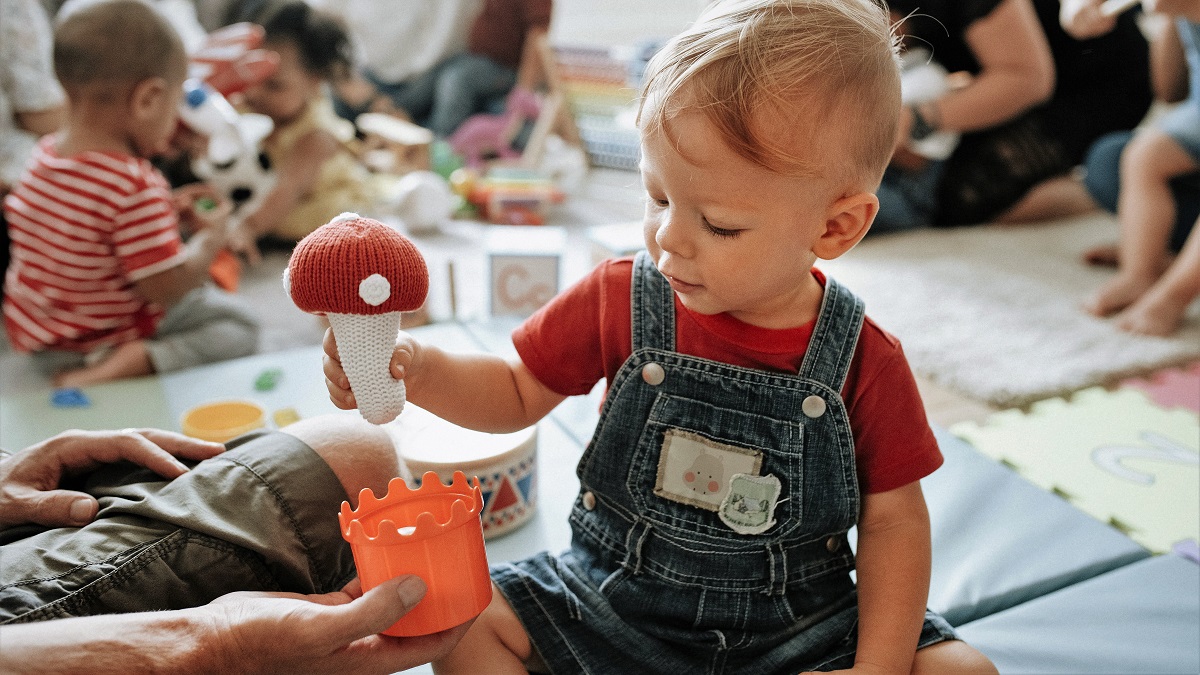
About 14.7 million American children under age 6 have all their parents working, so most spend their days outside the home, usually in child care. These settings have an environmental impact that many parents never notice, including diapers, food waste, cleaning products, art supplies, packaging, and the indoor air children breathe for hours each day.
Daycare is one of the most important places in a young child’s life. The habits children learn there, like how they deal with waste, connect with nature, and what they expect from their food, often come home with them. This means a daycare’s approach to sustainability matters for families, not just for the center itself. The good news is that about 70% of a typical preschool’s waste can be reused, recycled, or composted, so most centers can make big improvements without spending a lot.
This guide explains what to look for in a daycare, how to encourage changes at your child’s current center, and which areas—like diapers, food, indoor air, and outdoor time—parents can influence most.
The Footprint Nobody Talks About
Diapers are a huge part of the problem. Americans throw away about 20 billion disposable diapers each year, adding up to around 3.5 million tons of landfill waste. They are the third most common consumer item in U.S. landfills. The EPA says each diaper can take up to 500 years to break down and releases methane as it decomposes.
Food waste is also a big issue in early childhood settings. One U.S. study found that childcare programs throw away about 43% of the food they serve. A Finnish study showed that childcare centers waste more food per meal than restaurants or schools. When you add this up across thousands of centers, the loss of resources like carbon, water, and money is huge.
The largest U.S. study to measure environmental contaminants in childcare facilities found formaldehyde levels exceeded California’s chronic exposure guideline in 87% of centers tested, and indoor particulate matter exceeded 24-hour standards in nearly half. Sources include cleaning products, air fresheners, off-gassing furniture, art supplies, and pesticides used inside the building. Children, who breathe more air per pound of body weight than adults do, absorb more of the toxins they inhale. Most daycares have limited budgets and staff who are already busy. Still, small changes across many centers can make a big difference. Parents who notice these problems can help centers that want to improve but need support.ds an ally.
If You’re Still Choosing a Center
A center’s commitment to sustainability during licensing often shows how they operate every day. When you visit, ask clear questions. For example, “Do you compost food scraps?” gives you more information than asking, “Are you eco-friendly?”
Questions worth asking on a tour:
- How is food waste handled — composted, donated, or trashed?
- What cleaning products do you use, and are they third-party certified?
- How much time do children spend each day outdoors, and in what conditions?
- How are art supplies, books, and toys sourced — new each year, or rotated and shared?
- Do you have a recycling system the children participate in?
- What’s your policy on pest control and air freshening?
One credible signal to look for is the Eco-Healthy Child Care endorsement, a national program from the Children’s Environmental Health Network that has endorsed more than 1,500 facilities across the U.S., Canada, and Australia. Endorsed centers comply with at least 24 of 30 best practices covering pesticides, lead, art supplies, plastics, cleaning chemicals, and outdoor exposure. The program’s standards have been adopted by the National Association for the Education of Young Children as part of its accreditation criteria, and several states (Maryland, Pennsylvania, Utah) recognize it within their quality rating systems.
If a center can’t give specific answers to your sustainability questions, that tells you something. It doesn’t mean you should rule them out, but it suggests that any green changes may need to start with parents.
If Your Child Is Already Enrolled
Begin by talking to the director, not the classroom teacher. Directors make decisions about purchases, vendors, and staff training. Bring specific suggestions instead of general concerns. For example, asking, “Would you consider switching to a third-party-certified cleaning product?” is helpful, while “Can you be greener?” is too vague.
It helps to assume the director wants to improve but faces real limits. Offer to help with the work. Most centers will accept support that they don’t have time to organize on their own.
Rethinking the Diaper Question
If your center only allows disposable diapers, ask for the reason. Some states have strict rules about cloth diapers in group care, but many centers use disposables simply out of habit, not because of regulations.
Cloth diaper services, which handle laundry and delivery in bulk, address most of the staffing and hygiene worries that make centers choose disposables. More centers now accept plant-based or biodegradable disposables, which use less plastic but still go to landfills. These are better, but not a complete solution.
If your center won’t change its diaper policy, try suggesting a diaper recycling program if one is available nearby. Industrial diaper recycling is still uncommon in the U.S., but it exists in some parts of Europe and is growing.
Food Waste and What Kids Actually Eat
Food waste reduction is the single most effective change centers can make. It saves money, lowers methane emissions from food in landfills, and, when done openly, teaches children about food sources and the meaning of waste. Centers usually overestimate how much children eat and underestimate how much is thrown away. Simply starting to measure food wasted each day alone tends to drive a 20–30% reduction. A few tips can help:
- Serve family-style. Children who serve themselves take less and eat more of what they take, compared to pre-portioned meals.
- Compost on-site or partner with a local hauler. Many municipalities now have small-business composting service.
- Source from local farms when seasonal and affordable. CACFP-funded programs have flexibility here that many directors don’t realize.
When packing food from home, stick to the basics: whole fruit is better than packaged slices, reusable containers are better than single-use bags, and a thermos of water is better than a juice box. The goal isn’t perfection, but to cut down on single-use packaging, which makes up a big part of a center’s daily waste.
The Indoor Air Conversation
Improving indoor air is where parent advocacy can make the biggest difference for children’s health. Most directors are open to change once they understand the issue. Children spend over 90% of their time indoors, and the air quality depends on choices about cleaning products, furniture, art supplies, and pest control.
Concrete requests that work:
- Switch to Green Seal- or EPA Safer Choice-certified cleaning products. They cost roughly the same as conventional products and dramatically reduce exposure to volatile organic compounds.
- Eliminate air fresheners and scented plug-ins. “Fragrance” can include hundreds of undisclosed chemicals, and the underlying odor problem is almost always solved better by ventilation.
- Adopt integrated pest management instead of routine pesticide spraying. IPM uses traps, sealing, and sanitation first; pesticides are a last resort.
- Choose water-based, low-VOC paints and finishes during any renovation.
- Open windows when the weather allows. Mechanical ventilation in older buildings is often inadequate; outdoor air, even in mild urban areas, is usually cleaner than indoor air, which is often laden with cleaning residues and off-gassing from furniture.
These changes are inexpensive, easy to implement, and directly improve children’s breathing health. They also usually lower the number of sick days, which directors appreciate.
The case for getting children outside has shifted from a wellness argument to a developmental one. A 2022 review of nature-based early childhood education found consistent positive associations with self-regulation, social-emotional development, nature-relatedness, and play interaction. A 2024 study at the University of Minnesota Duluth found that nature-based preschool practices supported self-regulation development, particularly for children from lower socio-economic backgrounds.
This is important because outdoor time is often the first thing dropped when schedules get busy. Speaking up for outdoor time and helping make it easier for the center supports both sustainability and better education.
Practical contributions parents can make:
- Help build raised garden beds. Children who grow food eat more of it and waste less.
- Donate weather gear. Many centers cite “the kids don’t have rain boots” as a real barrier.
- Organize a parent work day. Remove invasive plants and add native species to outdoor play areas.
- Source loose parts for playgrounds. Logs, stumps, and large stones support unstructured nature play.
What You Can Pack from Home
What you do as a parent may not have as much impact as center-wide changes, but you can control it. The goal is to reduce single-use packaging in your child’s daily routine.
- Stainless steel or silicone snack containers. They survive being dropped, kicked, and chewed.
- A reusable water bottle. The juice-box equivalent in landfill waste over a daycare year is striking.
- Whole fruit instead of pre-cut packaged fruit cups.
- Cloth napkins or beeswax wraps in lunchboxes.
- Send clearly labeled hand-me-down clothes. Daycares go through clothing faster than almost anywhere else.
Helping the Center Help Itself
Most U.S. daycares are small, independent, and have limited funding. The average child care worker earns about $14.60 an hour. Free help and materials are not just appreciated; they are often the only way a center can start a sustainability project.
Donations that make the biggest difference include:
- Children’s books about nature, recycling, and food systems for the classroom library.
- Clean recyclable materials — cardboard tubes, egg cartons, glass jars — for art projects and sorting activities.
- Compost bins, indoor recycling stations, or rain barrels.
- Native plant starts from your own garden in spring.
But don’t forget to donate time:
- A Saturday building or repairing outdoor play structures.
- Running a parent fundraiser specifically for a sustainability upgrades, such as air purifiers, a compost system, and raised beds.
- Connecting the director with your municipal recycling or composting program.
When the Center Pushes Back
Some directors will see your interest as helpful, while others may feel it questions their judgment. Both responses are understandable. How you frame the conversation often decides whether it is productive or not. What tends to work is an offer, not a demand: “I’d love to help with this — what would make it easier for you?
If a center keeps refusing to discuss sustainability and it’s important to your family, that tells you something about whether it’s the right fit. Choosing a daycare is a major decision about your values, so it’s worth careful thought.
No single parent or center can solve the issue of daycare sustainability alone. But when parents ask good questions, offer real help, and choose centers that care, it adds up. This is already changing the industry.
Editor’s Note: Originally published on May 21, 2021, this article was substantially updated in May 2026.
The post How To Help Your Child’s Daycare Be More Sustainable appeared first on Earth911.