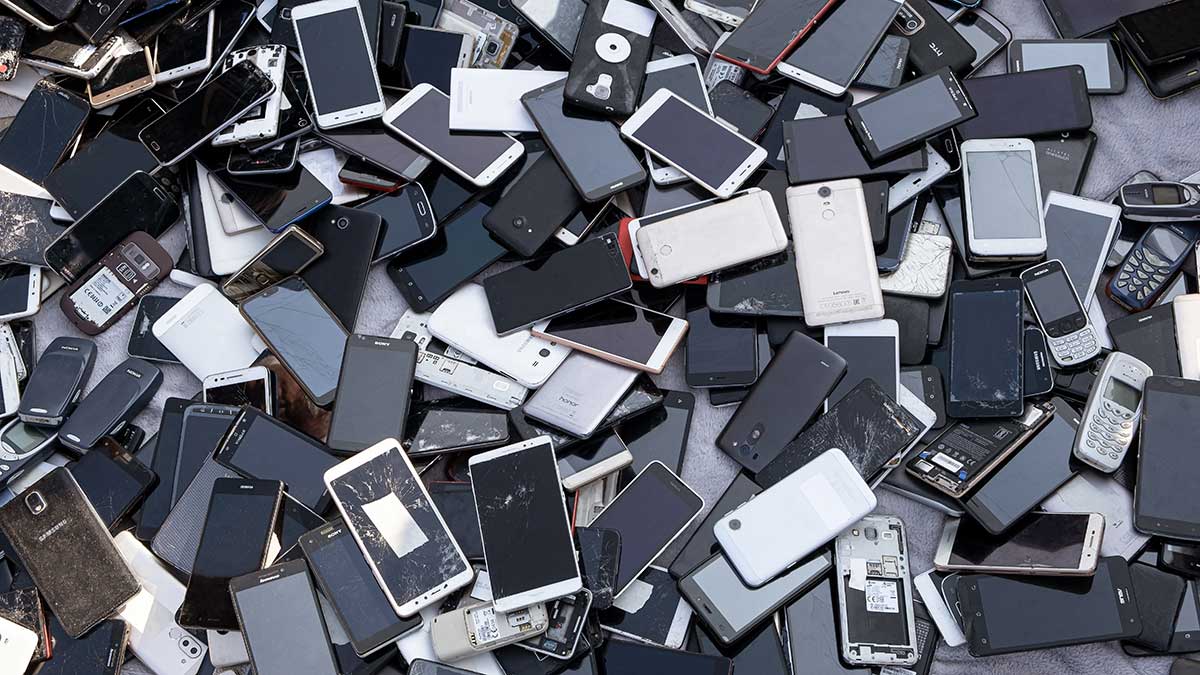
24. That is the average number of electronic devices sitting in a typical American home right now. Phones in drawers, tablets behind the TV, chargers without their devices, and devices without their chargers. Most of those products are headed for a landfill or a shipping container, not a recycler.
Electronics are the fastest-growing solid waste stream on the planet, and U.S. households are an outsize engine. The UN’s Global E-waste Monitor 2024 found that global e-waste reached a record 62 million tons in 2022, which is up 82 percent since 2010, and is rising five times faster than electronics recycling capacity. Americans produce roughly 46 to 48 pounds of it per person per year. Most of those discarded devices contain materials worth real money and environmental harms worth understanding.
The 2022 e-waste pile contained an estimated $91 billion in recoverable metals, according to the United Nations, including roughly $19 billion in copper, $16 billion in iron, and $15 billion in gold. About $62 billion of that value was lost to landfills, incinerators, or unregulated dumping.
Translate that into household terms. The metals in a single discarded smartphone include small but meaningful quantities of gold, silver, palladium, copper, and cobalt. Multiply by the 151 million cell phones, 40 million computers, 20 million televisions, and 23 million small appliances Americans throw away each year, and the unrecovered value runs into the billions for U.S. households alone.
The materials don’t disappear; they just stop circulating. Mining companies extract more virgin gold and copper from the ground while millions of pounds of the same metals sit on shelves in junk rooms and lie fallow in landfills.
What’s Driving the Growth
The average U.S. smartphone replacement cycle has stretched to 3.64 years in 2024, according to Assurant; that’s up from under 3 years a decade ago, yet the underlying hardware can typically last 5 to 7 years with software support. That gap between when consumers upgrade and when the device actually fails is where most e-waste is born.
Behind the phones, a longer parade of devices is generating serious volume. Wearables, smart speakers, e-cigarettes, lithium-powered toys, and cheap rechargeable accessories now show up in municipal waste streams in quantities that did not exist a decade ago. The WHO documented more than 1,000 hazardous substances associated with informal e-waste recycling, including lead, mercury, and brominated flame retardants, all of which can leach from devices that are crushed or burned rather than processed properly.
What the U.S. Actually Recycles
The picture here is genuinely confusing, and reporting that pretends otherwise is wrong. The most-cited EPA estimate of consumer electronics recycling puts the U.S. rate at 38.5 percent, but that figure dates from 2018. More recent independent estimates put the actual U.S. rate closer to 15 percent, with global formal recycling at 22.3 percent in 2022. The gap between the two numbers reflects the difference between what enters a recycling program and what actually gets recovered as usable material.
The remainder follows three main paths. Some heads to U.S. landfills, where heavy metals contribute to leachate problems. Some is incinerated, releasing dioxins from PVC and other plastics. And roughly 90 percent of exported e-waste is processed in low- and middle-income countries, where informal recyclers — often including children — strip devices by hand or by burning. A systematic review in PubMed Central links e-waste exposure in children to reduced lung function, altered thyroid function, ADHD, and lower cognitive scores. None of that shows up on the product box when you buy it.
The Household Financial Picture
Households absorb the cost from two directions at once. They pay for new devices that replace working products, and they leave material value on the table when they discard what they own.
A reasonable estimate, using the per-capita value of unrecovered e-waste metals from the UN report and U.S. generation rates, puts the recoverable value sitting in the average American household’s old electronics in the range of several hundred dollars over a few years. That is metal the household paid for, embedded in devices the household paid for, and the household will not recover unless the device reaches a refiner that can extract it.
The cost on the other side — replacement spending — is easier to size at the industry level than the household level. The Consumer Technology Association puts U.S. consumer technology retail revenue at roughly $505 billion in 2024, which works out to nearly $3,900 per household when spread across the 131 million U.S. households tracked by the BLS Consumer Expenditure Survey. Even allowing for wide variation across income tiers, much of that spending replaces devices that were repairable or still functional.
Right to Repair Is Starting to Bite
The most consequential policy shift on e-waste in the past two years has been the spread of right-to-repair legislation. As of mid-2025, eight states have passed right-to-repair laws covering consumer electronics: New York, California, Minnesota, Oregon, Colorado, Maine, Washington, and Massachusetts. Oregon’s law, which took effect January 1, 2025, became the first in the country to explicitly ban “parts pairing,” the practice of using software to disable replacement components installed by independent shops.
These laws do not immediately reduce e-waste, but they change the economics. When manufacturers must supply parts, tools, and documentation to independent repairers, the cost of fixing a phone or laptop drops. When repair is cheaper than replacement, more devices stay in service. The Repair Association tracks more than 40 active bills across at least 20 states in 2025.
Extended Producer Responsibility (EPR) for electronics covers 24 states, but there is substantial variation in how well-funded and enforced those programs are. A patchwork is still better than nothing, but the absence of a federal framework means a device thrown away in one state may be treated as toxic and a device thrown away in another may end up in a regular dumpster.
What You Can Do
The interventions here are tiered, with very different impacts depending on where you can act.
At home:
- Before replacing a device, check whether repair is feasible — battery swaps and screen replacements are the two most common smartphone failures and both are repairable.
- Sell or donate working electronics rather than storing them. The Earth911 recycling search tool provides local options by ZIP code.
- For batteries, including the lithium cells in earbuds, e-bikes, vapes, and power tools, use The Battery Network (formerly Call2Recycle), the North American battery stewardship program, which operates collection sites at most major retailers.
- For phones specifically, manufacturer trade-in programs (Apple, Samsung, Google) and carrier programs typically capture more material than dropping a phone in a generic recycling bin, because the devices are tested for reuse first.
- Buy refurbished when you can. Certified refurbished phones and laptops are typically 30 to 50 percent cheaper than new and have the same useful life.
In your community:
- If your state hasn’t passed a right-to-repair law, ask your legislators why. The model bill from the PIRG Right to Repair coalition is a good starting reference.
- Support EPR legislation that puts the cost of end-of-life management on manufacturers, not municipalities.
- Push back on devices that are designed against repair — glued-in batteries, paired parts, and service-only components — by buying brands that score well on iFixit’s repairability index.
Individual household action on e-waste matters, but it is not where the leverage lives. Changing product designs and recycling policy, both of which are moving slowly in the right direction, is the path to a more sustainable electronics industry. Your household choices buy time and recover value while the larger system catches up.
The post Electronics: The Fastest-Growing Waste Stream in Your Home appeared first on Earth911.