
Farms already have a fleet of farm machinery, but recent Canadian research is testing whether it’s time for them to also add an air force.
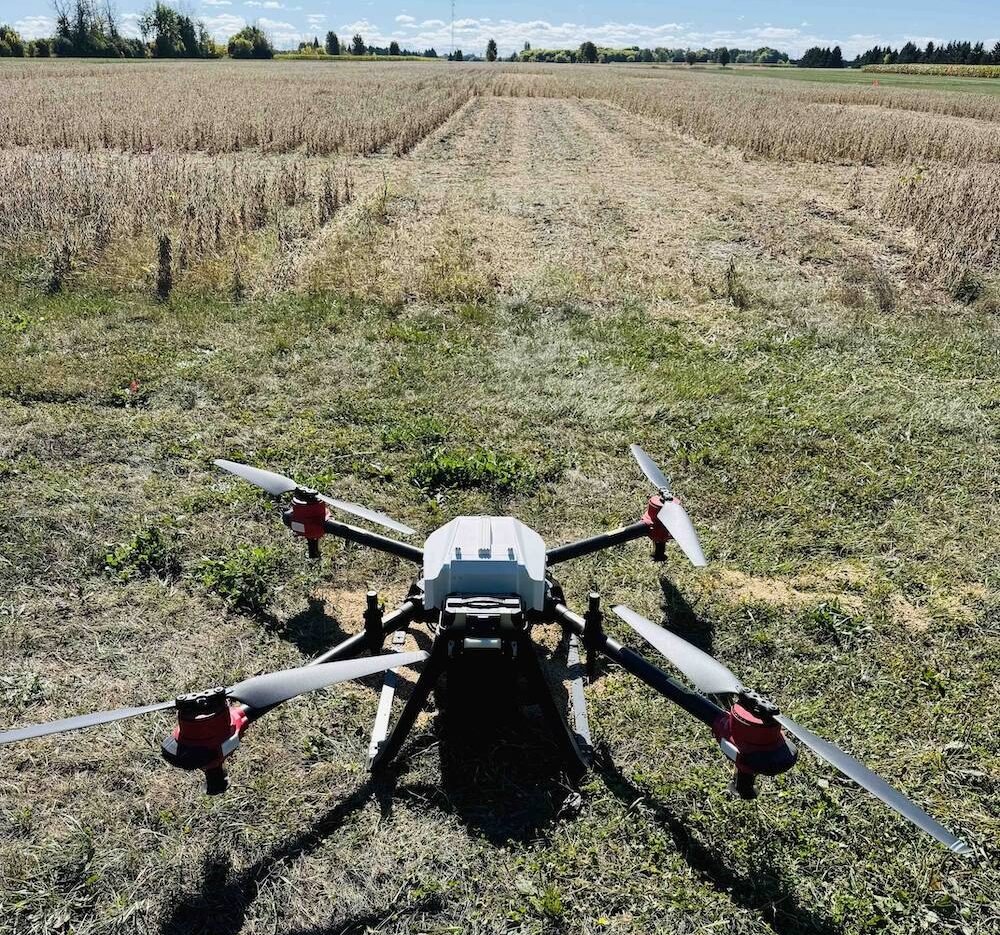
Drone seeding is challenging traditional planting approaches. A team of researchers from the University of Guelph, in collaboration with Corteva Agriscience, is looking at whether broadcasting winter wheat into standing soybeans is a feasible practice.
Joshua Nasielski, a professor in the University of Guelph’s Department of Plant Agriculture, and research technician Ian DeSchiffart lead the team. They’ve established test plots for drone-seeded winter wheat at the Ontario Crops Research Centre in Winchester.
Why it matters: Drone seeding could make planting more flexible and reduce harvest-planting conflicts.
The site is owned by Agricultural Research and Innovation Ontario and managed by the University of Guelph through the Ontario Agri-Food Innovation Alliance.
The research hopes to tease out optimal wheat seeding dates that often conflict with soybean harvest timing. That’s an ongoing challenge in eastern Ontario.
Chasing gains
Nasielski said he and his team believe similar, or potentially higher, yields can be achieved with broadcast seeding compared with traditional drilling, although current results aren’t there yet.
“Right now, we are having slightly lower yields or similar yields, not higher than drilled,” he said.
He pointed to potentially lower stands from poorer establishments, common with broadcast seeding. “We see lower populations when we broadcast versus drill. Hence, our focus on developing a biopolymer seed coating to improve germination/establishment when the soil surface is dry,” he said.
It’s not the only factor to consider. When wheat is drilled, there is also the opportunity to apply seed-placed phosphorus starter fertilizer, known to improve yields, he noted.
Potential gains on the soybean side, though, may make up for some of the loss.
“From a systems perspective, though, think about it like this: farmers often plant shorter-season soybeans on fields they plan to use for winter wheat, so they can harvest earlier, so they can plant winter wheat in a more timely manner,” he said. “Shorter-season soybeans normally mean lower yields, unfortunately. But if you can drone broadcast, you can plant longer-season soybeans that can give you more soybean yield and also seed wheat at the optimal time. So there is great promise in the system.”
He believes “once the kinks are figured out and adopting drone seeding becomes less risky,” crop rotation diversification will improve.
DeSchiffart said yields should improve if they can get more seed germination with the coating.
He added farmers will need to increase the seeding rate from 1.6 million per acre to 1.8 million or higher.
“With the coating that we are testing, I don’t think we would need to go as high since more of the seeds we broadcast will germinate,” he said.
Contamination worries
Nasielski said the main risk during the trials has been contamination of the soybean harvest with treated wheat seed. He noted soybean loads have been rejected by buyers if samples are contaminated with wheat seed treated with fungicide.
“This is a huge issue, the biggest one. But the other risk is poor establishment and lower yields if the soil is dry after broadcast and you don’t get good germination/seedling growth,” he said.
As a result, Nasielski said his team increases seeding rates by approximately 15 to 30 per cent to compensate for poorer stands. A typical seeding rate is 1.6 million seeds per acre; the team is testing rates between 1.8 million and 2.1 million seeds per acre.
“With drone seeding, the flight pattern/speed/etc. also influence how evenly the seed is broadcast,” he said, adding that more work needs to be done on how drone parameters impact seed spread.
“In terms of economics, you need a drone or a custom applicator,” he said.
Drone cost
Drones come with capital cost, he acknowledged, but there’s also potential for multiple use to justify the spend.
Other than broadcast seeding, there is future potential for spraying, he noted.
While drone spraying agricultural pesticides is currently illegal, Health Canada is currently weighing a regulation change that would allow products already approved for other aerial application to be used via drone.
As drone technology continues to evolve, he believes more farmers will adopt the practice.
“Drones are getting bigger and bigger and easier/more automated to use,” Nasielski said. “Our drone was donated to us by a company six years ago. At the time it was one of the largest on the market, now it is considered very small.”
Mainstream drone adoption
He added that increasing drone capacity is making the technology more useful for field crop agriculture.
In British Columbia, farmers are using drones to broadcast alfalfa and forage seeds into pastures on mountainsides that are too steep or remote for tractors.
“Even cowboys in Alberta are using drones equipped with infrared cameras that can sense body heat,” he said. “When the cowboys are rounding up cattle, sometimes a group will go into a wooded area and are hard to find. With drones you can easily look for them.”
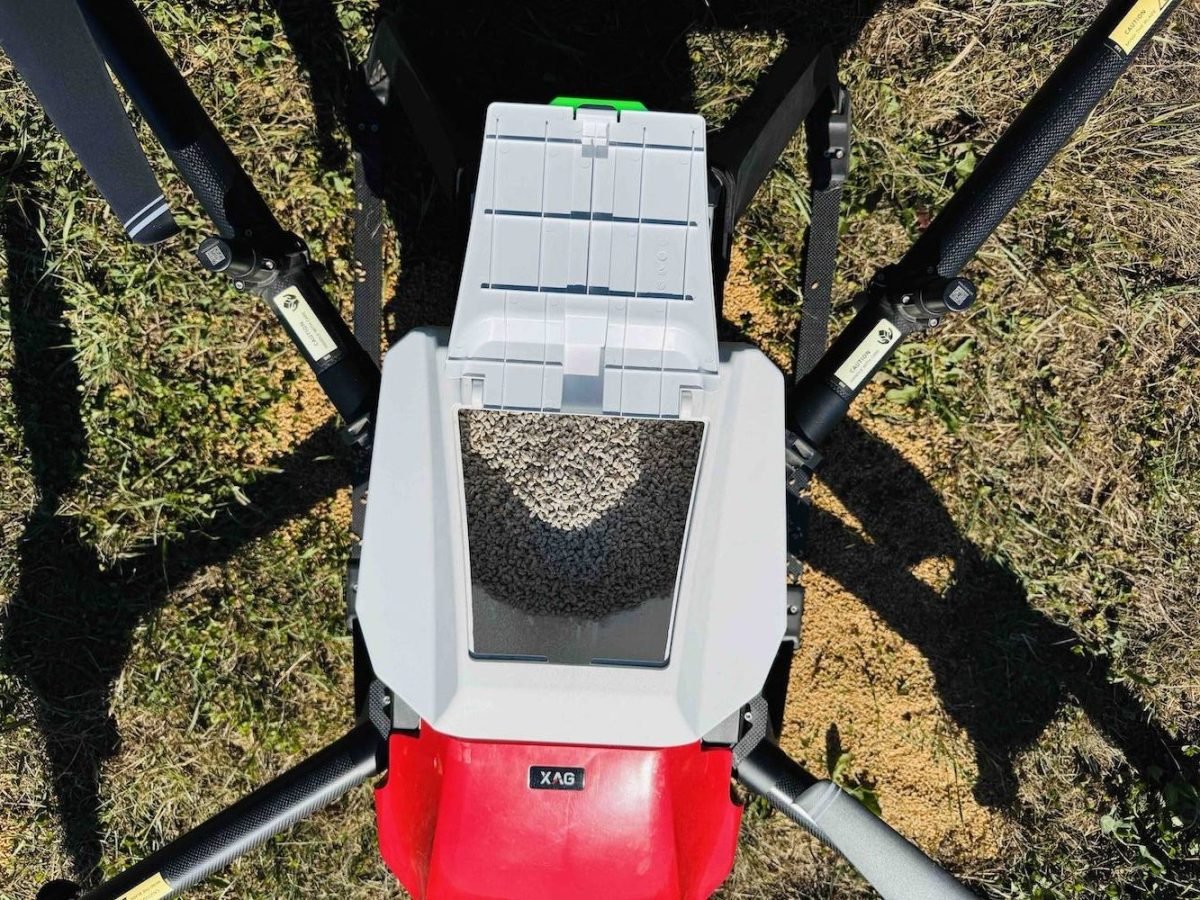
For seeding wheat and cover crops, he said drone use remains a small-scale, trial and error practice.
The bulk of drone interest for field crops right now is in spraying pesticides, he said.
DeSchiffart believes drone technology is getting better, but it’s not a finished product.
“I’ve been thankful to operate the drone the last few years. Getting familiar with the technology has been very helpful.”
“In high-tech language they talk about leading edge versus bleeding edge,” he said. “I would say the drone technology is moving more into the leading edge from bleeding edge. The support is getting much better and the different companies are starting to set up established dealership networks.”
To fly or not to fly?
DeSchiffart noted that drones may not be practical in all situations. “If you are going to buy a spray drone anyways I think this fits in really nice,” he said. “Also if the weather is not great during soybean harvest, you can still get that timely planting of winter wheat in.”
He also pointed to the potential of cover crop seeding.
He noted that changed regulations are making it easier to fly these larger types of drones.
“I would strongly encourage anyone looking to use these types of drones to go through the drone pilot certification process. You learn a lot about safety and it makes sure the industry can continue to grow and thrive,” he said.
The post Winter wheat-soybean crop mix tests drone seeding potential appeared first on Farmtario.


