Ranked: The World’s Biggest Economies by 2031
See visuals like this from many other data creators on our Voronoi app. Download it for free on iOS or Android and discover incredible data-driven charts from a variety of trusted sources.
Key Takeaways
- The U.S. and China are projected to remain the world’s two largest economies through 2031.
- India is forecast to climb to third place by 2031, passing Japan, the UK, and Germany.
- Russia is the only economy in the top 15 projected to shrink in nominal GDP by 2031.
The ranking of the world’s biggest economies is expected to shift by 2031, with India projected to make the biggest move near the top.
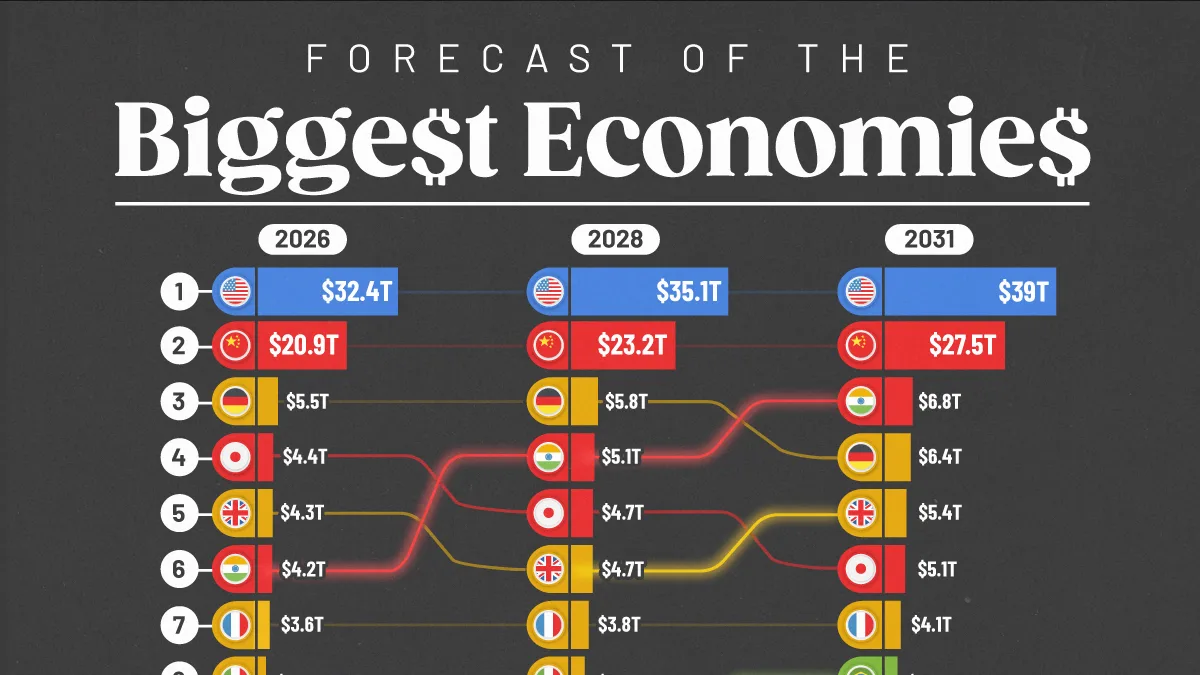
This graphic ranks the world’s 15 largest economies by nominal gross domestic product (GDP) in 2026, 2028, and 2031, using forecasts from the International Monetary Fund’s April 2026 World Economic Outlook update.
While the U.S. and China are expected to remain far ahead of the rest, emerging markets such as India, Brazil, and Mexico are forecast to climb in the global rankings.
The U.S. and China Stay Far Ahead
By 2031, the U.S. and China are projected to remain in a league of their own, with both economies far larger than any other country. The two giants are expected to add roughly $6.6 trillion each to their economies, reflecting about 20% growth for the U.S. and 32% growth for China.
China’s projected 2031 GDP of $27.5 trillion would still leave it nearly $11.5 trillion smaller than the U.S. economy, even as it remains roughly four times larger than the next biggest economy.
The data table below showcases forecasted nominal GDP for the world’s 15 largest economies in 2026, 2028, and 2031.
| Rank | Country | 2026F ($B) | 2028F ($B) | 2031F ($B) | Change |
|---|---|---|---|---|---|
| 1 |  U.S. U.S. |
32,384 | 35,066 | 39,031 | 20.5% |
| 2 |  China China |
20,852 | 23,260 | 27,497 | 31.9% |
| 3 |  Germany Germany |
5,453 | 5,819 | 6,352 | 16.5% |
| 4 |  Japan Japan |
4,379 | 4,744 | 5,128 | 17.1% |
| 5 |  UK UK |
4,265 | 4,675 | 5,403 | 26.7% |
| 6 |  India India |
4,153 | 5,059 | 6,792 | 63.5% |
| 7 |  France France |
3,596 | 3,776 | 4,117 | 14.5% |
| 8 |  Italy Italy |
2,738 | 2,887 | 3,128 | 14.2% |
| 9 |  Russia Russia |
2,656 | 2,552 | 2,615 | -1.6% |
| 10 |  Brazil Brazil |
2,636 | 2,879 | 3,379 | 28.2% |
| 11 |  Canada Canada |
2,507 | 2,759 | 3,139 | 25.2% |
| 12 |  Australia Australia |
2,124 | 2,293 | 2,590 | 22.0% |
| 13 |  Mexico Mexico |
2,121 | 2,327 | 2,667 | 25.8% |
| 14 |  Spain Spain |
2,091 | 2,285 | 2,572 | 23.0% |
| 15 |  South Korea South Korea |
1,931 | 2,094 | 2,357 | 22.1% |
Despite their strong growth, both the U.S. and China face significant economic challenges in the years ahead that could threaten future expansion.
The U.S. is battling heightened political polarization and a soaring national debt, with interest payments taking up a growing share of annual government spending. Meanwhile, China’s projected population decline leaves the export-driven economy vulnerable to slower long-term growth.
India Becomes the Third-Largest Economy
While the U.S. and China may maintain a comfortable lead over their peers, India is projected to become the next major economic powerhouse. The world’s most populous country is forecast to grow its GDP by 63.5% by 2031, making it the fastest-growing major economy in the world.
The IMF expects India to surpass Japan and the United Kingdom by 2028, when its economy tops $5 trillion for the first time, before overtaking Germany by 2031 as it reaches a projected GDP of $6.8 trillion.
India’s rise above several long-industrialized economies would place it at the forefront of a shifting global economic order. Its population of more than 1.4 billion people remains one of its greatest advantages as Indian companies expand their competitiveness on the world stage.
Russia’s Economic Flatline
Between 2016 and 2026, Russia’s economy more than doubled in size, marking one of the strongest growth periods among major economies over the decade. Yet the country is projected to become the only leading economy to shrink in nominal GDP by 2031.
Russia’s economy is forecast to contract between 2026 and 2031, allowing Brazil, Canada, and Mexico to move ahead in the rankings.
Part of the story stems from Russia’s continued reliance on hydrocarbon exports and weak productivity growth, alongside ongoing sanctions from Western powers such as the U.S. and European Union. However, Russia’s biggest long-term economic challenge may be its chronic population decline, which has worsened since the war in Ukraine.
Learn More on the Voronoi App 
Who’s been doing the best as of late? Find out with How Top Economies Performed in the Last 10 Years, After Adjusting For Inflation on Voronoi.Use This Visualization