Every year, Americans bury an estimated two million tons or more of used clay cat litter — clay that was strip-mined from the ground, trucked across the country, scooped once, used by a cat, and thrown away. It does not biodegrade, so it sits in the landfill essentially forever. And that is just the cat.
Pets belong to the household waste stream, even though we rarely add them to the tally. About 94 million U.S. households keep a pet, and the roughly 68 million dogs and 49 million cats among them, according to the American Pet Products Association’s 2025 survey, generate three large and mostly invisible waste streams: cat litter, dog waste and the bags that carry it, and the packaging that food and treats arrive in. Each one carries a cost at the kitchen counter and a much larger one at the national scale.
The Clay Nobody Thinks About
Conventional clumping litter is sodium bentonite, a clay valued for the way it seals around moisture. Getting it out of the ground means strip mining, and industry estimates put U.S. clay mined for litter at roughly five billion pounds a year. A single cat works through about 28 pounds of clay litter a month — close to 336 pounds a year — and none of it breaks down once discarded.
The household cost is real too. Litter runs roughly $180 to $480 a year for one cat, and multi-cat homes multiply that spending into the thousands of dollars annually. Spread across roughly 49 million cats, litter alone is a multi-billion-dollar annual purchase, a recurring spend on a product whose useful life is measured in days and whose afterlife is measured in centuries.
Plant-based alternatives, such as corn, wheat, walnut sshells, recycled paper, or and even tofu, cut the mining and landfill burden, though they vary in price, dustiness, and clumping performance. The table below compares the common options on the dimensions that matter for waste.
| Litter type | Made from | End of life | Waste trade-off |
|---|---|---|---|
| Clay (clumping) | Strip-mined sodium bentonite | Landfill; does not biodegrade | Highest mining and landfill footprint |
| Silica crystal | Mined silica gel | Landfill; inert | Lighter per use, but still mined and landfilled |
| Plant-based (corn, wheat, wood, paper, tofu) | Renewable crops or recycled fiber | Compostable in principle — but not with cat feces | Lowest extraction footprint; disposal still constrained by Toxoplasma risk |
One caution applies across every type: cat feces can carry Toxoplasma gondii, so even a compostable litter should never be flushed or composted for a food garden.
A Million Bags a Day
America’s dogs produce an estimated 10.6 million tons of waste a year. The U.S. Environmental Protection Agency estimates that each dog generates about three-quarters of a pound a day and classifies pet waste as a nonpoint source of pollution. Left on the ground, it washes into storm drains, carrying pathogens and the nutrients that fuel algae blooms downstream
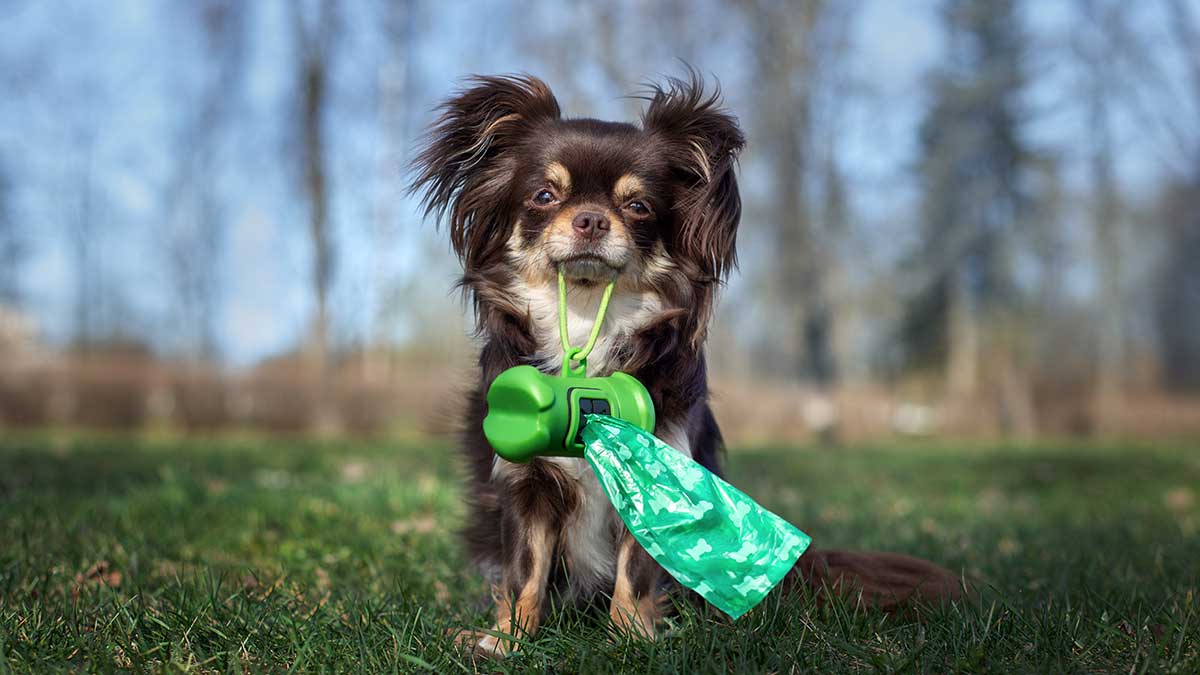
Then there is the bag. A study in the journal Environmental Pollution estimated that dog waste bags amount to roughly 415 billion worldwide each year, the equivalent of 0.76 to 1.23 million tons of plastic waste. Standard plastic bags can persist in a landfill for centuries, so the daily ritual of picking up after a dog quietly builds an enormous, near-permanent plastic stockpile that goes to landfills.
“Compostable” and “biodegradable” labels muddy the picture. Most municipal composting programs will not accept dog waste, so certified-compostable bags usually end up in the same trash stream as plastic bags, where landfill conditions do not break them down. In short, the label promises an outcome that the disposal system rarely delivers.
The disposal options that reduce harm are narrower than the marketing suggests. Flushing pet-safe waste, where local rules and septic systems allow it, routes the material to wastewater treatment rather than the landfill. In-ground pet-waste digesters can break down waste on-site for homeowners with yard space. Bagging and trashing remains the default for apartment dwellers, in which case a thin conventional bag and a premium compostable bag are typically sent to the same landfill.
The Pouch That Can’t Be Recycled
Food and treats arrive in some of the hardest-to-recycle packaging in the grocery aisle. The Pet Sustainability Coalition estimates that about 300 million pounds of pet food and treat packaging waste are generated by homes in the U.S. each year; more than 99% of it is landfilled.
The culprit is multilayer flexible packaging — pouches, treat bags, and kibble bags that fuse plastic, foil, and film into a single barrier that curbside systems cannot separate. Only about 2% of U.S. households have curbside access for film and flexible packaging, according to the Recycling Partnership, and material tossed in the wrong bin tangles sorting equipment at recovery facilities.
The picture is shifting. As of October 1, 2025, seven states had enacted comprehensive packaging extended producer responsibility laws — California, Colorado, Maine, Maryland, Minnesota, Oregon, and Washington — that move recycling costs onto producers. These regulations are already nudging brands toward easier-to-recycle mono-material bags. Store drop-off film programs and mail-in services for pouches and treat bags can fill some of the gap, but have not gained sufficient traction to make a substantial difference.
What You Can Do
Litter:
- Switch to a plant-based litter, such as corn, wheat, walnut, or recycled paper, where it works for your cat, to cut both mining and landfill volume.
- Buy larger packages to reduce packaging per pound, and scoop daily rather than dumping the whole box to stretch each batch. Never flush cat waste or compost it for edibles because of the Toxoplasma risk.
Dog waste:
- Treat “compostable” bag claims with skepticism unless you have a pet-waste digester or a municipal program that actually accepts dog waste; otherwise, the bag and the waste both go to landfill.
- Always pick up. Pet waste is a documented water pollutant, not fertilizer.
Packaging:
- Check store drop-off bins for clean film, and use mail-in programs for pouches and treat bags. Look up local options with Earth911’s recycling search.
- Favor brands moving to mono-material recyclable bags, and support packaging EPR laws that are already reshaping what shows up on the shelf.
The post What Pet Waste Costs: The Litter, Bags, and Packaging Filling America’s Landfills appeared first on Earth911.