
Ontario’s corn and soybean crops will be planted seven to 10 days later than normal. Warm weather is needed to enhance emergence and crop development.
Farmers in the United States are in the final stages of seeding and conditions for corn and soybeans are favourable. U.S. biofuel policy distorts the North American and world soybean markets. The world wheat market remains volatile as traders assess production in the Northern Hemisphere.
Quick look:
- Soybeans: Ontario soybean production expected to be higher in 2026 than 2025.
- Corn: Ontario corn is now competitive into European markets.
- Wheat: Stocks to hit historic lows in Ontario in the 2026 crop year.
Soybeans
Demand for Ontario soybeans is coming in larger than expected despite the year-over-year decrease in 2025 production. Ontario soybean stocks will drop to bin-bottom levels at the end of the 2025-26 crop year. Our Ontario soybean production forecast for 2026 remains at 4.1 million tonnes, up from the 2025 crop of 3.6 million tonnes.
U.S. farmers are expected to harvest 120.7 million tonnes of soybeans this fall according to the U.S. Department of Agriculture, up from the 2025 crop of 116 million tonnes. Despite the year-over-year increase in production, the fundamentals are expected to tighten during the 2026-27 crop year due to the year-over-year increase in domestic and export demand. The lower carryout projection will make the market extremely vulnerable to weather and crop development.
The U.S. Department of Agriculture’s May supply/demand estimates had the Argentine crop at 48 million tonnes, down from 51 million tonnes last year. Brazil’s output was estimated at 180 million tonnes, which was a year-over-year increase of eight million tonnes.
At the time of writing this article, Brazilian soybeans were offered at US$449/tonne f.o.b. Paranagua while U.S. soybeans were quoted at US$482/tonne f.o.b. the Gulf.
Brazilian prices are at a discount to U.S. origin. This price relationship will remain throughout the 2026-27 crop year due to U.S. biofuel policy. U.S. soyoil used for biofuels for the 2026-27 crop year is estimated at eight million tonnes, up from the 2025-26 usage of 6.5 million tonnes. U.S. biofuel policy artificially lifts the U.S. soybean market above normal market values.
Usually, U.S. soybean prices are at a discount to Brazil in the fall period at harvest. U.S. soybeans will not likely be discounted to Brazilian origin as long as oil prices remain elevated. China has committed to buy 25 million tonnes of soybeans annually from the U.S. as per the October 2025 agreement between President Trump and President Xi. If China fulfills this agreement, their purchases will be above Brazilian and normal world values.
This also distorts the soybean market in Ontario. During the harvest period, U.S. soybean prices will be artificially high while Ontario export offers will be in line with Brazilian origin. There are consequences in the latter part of the crop year as well when Ontario tends to import more U.S. soybeans. Longer-term, there will be more canola crushed in Ontario instead of soybeans.
We’ve advised farmers to be 100 per cent sold on their 2025 production and 10 to 15 per cent sold on their expected 2026 output.
Corn
Ontario corn prices in mid-May were hovering at 52-week highs. Domestic and export demand is moving through a seasonal high, resulting in higher prices. Cattle-on-feed inventories tend to peak in the late spring period and a larger percentage of cattle are on full feed rations, which use more corn. At the time of writing this article, Ontario corn was quoted at US$235/tonne f.o.b. St. Lawrence port, while French corn was quoted at US$245/tonne f.o.b. La Pallice. Ontario corn is now competitive into northern European markets.
World values are also percolating higher. In mid-May, Brazilian corn was quoted at US$233/tonne f.o.b. Paranagua, while U.S. corn was quoted at US$223/tonne f.o.b. the Gulf.
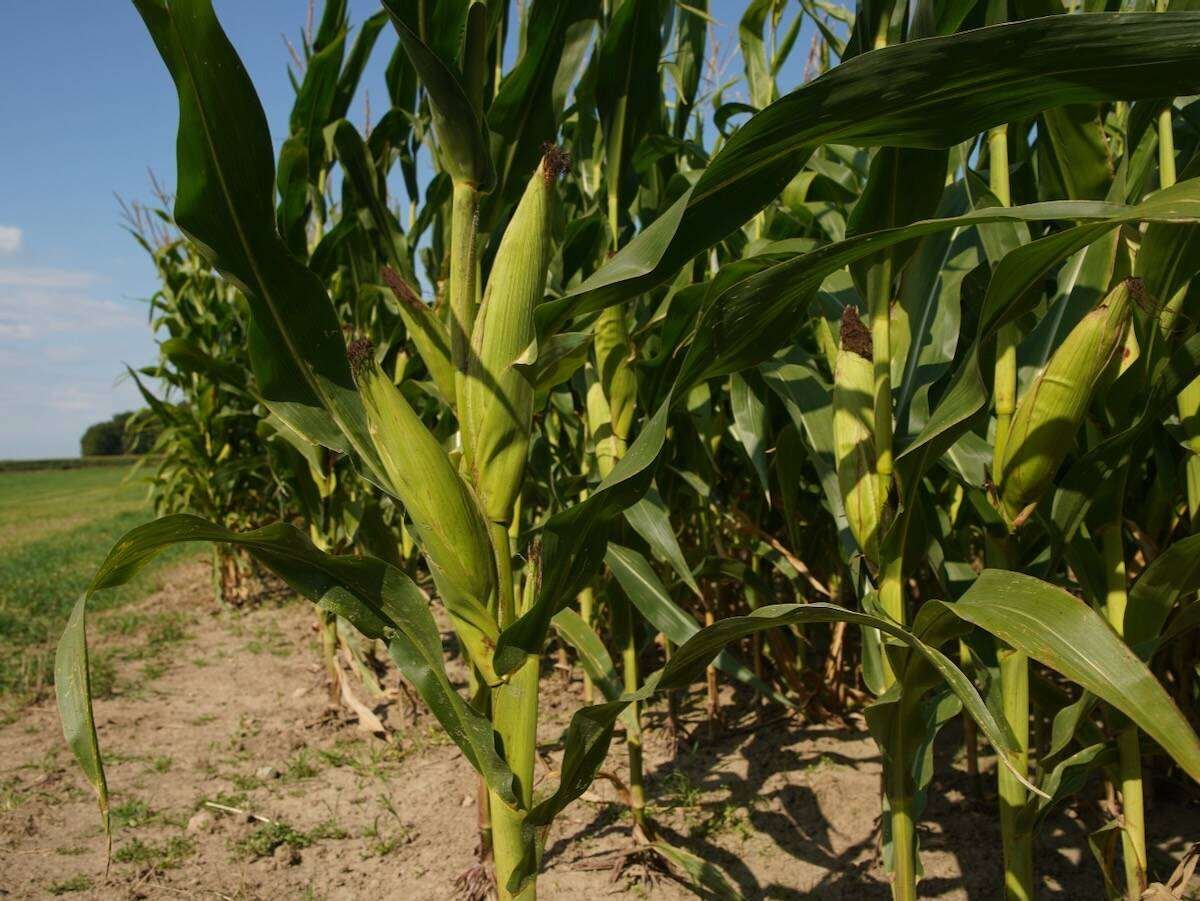
Export and domestic demand is seen to be increasing for Ontario corn, so Jerry Klassen is advising growers to be patient on additional sales of their 2025 crops. Photo: File
Apparently, in China, Dalian corn is trading at US$120/tonne premium to U.S. corn f.o.b. the Gulf. On May 18, the White House released a press release stating that China has pledged to buy US$17 billion of U.S. agriculture products. This is in addition to the October 2025 soybean agreement. China is in a situation where they cannot afford a crop problem. The Chinese carryout has been decreasing over the past couple of years. We’re looking for China to step up both U.S. and Brazilian corn purchases over the next of months.
U.S. farmers are expected to harvest 406 million tonnes of corn this fall, according to the USDA. This is down from the 2025 crop of 432 million tonnes. We’re looking for the USDA to trim their corn seeded acreage on their June acreage survey. The market will be very volatile during the pollination period due to the year-over-year decrease in seeded area.
In conclusion, export and domestic demand is increasing for Ontario corn. On the world market, we’re expecting prices to percolate higher due to stronger Chinese demand. Both China and the U.S. are in situations where they cannot afford a crop problem.
We’ve advised Ontario farmers to be 90 per cent sold on their 2025 production. Be patient on additional sales.
Wheat
Ontario elevator bids for soft red winter wheat reached $8.03/bu. This is the highest level since April 18, 2024. Ontario wheat stocks will dip to historical lows at the end of the 2025-26 crop year. For 2026, we’re expecting a crop size of 2.7 million tonnes, down 200,000 tonnes from last year.
Lower U.S. production estimates have been the main factor driving the wheat market. On the May USDA report, U.S. hard red winter wheat production was estimated at 14 million tonnes, down from the 2025 output of 21.9 million tonnes. U.S. soft red winter was estimated at 8.4 million tonnes, which was a year-over-year decrease of 1.2 million tonnes. A large portion of the U.S. hard red winter crop is used for domestic food usage. Therefore, the domestic market rations demand away from export channels in the first half of the crop year. U.S. offers f.o.b. the Gulf are at a sharp premium to other major exporters.
For hard red spring wheat, the fundamentals will be rather snug for the 2026-27 campaign. We’re estimating U.S. hard red spring wheat production at 12.6 million tonnes, down from 12.4 million tonnes last year. In Canada, total spring wheat (excluding durum) is estimated at 26 million tonnes, down 3.6 million tonnes from last year.
The USDA is projecting total Russian wheat output to reach 86 million tonnes, down from the 2025 crop of 90.3 million tonnes. The Russian crop was in good shape throughout the winter. However, conditions turned dry in March for a large portion of the winter wheat region. Conditions have stayed rather dry through April and May. We’re expecting downward revisions to the Russian wheat crop and this will be a surprise to the trade.
We’ve advised farmers to be 100 per cent sold on their 2025 production. We expect the wheat market to be quite volatile over the next few months as traders assess the Russian conditions. This wheat market has the potential to rally an additional $1 to $2/bu. if the current weather forecasts for Russia materialize.
The post Wheat market fundamentals force prices higher appeared first on Farmtario.


