Ranked: The Hardest Languages for English Speakers to Learn
This was originally posted on our Voronoi app. Download the app for free on iOS or Android and discover incredible data-driven charts from a variety of trusted sources.
Key Takeaways:
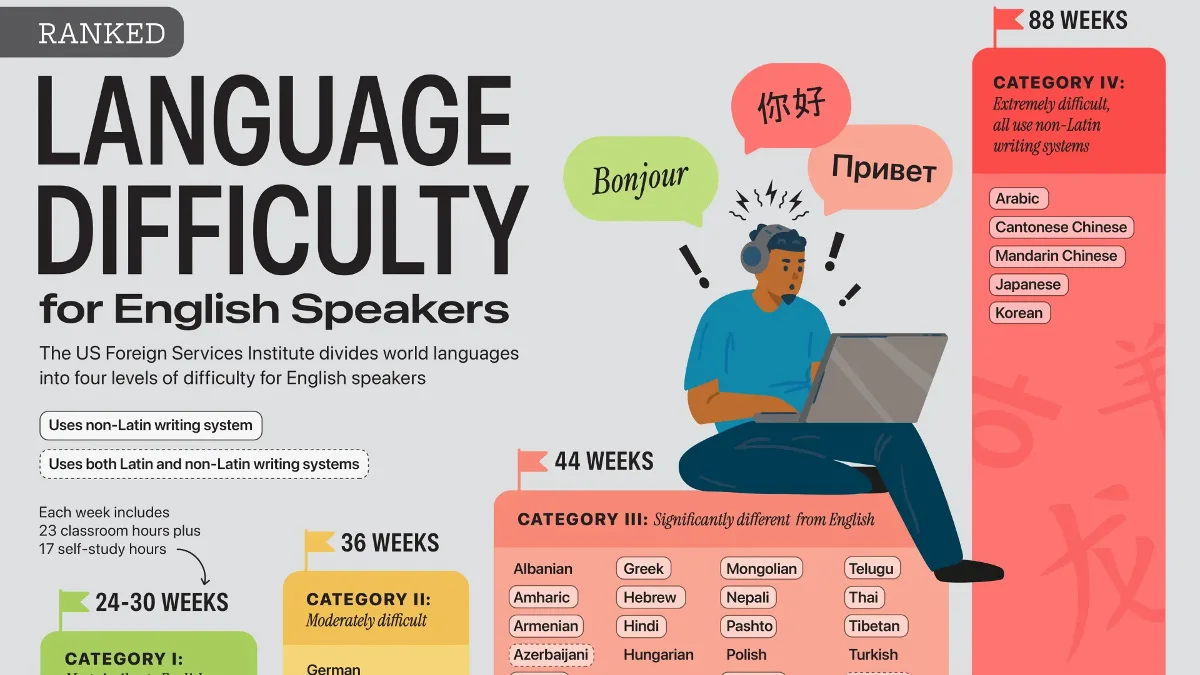
- Languages like Spanish, French, Italian, and Dutch typically require 24–30 weeks of study for English speakers to reach professional working proficiency.
- Languages such as Russian, Hindi, Turkish, and Vietnamese take about 44 weeks, nearly twice as long as the easiest group.
- Arabic, Mandarin, Japanese, and Korean require about 88 weeks of study, making them the most difficult languages for English speakers to learn.
For English speakers, learning Spanish or Italian can take less than a year. Reaching the same level of proficiency in Japanese, Korean, Mandarin, or Arabic may require nearly four times as much study.
This wide gap reflects how closely a language resembles English in its vocabulary, grammar, sounds, and writing system.
This visualization, created by Julie R. Peasley, ranks languages by difficulty using categories and study-time estimates from Effective Language Learning and Rosetta Stone, which reference Foreign Service Institute-style benchmarks.
Which Languages Are Easiest to Learn for English Speakers?
Languages are generally easier to learn when they share familiar grammar, vocabulary, sounds, or writing systems. That’s why many Category I languages, including Spanish, French, Italian, Dutch, and Swedish, are considered relatively approachable.
The data table below shows the difficulty rankings and estimated learning time for 70 different languages:
| Language | Category | Time to learn |
|---|---|---|
  Afrikaans Afrikaans |
I | 24-30 weeks |
 Danish Danish |
I | 24-30 weeks |
  Dutch Dutch |
I | 24-30 weeks |
   French French |
I | 24-30 weeks |
 Italian Italian |
I | 24-30 weeks |
 Norwegian Norwegian |
I | 24-30 weeks |
  Portuguese Portuguese |
I | 24-30 weeks |
  Romanian Romanian |
I | 24-30 weeks |
   Spanish Spanish |
I | 24-30 weeks |
 Swedish Swedish |
I | 24-30 weeks |
  German German |
II | 36 weeks |
 Haitian Creole Haitian Creole |
II | 36 weeks |
 Indonesian Indonesian |
II | 36 weeks |
  Malay Malay |
II | 36 weeks |
  Swahili Swahili |
II | 36 weeks |
  Albanian Albanian |
III | 44 weeks |
 Amharic Amharic |
III | 44 weeks |
 Armenian Armenian |
III | 44 weeks |
 Azerbaijani Azerbaijani |
III | 44 weeks |
  Bengali Bengali |
III | 44 weeks |
 Bulgarian Bulgarian |
III | 44 weeks |
 Burmese Burmese |
III | 44 weeks |
 Czech Czech |
III | 44 weeks |
 Dari Dari |
III | 44 weeks |
 Estonian Estonian |
III | 44 weeks |
 Farsi Farsi |
III | 44 weeks |
 Finnish Finnish |
III | 44 weeks |
 Georgian Georgian |
III | 44 weeks |
  Greek Greek |
III | 44 weeks |
 Hebrew Hebrew |
III | 44 weeks |
| Hindi |
III | 44 weeks |
 Hungarian Hungarian |
III | 44 weeks |
 Icelandic Icelandic |
III | 44 weeks |
 Kazakh Kazakh |
III | 44 weeks |
 Khmer Khmer |
III | 44 weeks |
| Kurdish | III | 44 weeks |
 Kyrgyz Kyrgyz |
III | 44 weeks |
 Lao Lao |
III | 44 weeks |
 Latvian Latvian |
III | 44 weeks |
 Lithuanian Lithuanian |
III | 44 weeks |
 Macedonian Macedonian |
III | 44 weeks |
 Mongolian Mongolian |
III | 44 weeks |
 Nepali Nepali |
III | 44 weeks |
 Pashto Pashto |
III | 44 weeks |
 Polish Polish |
III | 44 weeks |
 Russian Russian |
III | 44 weeks |
    Serbo-Croatian Serbo-Croatian |
III | 44 weeks |
 Sinhala Sinhala |
III | 44 weeks |
 Slovak Slovak |
III | 44 weeks |
 Slovenian Slovenian |
III | 44 weeks |
 Somali Somali |
III | 44 weeks |
| Telugu |
III | 44 weeks |
| Tibetan | III | 44 weeks |
 Tamil Tamil |
III | 44 weeks |
 Tajiki Tajiki |
III | 44 weeks |
 Tagalog Tagalog |
III | 44 weeks |
 Thai Thai |
III | 44 weeks |
 Turkish Turkish |
III | 44 weeks |
 Turkmen Turkmen |
III | 44 weeks |
 Ukrainian Ukrainian |
III | 44 weeks |
| Urdu |
III | 44 weeks |
 Uzbek Uzbek |
III | 44 weeks |
 Vietnamese Vietnamese |
III | 44 weeks |
| Xhosa |
III | 44 weeks |
| Zulu |
III | 44 weeks |
   Arabic Arabic |
IV | 88 weeks |
  Cantonese Chinese Cantonese Chinese |
IV | 88 weeks |
  Mandarin Chinese Mandarin Chinese |
IV | 88 weeks |
 Japanese Japanese |
IV | 88 weeks |
  Korean Korean |
IV | 88 weeks |
One of the most striking findings is the size of the gap between the easiest and hardest languages. While Spanish or French can often be learned in 24–30 weeks, mastering Japanese, Korean, Mandarin, or Arabic may require roughly 88 weeks of study.
Many Category I languages use the Latin alphabet and share vocabulary roots with English through Germanic or Romance-language connections.
This may also help explain why European languages often rank highly in language-learning apps and why Duolingo’s most popular languages globally include several widely taught European options.
What Makes a Language Harder to Learn?
Category III languages tend to have greater linguistic distance from English. This can include unfamiliar grammar structures, new alphabets, or pronunciation patterns that require more time to master.
For example, languages like Russian, Greek, Hindi, Turkish, and Vietnamese all fall into this category. Some use different scripts, while others introduce grammatical systems that are less intuitive for native English speakers.
The “Super-Hard” Languages
Category IV languages are considered exceptionally difficult for English speakers. This group includes Arabic, Cantonese, Mandarin, Japanese, and Korean.
Many of these languages present multiple learning hurdles simultaneously. Mandarin and Cantonese require mastery of tones, Japanese combines several writing systems, Korean introduces a unique alphabet and grammar structure, and Arabic uses an entirely different script. Together, these differences significantly increase the time needed to reach professional proficiency.
Learn More on the Voronoi App 
To learn more about language use across the U.S., check out Mapped: America’s Most-Spoken Languages After English and Spanish on the Voronoi app.
- Source: https://www.visualcapitalist.com/cp/ranked-the-hardest-languages-for-english-speakers-to-learn/