
In the sprawling, dusty corridors of Kibera, one of Africa’s largest urban informal settlements, the air is thick with the scent of resilience. But for generations, there has been another, more troubling smell lingering beneath the surface—the stench of untreated human waste seeping into the soil and water table.
For most of the world, human excreta is the ultimate taboo. It is the endpoint of consumption, a biohazard to be flushed away and forgotten. But for Dr. Ruthie Rosenberg, a Cornell University researcher, and her team of African soil scientists and sanitarians, that “waste” is a manufacturing error. In their eyes, a single flush is a tragedy of misplaced resources.
Today, a quiet revolution is taking root in the fertile highlands of Kenya. It is a movement that transforms the disgusting into the beautiful, the hazardous into the harvestable. They call it KIYA Gold, and it is proving that one person’s waste is literally another person’s gold.
The Hidden Crisis in the Soil
To understand the value of KIYA Gold, you must first understand the dual crisis facing Kenya.
First, there is the sanitation crisis. In informal settlements like Mathare and Mukuru, pit latrines are overflowing. Traditional sewage infrastructure is non-existent. Waste is often dumped illegally into rivers or left in “flying toilets” (plastic bags tossed into the streets). This leads to rampant groundwater contamination, outbreaks of typhoid and cholera, and the degradation of the natural environment. What we flush away in the West stays out of sight; here, it stagnates in the community.
Second, there is the agricultural crisis. Kenyan smallholder farmers are struggling. The global price of synthetic fertilizer has skyrocketed due to supply chain disruptions and the war in Ukraine. To afford a single bag of NPK (Nitrogen, Phosphorus, Potassium), a farmer often has to sell a significant portion of their expected harvest before it even grows. Consequently, farmers are depleting their soil, leading to lower yields, food insecurity, and a vicious cycle of poverty.
Dr. Rosenberg looked at these two crises—too much waste in the cities, not enough nutrients in the soil—and saw a closed loop.
The Alchemy of Sanitization
The journey from “yuck” to “yield” is not as simple as digging up a latrine and dumping it on a field. That would be dangerous. The magic of KIYA Gold lies in the science of thermophilic treatment.
“The visceral reaction to human waste is valid,” says Dr. Rosenberg during a field visit to the treatment site. “Pathogens are real. But nature already has the recipe to kill them. We just have to industrialize that recipe.”
Here is how the green tech works:
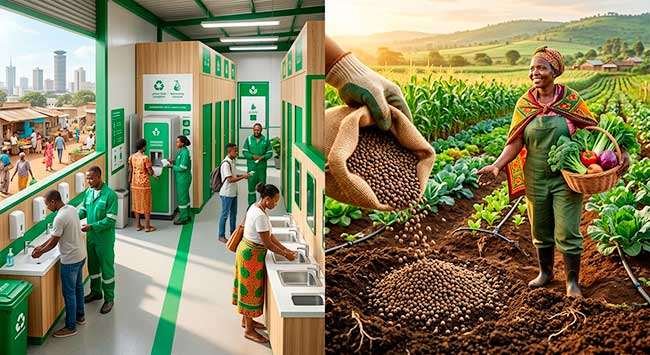
- Collection: Teams in protective gear collect fresh human excreta from “container-based sanitation” (CBS) units—sealed, removable cartridges installed in homes that lack sewer connections. This prevents the waste from ever touching the environment.
- The Thermal Kill Step: The waste is transported to a centralized facility. Here, it is mixed with agricultural byproducts (like maize stalks or sawdust) to adjust the carbon-nitrogen ratio. Then, it is subjected to high-temperature composting. Using solar-thermal heat or passively aerated windrows, the material is held at a precise temperature (over 55°C or 131°F) for several weeks.
- Destruction: At these temperatures, every pathogen is destroyed. E. coli, Salmonella, and parasitic helminths (worms) are cooked into oblivion. What remains are the mineralized nutrients and stable organic carbon.
- Refinement: The resulting material is dried, screened for physical impurities (like sand or small plastics), and bagged.
The result is a dark, earthy, odorless pelletized fertilizer. It smells like forest soil, not a sewer. Microbiologically, it is safer than raw manure from your local cattle farm.
The Rebrand: Why “KIYA Gold”?
Marketing a product made from human excreta is the ultimate challenge in behavioral change. No farmer wants to ask for “poo-pellets.” Dr. Rosenberg knew the science was sound, but the branding had to be flawless.
Enter the name: KIYA Gold.
“Ki” derives from Kiswahili (the root for “thing” or “nature”) and “YA” stands for “Yet Another” or “Your Asset.” More importantly, “Gold” speaks to its value. The team meticulously avoided clinical terms like “biosolids” or “sludge.” They focused entirely on the outcome: gold-like yield, gold-like quality, gold-like value.
The packaging is bright, clean, and features images of robust maize cobs and lush kale. There is no silhouette of a pit latrine on the bag. Instead, there is a certification stamp from local public health officials. The tagline reads: “For your soil. For your future.”
The Environmental Ledger
As a green technology writer, I look for the lifecycle assessment. Does the cure cause more harm than the disease? In the case of KIYA Gold, the carbon and water savings are staggering.
- Water Savings: Traditional sanitation flushes 3-5 gallons of potable water down the toilet per use. KIYA Gold uses dry sanitation. By recycling waste as solids, the project saves millions of liters of fresh water annually from becoming polluted sewage.
- Carbon Reduction: Synthetic nitrogen fertilizer (Haber-Bosch process) is incredibly energy-intensive. It accounts for roughly 2% of global energy use and significant CO2 emissions. KIYA Gold recycles nitrogen that already exists. It prevents methane (a potent greenhouse gas) from escaping open latrines and sequesters carbon back into the agricultural soil.
- Health Offset: By removing fecal matter from the environment, the project reduces diarrheal disease incidence in children under five by an estimated 35% in pilot zones. That is the most important “green” metric of all.
The Farmer’s Verdict
I spoke with Grace Mwangi, a vegetable farmer on the outskirts of Nakuru. She used to use chemical fertilizers until they burned her pockets and, after years of use, hardened her soil.
“I was skeptical,” Grace admits, holding a bag of KIYA Gold. “My neighbor said, ‘You are going to grow tomatoes in that?’ I laughed. But the price was half what I pay for the white pellets from China.”
She applied it to her sukuma wiki (collard greens) and tomatoes.
“The growth came faster. The leaves were thicker, darker,” she says, pointing to a row of vibrant green plants. “The soil became soft again—like a sponge. When I harvested, my yield went up by 30%. My customers don’t know where the fertilizer came from. They only know that the vegetable tastes better. And it does. Because the soil is alive again.”
The Bottom Line
KIYA Gold is currently retailing at roughly 60% the cost of imported synthetic fertilizer. For a smallholder farmer living on $2 a day, that is the difference between eating and starving.
From a market perspective, Dr. Rosenberg is not just running an NGO project; she is building a circular economy. The processing facility pays local youth to collect the waste (dignified work, Green Jobs). It sells the product to farmers. The farmers produce more food. The food feeds the city. The city produces more waste. The loop closes.
The “Beautiful” Truth
We have spent 200 years building a linear economy: Take, Make, Use, Dispose. Now, in the face of climate change and fertilizer shortages, we must build a circular one.
What Dr. Rosenberg and her colleagues in Kenya have done is not just technological innovation; it is psychological alchemy. They have taken our deepest cultural “ick” and reframed it as a symbol of regeneration.
They have proven that the line between disgusting and beautiful is not a hard line—it is just a thermal composting cycle.
The future of green tech isn’t just wind turbines and solar panels. It is also humble, dark, odorless bags of gold sitting in a farmer’s shed, waiting to feed a nation. In Kenya, the revolution smells like earth after rain. And it is beautiful.
The post From Pit Latrine to Profit: How “KIYA Gold” is Turning Kenya’s Sanitation Crisis into Agricultural Gold first appeared on Green Tech Gazette.


