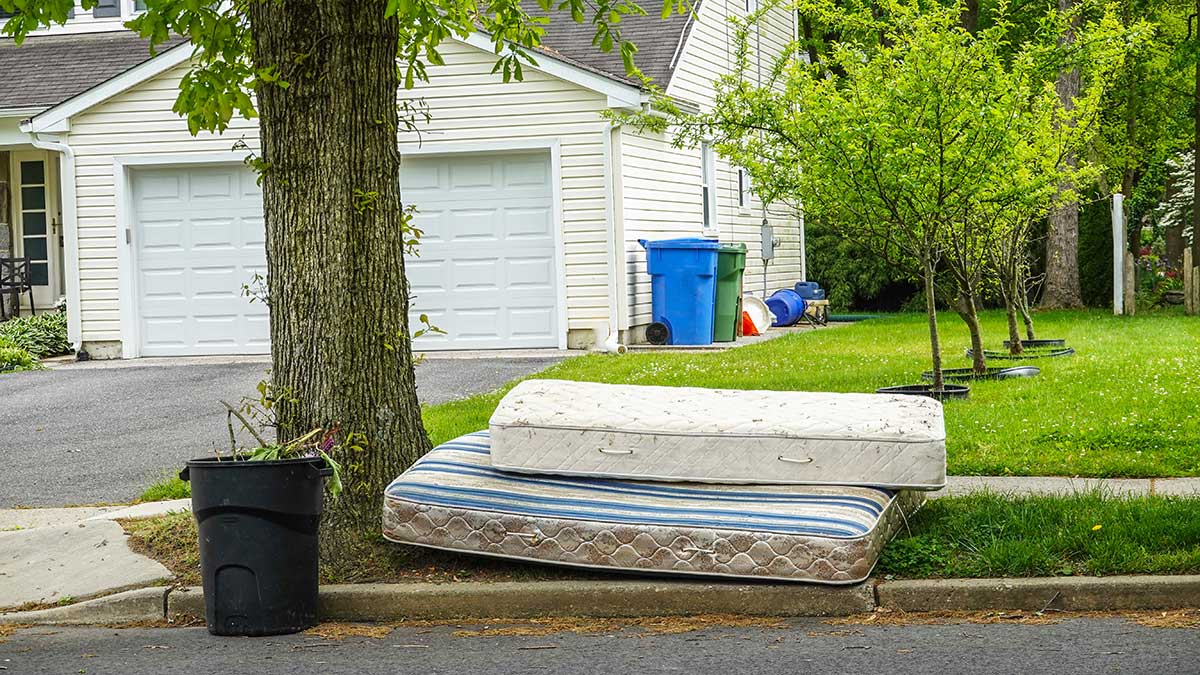
Pull the sheets back from the numbers and the American mattress starts to look less like a product and more like a disposal problem. The United States throws out an estimated 18.2 million mattresses a year — roughly 50,000 every day — and only about 19% of them are recycled. The rest, more than four out of five beds, are landfilled or incinerated.
A mattress is one of the largest, bulkiest, and most expensive things you own, and almost none of it has to be wasted. Recyclers can recover 80 to 95% of a mattress — steel, foam, fiber, and wood that become new products. Yet the default path for most beds is a hole in the ground, and that default costs the typical household twice: once to buy the bed, and again to get rid of it. Most mattresses are built to last seven to ten years, so a single household will buy and discard several over a lifetime. The bed itself is the obvious expense: a new queen mattress averages around $1,500, and even budget models start near $400.
The hidden cost shows up at the curb. Getting rid of an old mattress averages about $100 and runs from $40 to $200 or more depending on how you do it. Junk-hauling services typically charge $80 to $250. Municipal bulk pickup is often free but can mean a two- to eight-week wait, and many landfills tack on a $20 to $40 bulky-item fee. For a household replacing a bed every several years, disposal alone quietly adds up.
Why the landfill is the worst place for it
Mattresses are built to resist compression, which makes them miserable landfill tenants. Each one can take up as much as 23 cubic feet of space even after compacting, and their steel springs tangle and damage the heavy equipment that operators use to manage the waste. Multiply that by tens of thousands a day and mattresses become a stubborn drain on landfill capacity.
The waste is also material that holds real value. A typical mattress contains roughly 25 pounds of steel and 9 pounds of cotton, plus foam and wood. Across its programs, the Mattress Recycling Council reports keeping more than 555 million pounds of steel, foam, fiber, and wood out of landfills by recycling over 14 million mattresses. Buried beds throw all of that away.
A recycling system exists, but it’s uneven
Where you live largely decides whether recycling is even an option. Four states — California, Connecticut, Rhode Island, and Oregon, whose program began January 1, 2025 — run extended producer responsibility (EPR) programs. A small fee on every new mattress funds free drop-off through the industry’s Bye Bye Mattress program. The access is meaningful: in 2024, 98.4% of California residents lived within 15 miles of a collection site.
Once a mattress is dismantled, up to 75% of its materials become new products. The foam and fiber go into carpet padding, springs are melted down as scrap steel, and box-spring wood is chipped into mulch or biomass fuel. Outside the four EPR states, though, recycling depends on a patchwork of private facilities, and most households still pay to haul a bed away.
What you can do
- Recycle it where you can. In California, Connecticut, Rhode Island, and Oregon, drop-off is free through byebyemattress.com. Everywhere else, search by ZIP Code on Earth911’s recycling locator to find the nearest facility, if one is available.
- Donate a bed that still has life. Charities, shelters, and reuse organizations accept clean, structurally sound mattresses. Reuse beats recycling because it skips the dismantling step entirely.
- Extend the lifespan you already paid for. A protector, a supportive foundation, and regular rotation can push a quality mattress toward the long end of its seven-to-ten-year range, cutting both cost and waste.
- Ask the retailer about takeback before you buy. Many sellers will haul away your old mattress on delivery, sometimes routing it to a recycler. Confirm where it actually goes.
- Back producer-responsibility laws. EPR programs are the single biggest reason recycling is free and accessible in some states and not others. Their expansion is what moves the national recycling rate above 19%.
The post 18.2 Million Mattresses Disposed a Year, and Most of Them Get Buried appeared first on Earth911.