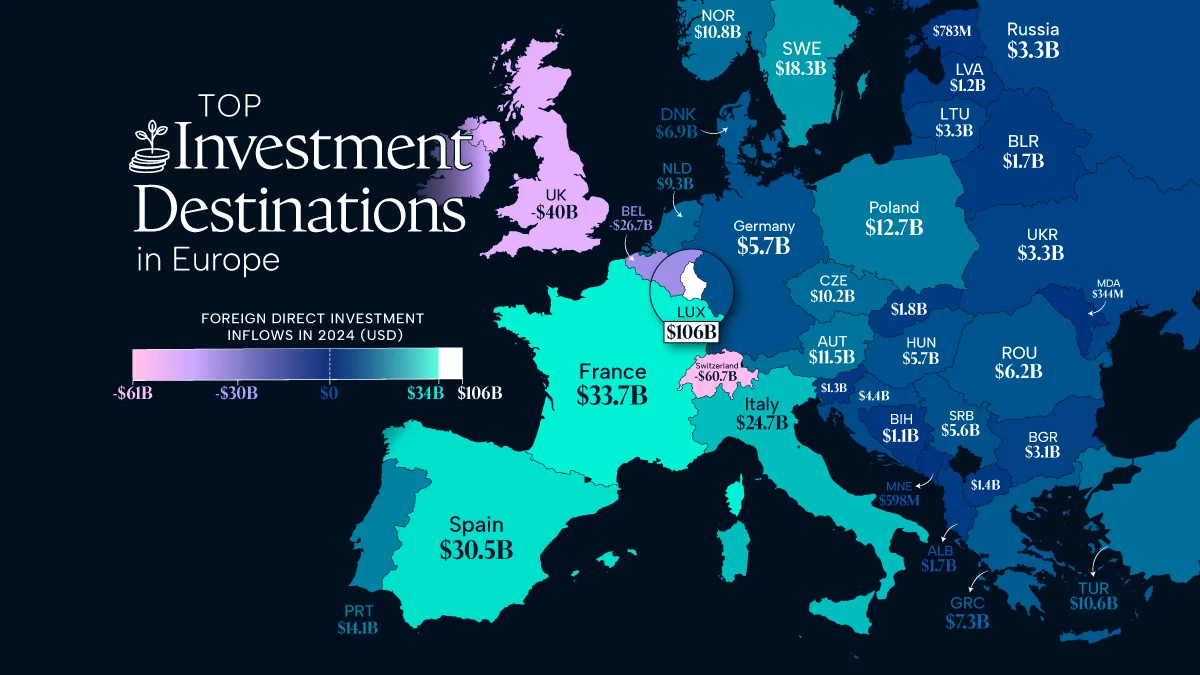
Mapped: Where Foreign Investment Is Flowing in Europe
See visuals like this from many other data creators on our Voronoi app. Download it for free on iOS or Android and discover incredible data-driven charts from a variety of trusted sources.
Key Takeaways
- Luxembourg attracted $106 billion in foreign investment in 2024, more than France, Spain, and Italy combined.
- France ($33.7B) and Spain ($30.5B) were Europe’s largest major-economy destinations for foreign capital.
- The UK recorded -$40 billion in FDI inflows in 2024, one of only four European countries with negative FDI inflows.
A country of just 700,000 people attracted more foreign investment than any other nation in Europe in 2024.
This map shows FDI inflows across Europe using data from the 2025 World Investment Report published by UN Trade and Development.
These FDI inflows measure foreign companies’ direct investment positions in local businesses and subsidiaries, including equity investment, reinvested earnings, and intra-company lending.
Europe’s Top Investment Recipient Is… Luxembourg?
Luxembourg attracted nearly $106 billion in foreign investment in 2024, more than France, Spain, and Italy combined. Despite its small population, the country ranked as Europe’s largest destination for FDI by a wide margin.
Luxembourg serves as one of the world’s largest financial conduits. Companies often route capital through the country to reduce tax burdens in larger markets, which can significantly inflate its recorded FDI inflows relative to the size of its domestic economy.
The following data table lists European countries by their 2024 FDI inflows.
| Rank | Country | FDI Inflows in 2024 (billions of USD) |
|---|---|---|
| 1 |  Luxembourg Luxembourg |
105.99 |
| 2 |  France France |
33.74 |
| 3 |  Spain Spain |
30.54 |
| 4 |  Italy Italy |
24.73 |
| 5 |  Sweden Sweden |
18.29 |
| 6 |  Portugal Portugal |
14.06 |
| 7 |  Poland Poland |
12.74 |
| 8 |  Austria Austria |
11.53 |
| 9 |  Norway Norway |
10.76 |
| 10 |  Turkiye Turkiye |
10.59 |
| 11 |  Czechia Czechia |
10.16 |
| 12 |  Netherlands Netherlands |
9.27 |
| 13 |  Cyprus Cyprus |
7.39 |
| 14 |  Greece Greece |
7.30 |
| 15 |  Denmark Denmark |
6.90 |
| 16 |  Romania Romania |
6.20 |
| 17 |  Hungary Hungary |
5.74 |
| 18 |  Germany Germany |
5.72 |
| 19 |  Serbia Serbia |
5.64 |
| 20 |  Malta Malta |
5.37 |
| 21 |  Croatia Croatia |
4.38 |
| 22 |  Russia Russia |
3.35 |
| 23 |  Ukraine Ukraine |
3.33 |
| 24 |  Lithuania Lithuania |
3.27 |
| 25 |  Bulgaria Bulgaria |
3.09 |
| 26 |  Finland Finland |
1.85 |
| 27 |  Slovakia Slovakia |
1.84 |
| 28 |  Albania Albania |
1.72 |
| 29 |  Belarus Belarus |
1.71 |
| 30 |  North Macedonia North Macedonia |
1.36 |
| 31 |  Slovenia Slovenia |
1.30 |
| 32 |  Latvia Latvia |
1.21 |
| 33 |  Bosnia and Herzegovina Bosnia and Herzegovina |
1.11 |
| 34 |  Estonia Estonia |
0.78 |
| 35 |  Montenegro Montenegro |
0.60 |
| 36 |  Moldova Moldova |
0.34 |
| 37 |  Iceland Iceland |
0.19 |
| 38 |  Belgium Belgium |
-26.72 |
| 39 |  Ireland Ireland |
-38.89 |
| 40 |  UK UK |
-40.00 |
| 41 |  Switzerland Switzerland |
-60.71 |
Luxembourg is not the only European country associated with international tax planning. However, several other financial hubs posted negative FDI inflows in 2024.
Switzerland recorded -$60.7 billion in FDI inflows, while Ireland recorded -$38.9 billion. Both countries are also commonly used by multinational companies for tax and corporate structuring purposes.
London and Negative Inflows
Ireland and Switzerland represent half of the European countries with negative FDI inflows. The other two are Belgium (-$26.7 billion) and the United Kingdom (-$40 billion), the latter of which is particularly important owing to the presence of London, a global financial center.
Negative FDI inflows can occur when foreign-owned firms reduce their investment positions in a country. This may happen through capital withdrawals, divestments, or repayments of intra-company loans.
As an example, Ireland is home to local subsidiaries of many U.S. multinational tech and finance firms. If one of these subsidiaries repaid a loan to its U.S. parent company, it would contribute to lower FDI inflows for Ireland.
FDI in Europe’s Major Economies
Besides the UK, most of Europe’s major economies also serve as significant host countries for international investment. France received $33.7 billion in FDI inflows in 2024, followed by Spain at $30.5 billion and Italy at $24.7 billion.
One of the biggest surprises in the data is Germany. Despite being Europe’s largest economy, it attracted just $5.7 billion in FDI in 2024, ranking behind much smaller countries including Poland, Portugal, and Sweden.
Part of the explanation is that multinational firms often structure investments through intermediary jurisdictions such as Luxembourg. As a result, some investment ultimately tied to larger economies may first appear in the FDI statistics of smaller financial hubs.
Germany’s relatively high regulation and corporate taxation may also weigh on its official FDI inflows, helping explain why Europe’s largest economy ranks so far below several smaller markets.
Learn More on the Voronoi App 
If you enjoyed today’s post, check out The Shape of Investment: Global FDI Sector Leaders in 2024 on Voronoi, the new app from Visual Capitalist.