Charted: Where Cooling Is Becoming a Luxury in Europe
This was originally posted on the Voronoi app. Download the app for free on iOS or Android and discover incredible data-driven charts from a variety of trusted sources.
Key Takeaways:
- Cyprus, Malta, Spain, and Italy record some of Europe’s highest cooling demand, putting growing pressure on household energy budgets.
- Northern European countries still have relatively low cooling needs, but hotter summers are steadily increasing demand across the region.
- High electricity prices across Europe are making air conditioning harder for many households to afford.
Europe’s summers are getting hotter, longer, and more dangerous. At the same time, the cost of staying cool is rising, turning air conditioning and indoor cooling into a luxury for many households.
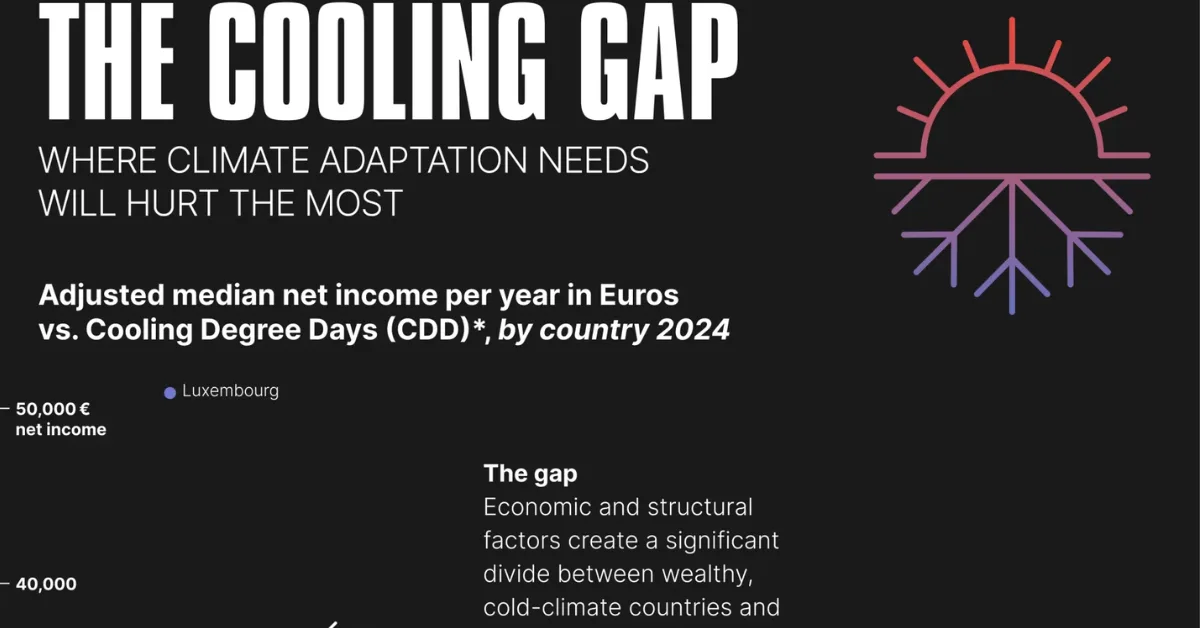
The visualization above, created by DataPulse, uses data from Eurostat to examine cooling degree days across Europe, a metric used to estimate how much energy is needed to cool buildings.
Countries in Southern Europe, including Spain, Italy, Greece, and Cyprus, record some of the highest cooling demand in the region. Meanwhile, Northern European nations have historically required little cooling, but hotter summers are steadily changing that equation.
Why Cooling Demand Is Rising
Cooling degree days measure how often outdoor temperatures exceed a comfort threshold, typically around 24°C (75°F). The higher the number, the greater the need for indoor cooling systems like air conditioning.
As Europe experiences more frequent heatwaves, cooling is becoming less optional. Eurostat’s cooling degree day data shows how demand varies sharply across the continent, with hotter southern countries facing much higher cooling needs than most of Northern Europe.
| Country | 2024 Net Income (€, thousands) | Cooling Degree Days Avg. |
|---|---|---|
 Belgium Belgium |
30.4 | 21.2 |
 Bulgaria Bulgaria |
7.8 | 237.1 |
 Czechia Czechia |
15.1 | 23.8 |
 Denmark Denmark |
34.8 | 1.0 |
 Germany Germany |
27.6 | 21.8 |
 Estonia Estonia |
16.1 | 13.0 |
 Ireland Ireland |
33.0 | 0.1 |
 Greece Greece |
10.9 | 418.4 |
 Spain Spain |
19.3 | 308.8 |
 France France |
25.6 | 74.8 |
 Croatia Croatia |
12.3 | 207.8 |
 Italy Italy |
20.6 | 317.4 |
 Cyprus Cyprus |
20.7 | 804.9 |
 Latvia Latvia |
12.8 | 14.0 |
 Lithuania Lithuania |
12.3 | 19.3 |
 Luxembourg Luxembourg |
50.8 | 15.5 |
 Hungary Hungary |
8.8 | 158.7 |
 Malta Malta |
20.4 | 772.5 |
 Netherlands Netherlands |
32.0 | 15.9 |
 Austria Austria |
33.2 | 31.8 |
 Poland Poland |
11.9 | 29.9 |
 Portugal Portugal |
12.6 | 226.4 |
 Romania Romania |
7.8 | 158.7 |
 Slovenia Slovenia |
19.6 | 74.3 |
 Slovakia Slovakia |
10.2 | 64.4 |
 Finland Finland |
28.7 | 2.6 |
 Sweden Sweden |
26.9 | 0.5 |
This trend comes alongside growing concerns over climate resilience. Heat-related deaths have climbed during extreme weather events, while public infrastructure faces additional strain during prolonged periods of high temperatures.
Soaring Electricity Bills Are Widening the Cooling Gap
While cooling demand rises, energy affordability is moving in the opposite direction.
Electricity prices across Europe surged sharply following the energy crisis triggered by Russia’s invasion of Ukraine, exposing how vulnerable many households are to energy shocks. Even as wholesale prices stabilize, residential electricity bills remain elevated in many countries.
For lower-income households, this creates what some researchers call a “cooling gap”: the inability to afford adequate indoor cooling during dangerous heat periods.
The regions that need cooling most are also places where higher electricity costs can put added pressure on household budgets. This is turning access to cooling into a growing climate affordability issue across Europe.
The issue also intersects with broader emissions and energy-transition debates. While cooling demand grows, Europe is simultaneously attempting to reduce fossil fuel dependence and decarbonize its electricity grid.
When Air Conditioning Becomes Essential Infrastructure
Historically, many European homes were built to retain heat rather than release it. As a result, buildings in countries like Germany, France, and the UK are often poorly adapted for extreme summer temperatures.
This raises a larger question for Europe: when extreme heat becomes more common, should access to cooling be treated as basic infrastructure?
In many parts of the world, access to cooling increasingly resembles a public health necessity rather than a discretionary expense. Governments are beginning to invest in cooling centers, urban tree coverage, and building retrofits to reduce indoor heat exposure without relying solely on energy-intensive air conditioning.
Still, for millions of households, relief from extreme heat may ultimately come down to one thing: whether they can afford the electricity bill.
Learn More on the Voronoi App 
To learn more about Europe’s energy transition and climate outlook, check out Europe’s Emissions Are Set to Shrink 43% by 2050 on the Voronoi app.