Ranked: The World’s Biggest Reserve Currencies Today
See visuals like this from many other data creators on our Voronoi app. Download it for free on iOS or Android and discover data-driven charts from a variety of trusted sources.
Key Takeaways
- The U.S. dollar accounted for 56.8% of global foreign exchange reserves at the end of 2025, more than all other major reserve currencies combined.
- The euro ranked second with $2.66 trillion in reserve holdings, equal to 20.2% of the global total.
- China’s renminbi represented just 2.0% of reserves, down from its 2022 peak despite years of de-dollarization efforts.
Central banks held $13.1 trillion in foreign exchange reserves at the end of 2025, with the U.S. dollar continuing to dominate global holdings.
Despite years of discussion around de-dollarization, reserve managers still keep the majority of their assets in dollar-denominated instruments. Meanwhile, the euro remains the leading alternative, and the Chinese renminbi’s share has slipped from recent highs.
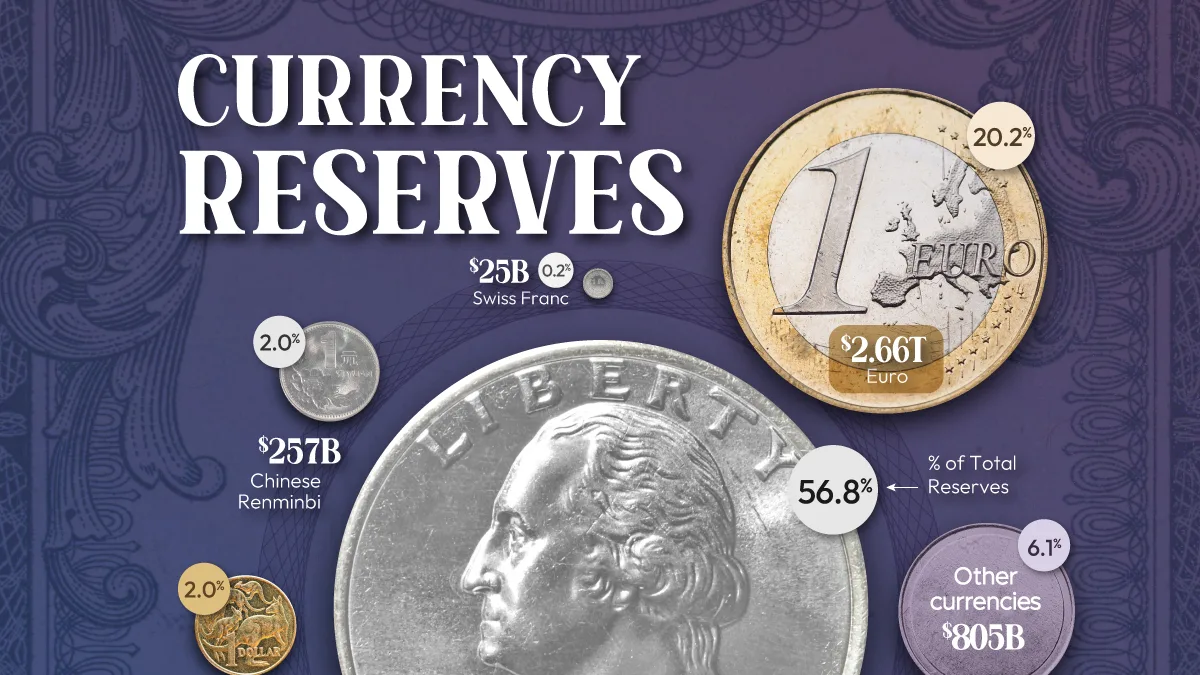
This visualization shows how global foreign exchange reserves were allocated across currencies in Q4 2025, based on data from the IMF’s Currency Composition of Official Foreign Exchange Reserves (COFER) database.
The Dollar Still Dominates Global Reserves
Despite years of de-dollarization efforts, the U.S. dollar remains by far the world’s most important reserve currency.
Central banks collectively held $7.46 trillion in dollar-denominated reserves at the end of 2025, representing 56.8% of the global total.
| Currency | Reserves (USD trillions) | Share of Total Reserves |
|---|---|---|
 U.S. dollars U.S. dollars |
7.46 | 56.8% |
 Euros Euros |
2.66 | 20.2% |
 Japanese yen Japanese yen |
0.76 | 5.8% |
 Pounds sterling Pounds sterling |
0.58 | 4.4% |
 Canadian dollars Canadian dollars |
0.33 | 2.5% |
 Australian dollars Australian dollars |
0.27 | 2.0% |
 Chinese renminbi Chinese renminbi |
0.26 | 2.0% |
 Swiss francs Swiss francs |
0.03 | 0.2% |
 Other currencies Other currencies |
0.81 | 6.1% |
| Total foreign reserves | 13.14 | 100.0% |
The dollar’s dominance stems from the size of the U.S. economy, the depth of U.S. Treasury markets, and its central role in global trade and finance.
Many commodities, including oil, continue to be priced and settled in dollars, reinforcing demand for the currency worldwide.
The dollar’s share has gradually declined from roughly 65% a decade ago, but no single currency has emerged as a clear replacement.
The Euro Remains the Leading Alternative
The euro is the world’s second-largest reserve currency, accounting for $2.66 trillion in holdings and 20.2% of total reserves. Although well behind the dollar, the euro remains the primary alternative for central banks seeking diversification.
The currency benefits from the economic size of the Eurozone and the liquidity of European government bond markets.
Together, the dollar and euro account for more than three-quarters of all global reserves.
Beyond these two leaders, the Japanese yen and British pound hold shares of 5.8% and 4.4%, respectively.
Renminbi Growth Has Stalled
One of the most notable findings is the relatively small role played by China’s renminbi. Central banks held approximately $257 billion worth of renminbi reserves in Q4 2025, equal to just 2.0% of the global total.
The renminbi’s reserve share declined from its 2022 peak of 2.9%, despite expectations that geopolitical tensions and diversification efforts might accelerate its adoption.
Instead of flowing primarily into the renminbi, some reserve diversification has been spread across currencies such as the Canadian dollar, Australian dollar, Swiss franc, and a growing collection of smaller reserve currencies.
Learn More on the Voronoi App 
If you enjoyed today’s post, check out The $126T Global Economy in One Giant Chart on Voronoi.