
Herbicide-resistant weeds continue to be a growing problem across Ontario. That includes Palmer amaranth, one of the most concerning weeds for farmers in the United States.
Palmer amaranth was identified in fvive regions from southwest to eastern Ontario in 2025, but it’s not yet ubiquitous across the province. It will eventually be a weed that growers here will likely become very familiar with, though proactive identification and plant removal can help reduce its spread and impact.
Resistance to nine herbicide groups
Palmer amaranth is a major problem in field and vegetable crops throughout the U.S., where it causes severe yield losses, says Mike Cowborough, field crop weed management specialist with the Ontario Ministry of Agriculture, Food and Agribusiness, in a Field Crop News summary of the ministry’s 2025 resistant weed testing season.
“This species is extremely competitive and has globally developed resistance to nine herbicide groups, with some populations resistant to as many as six modes of action at once,” Cowborough says.
Resistance has been found to herbicide groups 2, 3, 4, 5, 6, 9, 10, 14, and 27.
Palmer amaranth’s first identified incursion into Canada occurred in 2007, where it was found along a rail line in Niagara. It disappeared again until 2023, when an individual plant was found in a Wellington County field. Plants were also identified in Bruce and Haldimand counties in 2024, with the latter case occurring amid a population of waterhemp — a weed that looks strikingly similar to Palmer amaranth.
Results from the 2025 resistant weed testing season identified herbicide-resistant Palmer amaranth in the counties of Wellington, Bruce, and Haldimand, now with the addition of Lambton, Stormont, Dundas and Glengarry.
Identification
Palmar amaranth can be hard to spot with an untrained eye, thanks to its likeness to common pigweed species. Cowbrough’s Field Crop News report from 2023 says those scouting should look for plants with four characteristics unique to Palmer amaranth: leaf blades that are shorter than leaf petioles, hairless stems, thick as well as tall stems and diamond-shaped leaves.
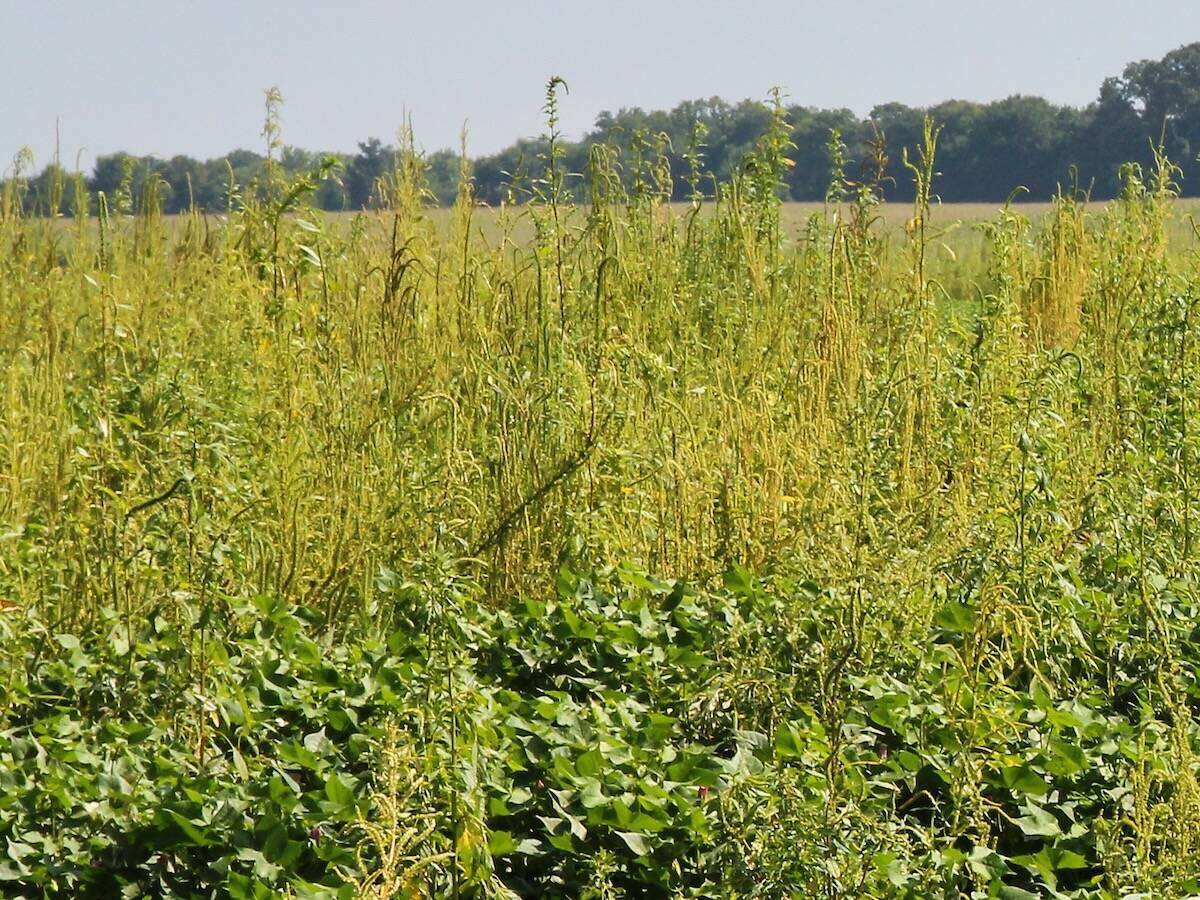
Palmer amaranth can also be identified by its taproot, long and spikey seed clusters, stems with alternate leaf orientation, and stalks that grow noticeably thicker than more common pigweed species. Unlike redroot and green pigweed specifically, Palmer amaranth stems are smooth and hairless. Waterhemp petioles are shorter than Palmer amaranth petioles.
READ MORE: Waterhemp and its crazy advantage
Isabelle Aicklen, assistant professor of weed management at the University of Guelph, Ridgetown, says identification is going to be an ongoing challenge given Palmer amaranth is still relatively unknown in Ontario.
“What we’ve seen over time, especially from Palmer amaranth, is it started in the southern United States and has moved north over time. I suspect a lot of that has to do with equipment,” Aicklen says, adding it’s possible the apparent preference of Palmer amaranth for more southern climactic conditions could be a reason Ontario has been largely spared at this point. Small increases in average temperatures could change that, however.
“I’ve also heard we still find waterhemp is the bigger problem because we haven’t worked with Palmer amaranth that long in Ontario.”
The good news
While Palmer amaranth can spread quickly once established — it can produce 250,000 tiny seeds per plant — it’s relatively limited inroads in Ontario means proactive scouting and plant removal can go a long way in minimizing its negative impact. Ensuring equipment is thoroughly cleaned and weed-seed-free can help reduce its spread as well. Aicklen also points to the fact that Palmer amaranth requires cross-pollination in seed production, meaning isolated plants are less of a threat. The herbicide resistances of populations that have been found in Ontario are also “very site-specific,” and not uniform.
“Potentially there could be more populations in the province. It’s just so new identification isn’t as clear,” Aicklen says. “In terms of risk right now I would say, when I talk about management, we should treat it similar to waterhemp and take all the precautions. The faster we can remove existing plants, and identifying them when they show up, that will minimize the spread.”
“Be on the lookout for it. If you have a different-looking pigweed in your field, try to get familiar with identifying it or get your agronomist or some support for identifying it so we can keep an eye on these populations and minimize spread as best as possible.”
The post Palmer amaranth spreads further through Ontario appeared first on Farmtario.


