

A dramatic surge in common octopus populations off the southwest coast of England has been linked to warming seas and wider environmental changes, according to new research by the Marine Biological Association (MBA).
The study, funded by the Department for Environment, Food and Rural Affairs (Defra) and conducted in collaboration with the University of Plymouth, documents what researchers describe as the largest recorded bloom of common octopus (Octopus vulgaris) in at least 75 years.
The report combines scientific surveys, underwater video monitoring and observations from recreational divers and snorkellers to investigate how and why octopus numbers increased so dramatically during 2025.
One of the most significant findings came from a public survey that gathered 120 responses from divers and snorkellers. Participants reported unprecedented encounters with octopus along the coasts of Devon and Cornwall, with many describing sightings unlike anything they had experienced before.
“I had never seen a common octopus in the UK before and have been snorkelling all my life around Cornwall,” one respondent said.
The bloom also generated considerable interest among the diving community. More than 30% of respondents said they had travelled to specific locations in southwest England specifically to see octopus, with Cornwall’s Porthkerris emerging as the most popular destination.
Researchers found that 96.5% of surveyed divers and snorkellers reported seeing common octopus during 2025. Nearly half observed between two and four octopus on a single dive, while some reported seeing as many as 20.
Dr Bryce Stewart, Senior Research Fellow at the MBA said: ‘I can’t thank the divers and snorkellers who took part in our survey enough. Their responses provided new information about octopus distribution and behaviour at a scale that would be almost impossible to replicate scientifically.
‘Particularly significant were observations confirming widespread breeding of the common octopus in UK waters, and reports of octopus predation on a wide range of species, including commercially important crabs and lobsters.’
Observations revealed octopus actively hunting, guarding food, interacting with other marine species and displaying territorial behaviour. Researchers also documented eggs, juvenile octopus and mature adults nearing the end of their life cycle, providing strong evidence that successful breeding occurred in UK waters during 2025.
The findings were supported by footage from Baited Underwater Remote Videos (BRUVs), which confirmed large numbers of octopus occupying rocky reef habitats often targeted by shellfish fisheries.
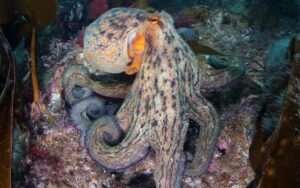
Professor of Marine Ecology at the University of Plymouth, Professor Emma Sheehan, said: ‘Our University of Plymouth long-term, underwater video monitoring data helped to evidence that this species of octopus was not typically observed along the southwest coast, and provided an excellent non-destructive means of recording octopus abundance and behaviour.’
The bloom has not been without consequences. Scientists say the increase in octopus numbers coincided with significant declines in commercially important shellfish species, including crabs, lobsters and scallops. Evidence suggests octopus were feeding on shellfish both on the seabed and inside fishing gear, reducing catches and affecting the livelihoods of small-scale fishermen.
Researchers believe the population originated from breeding grounds near the Channel Islands and northern France, with warmer sea temperatures helping young octopus survive and spread into UK waters.
Recent reports suggest the species has now expanded beyond southwest England, with sightings recorded in Wales, Dorset, East Sussex and Scotland.
Dr Stewart concluded: ‘This event is a striking example of how quickly our seas can change. By working together with fishermen, divers and coastal communities, we can better understand what’s happening and plan for a future where these changes may become more frequent.’
Photos: Kirsty Andrews


