
Jean-Pierre Bussières of Ferme 299 at Yamaska, Que., redesigned his robot milking barn to put more emphasis on the high-producing cows and give them more access to the robots they need.
The changes will also save him $1 per day per cow in feed costs, but targeting feed for high milk production only to those producing to those levels.
There was no new barn for Farm 299. Heifers, dry cow and calving pens are the same. The feeding system is also the same. But the milking cow area is much changed.
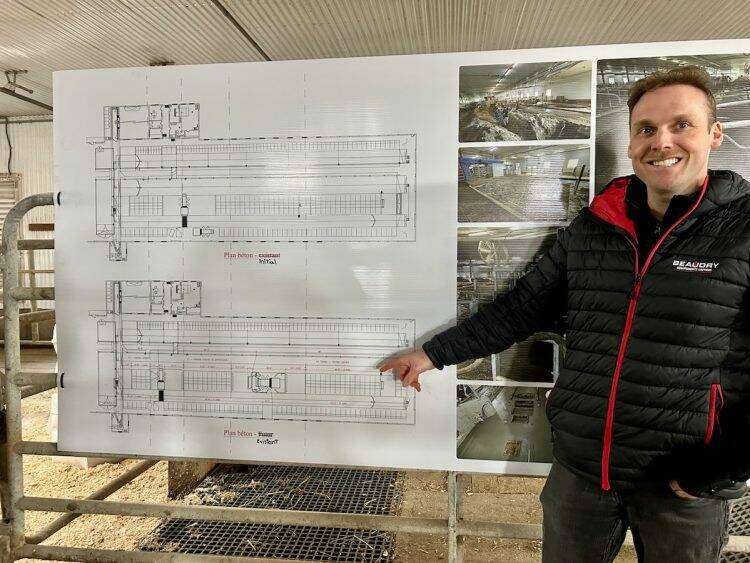
The group of milking cows was separated into two: one for high-producing cows and another for those at the end of lactation.
There are two updated Boumatic milking robots: one a single and one a double setup.
The single robot is for the highest-producing cows and cows with special needs, a smaller number than the lower-production group, which gets the double robot.
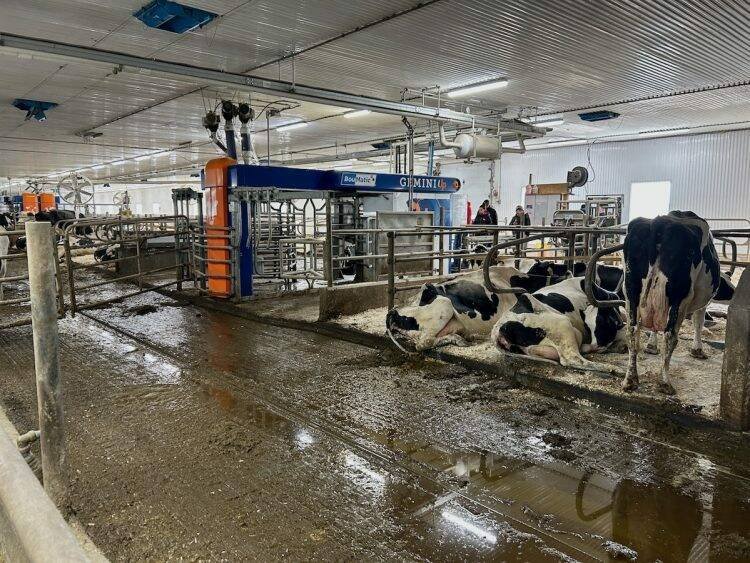
The higher producing cows can also access the other robot system — if necessary.
The plan was designed by Tommy Beaudry of Beaudry Dairy Equipment. According to him, it’s unique. By consulting with key people in the company, he developed the plans based on the client’s objectives. Once finalized, the plan was approved by the producer his team of experts.
Two other people played an important role. Alicia Moreau is a robotics consultant who has worked with the farm for five years. She provides management advice. Nutrition consultant Christian Janelle from Moulée Vallée Mill, a ShurGain affiliate, is responsible for feeding the dry cows and lactating cows. The feed for replacement animals is formulated by Laura Lefebvre from Benjamin Mill.
The farm development project
Jean-Pierre Bussières wanted to have a setup that would eventually allow him to produce 200 kg of quota (kg fat/day) with only one employee to do everything.
He recounts that the farm burned down in 2013. The barn was rebuilt in 2014 with two robots in a single group for 100 cows.
“The robots had become outdated. We weren’t getting the performance we wanted. It was time for a change,” he says. So he looked into a new generation of robots and a new configuration.
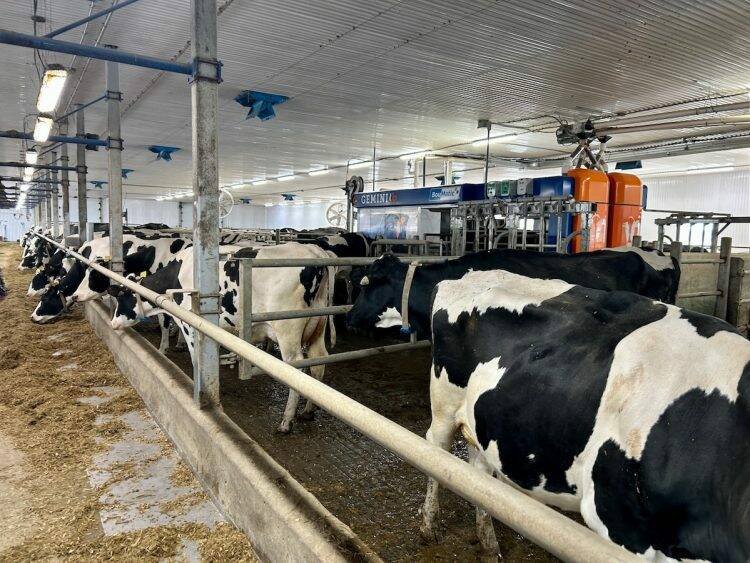
“We changed the way we position the milking robots,” he said. “That’s where, for me, the major savings lie. We’re looking at several thousand dollars in annual savings on feed costs because we have a very efficient group 1 that is fed adequately, and we have a second group that is at the end of lactation and should have less support with feed. We’re not wasting our money there. We easily save $1 per day per cow.”
The first robots went into operation on July 1, 2025, and production never stopped during the work. According to Jean-Pierre Bussières, the reduction in feed costs is not yet complete. He and his team are working on it.
“The barn here isn’t perfect,” he said. “We still have work to do. We want to do even better. We know we’re capable of it.”
The company currently produces 140 kg of fat per cow with a potential of 150 kg without expansion. “We would have a project to do to get to 200 kg, but the quota will limit us,” he says.
Part of the stalls had to be renovated. The mattresses for the high-producing cows were replaced for greater comfort and to increase milk production.
Reconfiguration assessment
Bussières is already seeing changes in the number of times the cows are milked by robots. Previously, they were milked 2.8 times a day, whereas now they go 3.4 times a day. Milk production has remained at 40 kg per cow per day at 190 days of lactation.
“This farm is run with a cell phone and one employee,” says Jean-Pierre Bussières. He’s present 10 hours a week at the barn. Everything else is done by the employee. “I handle the management,” he explains.
In his mid-40s, Bussières doesn’t know if he’ll have anyone to take over the business.
“I did this because I love it,” he says. He has two daughters, aged 5 and 12, who are still too young to be considered successors.
“I hope to have someone to take over, but above all, I hope my daughters are happy,” he says.
The post Optimizing the interior of a robot milking barn appeared first on Farmtario.


