
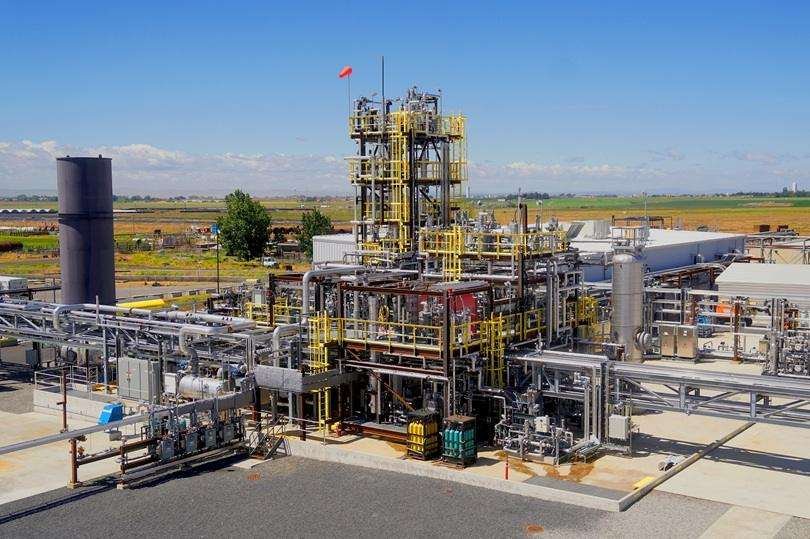
Carbon transformation-focused cleantech company Twelve announced the launch of AirPlant One, the first commercial-scale facility in the U.S. to produce E-Jet fuel – a power-to-liquid (PtL) sustainable aviation fuel (SAF) made from CO2 and renewable electricity.
Founded in 2015, California-based Twelve produces chemicals, materials and fuels from captured CO2 combined with water. The process is powered by renewable energy and produces water and oxygen as byproducts. According to Twelve, its SAF has the potential to reduce lifecycle greenhouse gas emissions by up to 90% compared to conventional jet fuel.
Located in Moses Lake, Washington, the new facility is currently producing on-spec jet fuel that meets ASTM (American Society for Testing and Materials) International certification standards for use in commercial aircraft, requiring no modifications to aircraft, engines or existing airport infrastructure. The fuel is currently being delivered and sold for commercial aviation, with Alaska Airlines expected to operate regular domestic flights using E-Jet SAF manufactured at the facility.
Microsoft and Alaska Airlines supported the development of the new plant, with a joint commitment in 2022 to purchase output from Twelve’s facility, and through investments in Twelve through the Microsoft Climate Innovation Fund and Alaska Star Ventures. Both companies were present at the ribbon cutting for the new facility.
Melanie Nakagawa, CVP and Chief Sustainability Officer, Microsoft said:
“Our investment in Twelve helps scale energy solutions while laying the groundwork for cleaner aviation at a global scale. We look forward to sourcing future gallons of Washington-produced SAF to help reduce our business travel emissions.”
Unlike bio-based SAF pathways that rely on agricultural feedstocks, E-Jet fuel is produced from captured CO2 and renewable electricity. Twelve said its proprietary eManufacturing process combines CO2, water and renewable power to create hydrocarbon fuel molecules, producing a synthetic jet fuel that is chemically identical to conventional aviation fuel, making it fully compatible with existing aircraft and airport infrastructure.
Additional benefits cited include greater price predictability through electricity-based inputs, lower land and water requirements than many biofuel pathways, enhanced energy security through fuel supply diversification, support for domestic industrial growth and job creation, and a scalable pathway for reducing emissions from long-haul aviation, where electrification remains challenging.
Ryan Spies, Alaska Airlines Managing Director of Sustainability, said:
“Our partnership with Twelve and Microsoft demonstrates the power of innovation and collaboration to successfully advance SAF, while creating new jobs, diversifying fuel supply chains and strengthening energy security.”
In addition to aviation fuel, AirPlant One produces E-Naphtha, a synthetic chemical feedstock made from captured CO2, water and renewable energy. Twelve said the product is chemically identical to conventional naphtha and can serve as a drop-in replacement in the production of a wide range of products, including plastics, packaging, solvents and synthetic fibers.
According to Twelve, E-Naphtha represents an early step in the development of a new category of eChemicals, enabling manufacturers to source key chemical building blocks from renewable electricity and captured carbon dioxide rather than fossil-based feedstocks. The company said this approach will enhance supply chain resilience, provide greater predictability in input costs and strengthen American industrial leadership.
Nicholas Flanders, Co-Founder and CEO of Twelve said:
“We broke ground on AirPlant One with a simple thesis: that the fuels powering the global economy could be made from renewable electricity and air, anywhere in the world.”


