

Researchers from Cornell University have assessed the sustainability potential of integrating advanced perovskite tandem PV into agrivoltaic lettuce production in the United States. Their “farm-to-fork” life-cycle assessment focuses on perovskite-silicon (P-S) and perovskite-perovskite (P-P) tandem technologies, and compares them with a baseline of conventional silicon PV.
“We look at agrivoltaics not only as a solar deployment question or an on-farm crop-yield question, but as an integrated food-energy-water system,” said corresponding author Fengqi You to pv magazine. “To our knowledge, this is the first prospective ‘farm-to-fork’ life-cycle assessment of agrivoltaic food production using emerging perovskite tandem photovoltaic technologies.”
The researcher added that the team combined advanced solar module scenarios, circular recycling assumptions, region-specific agricultural production data, irrigation and shipping inputs, and food loss and waste across the supply chain. “This system-level view allows us to evaluate whether farms can simultaneously produce food, generate clean electricity, reduce greenhouse gas emissions, conserve water, and ease land-use competition,” Fengqi said.
The team investigated agrivoltaic production in major US lettuce-growing regions: California’s Central and Southern Coasts, the Southern Desert, the Central Valley, Arizona, and Florida. Using current regional production data and yields, they analysed changes under different scenarios combining agrivoltaic configurations, technologies, system lifetimes, and power conversion efficiencies (PCEs).
The full-density (FD), half-density (HD), single-axis tracking, and dual-axis tracking configurations reduce lettuce yields by 40%, 20%, 12%, and 5%, respectively, while reducing irrigation demand by 50%, 30%, 30%, and 15%, respectively.
For P-S tandems, the study assumes three PCE scenarios of up to 25%, 30%, and 35%. For P-P tandems, scenarios are set at 25%, 30%, and 35%. System lifetimes of 2, 5, and 10 years are also modelled.
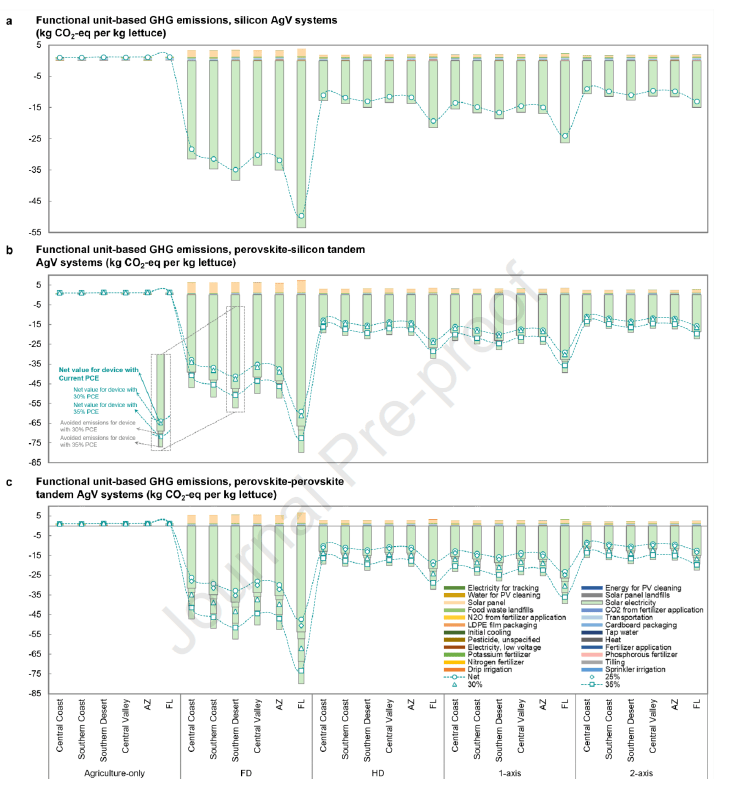
The scientists employed a comprehensive farm-to-fork life-cycle assessment to quantify greenhouse gas emissions and water impacts associated with the consumption of 1 kg of fresh lettuce. The system boundary included fertilizer production, irrigation, cultivation, harvesting, PV manufacturing and operation, packaging, refrigerated transport, retail distribution, consumer food waste, and landfill disposal. It also incorporated electricity generation from the PV system, module recycling, and remanufacturing within a circular solar economy framework. Environmental benefits from solar electricity were accounted for as avoided grid emissions.
“One of the most surprising findings was the magnitude of the potential benefits,” said You. “Under favorable conditions, retrofitting US lettuce farmland with agrivoltaics could offset up to 30.9 million tons of CO₂-equivalent annually and conserve about 8.4 billion m³ of water annually.”
He added that another notable result was geographic: the highest carbon-offset potential per kilogram of lettuce did not necessarily occur in the sunniest regions. “Florida, despite lower solar irradiance than desert regions, showed very high unit decarbonization potential because lower agricultural yield means more land area is associated with each kilogram of lettuce, which in turn enables more solar generation in an agrivoltaic configuration,” he said. “For water conservation, the strongest potential is in water-scarce regions such as California’s Southern Desert and Arizona.”
“If designed responsibly, next-generation agrivoltaics can turn farmland from a site of competition between food and energy into a platform for integrated food production, clean energy generation, and water conservation,” the academic concluded.
The research work was presented in “Advancing Food-Energy-Water Sustainability with Scalable Perovskite Tandem Agrivoltaics,” published in Nexus.
The post Perovskite tandem PV for agrivoltaics appeared first on pv magazine Global.


