Earth911’s Earth Action series shares one practical step at a time to invest in the Earth and make your own life more sustainable.
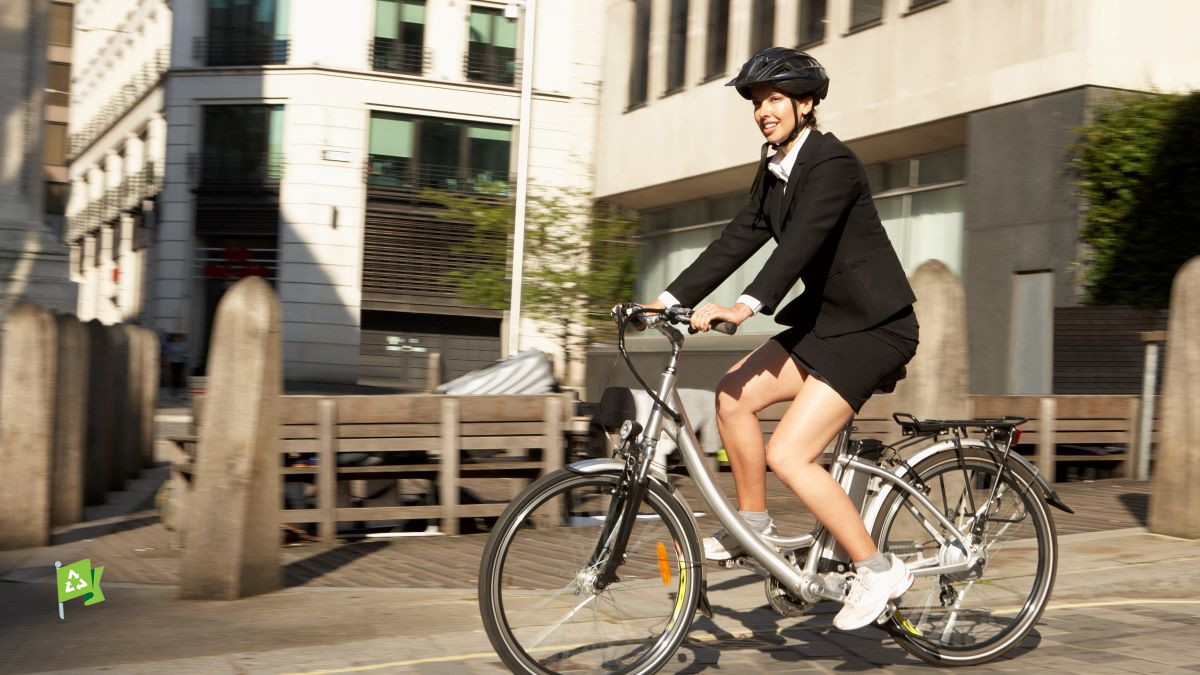
Action: Bike to Work
Transportation Impacts
Transportation generates about 28% of all U.S. greenhouse gas emissions — more than any other sector. North America’s car culture also gives the United States one of the largest per-capita carbon footprints of any major economy, well above the global average and rivaled only by a handful of other industrialized and oil-rich nations. On average, American drivers still cover roughly 13,500 miles a year — more than four round-trip drives from New York to Dallas — and collectively logged a record 3.28 trillion miles in 2024.
New cars are cleaner than ever, averaging a record 27.2 mpg for model year 2024, but they still burn gasoline every mile. Not many lifestyle changes could reduce our environmental impact as much as driving fewer miles.
Bike to Work Day
National Bike to Work Day is a project of the League of American Bicyclists, which has promoted National Bike Month every May since 1956. It lands on the third Friday in May — May 15 in 2026 — at the end of Bike to Work Week (May 11–17), and the League now frames the whole month around all the ways and days people bike, from National Ride a Bike Day on May 3 to a commute, a coffee run, or a spin around the block. (Colorado does its own thing, holding its statewide Bike to Work Day on Wednesday, June 24, 2026.)
While the League is inspired more by a love of cycling than by any particular environmental interest, the month-long celebration provides the support and encouragement to help you get on a bike at least once.
And there is no question that cycling is a more environmentally friendly way to get around. It doesn’t just cut down on vehicle emissions, cycle-friendly cities are safer for everyone. A study of 12 large U.S. cities found that those with the most protected bike lanes had 44% fewer road fatalities across all users — drivers, pedestrians, and cyclists alike — with Seattle’s fatal crash rate falling more than 60% as it built out that infrastructure. The health payoff is enormous, too.
In Copenhagen, famously bike-friendly, the World Economic Forum estimates that every kilometer cycled returns roughly 75 cents to $1.55 to society, adding up to $1 to $2 million in combined health and economic benefits every day. And because getting sick carries a heavy carbon footprint of its own, healthier cyclists are cutting more than just tailpipe emissions.
Lasting Change
You might bike every day for a month, every day of Bike Week, or just every year on Bike to Work Day, May 15.
Maybe this weekend your action is simply to dig your bike out of the garage and give it a tune-up so it’s ready the next time you feel like giving it a try. Whatever action you start with, you’ll only make a dent in your transportation footprint if it helps you make a regular change. But don’t be discouraged if it doesn’t convert you into a full-time bike commuter. You might end up riding every day but only in summer, or biking to work once a week. If your job is too far to bike, maybe you can ride as far as the train station. Or choose a different frequent car trip to replace with cycling.
If biking isn’t physically possible for you, get creative with other eco-friendly transportation options like carpooling or taking public transit. Bicycles are one great option, but the point is to lower your transportation footprint, so use this as a chance to rethink the way you get around.
Related Reading on Earth911
Editor’s Note: Originally published on May 20, 2022, by Gemma Alexander, this article was updated in June 2026.
The post Earth Action: Ride a Bike for Your Health and the Planet’s appeared first on Earth911.