

Artificial intelligence is changing how data centers consume electricity. New workloads are introducing levels of variability that conventional power systems were not designed to handle, creating operational challenges both inside the facility and across the wider grid. Battery energy storage systems (BESS) are proving an essential tool to manage these rapid demand fluctuations, as S&P Global analyst Henrique Ribeiro explains.
Historically, data centers operated with relatively stable and predictable load profiles. That is changing rapidly. Training and inference workloads can lead to sharp swings in demand at the megawatt scale, sometimes occurring several times within a short period. These changes place stress on electrical infrastructure and increase the risk of power quality issues that can affect sensitive equipment. At the same time, the overall scale of data center development continues to grow, with new projects often requiring hundreds of megawatts of capacity.
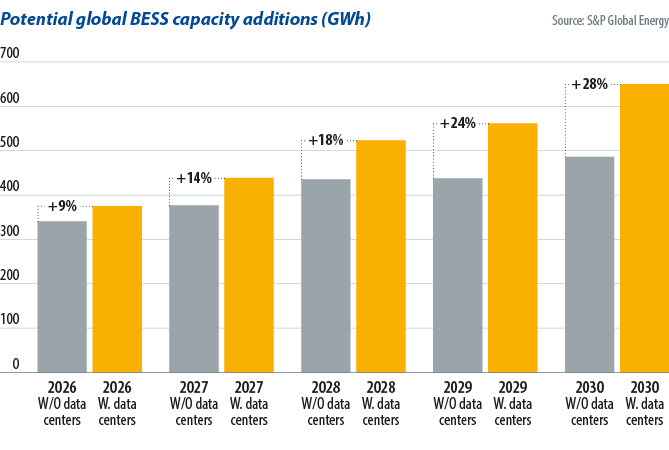
This combination of rapid expansion, volatile demand, and constrained grid infrastructure is forcing operators to rethink how power is sourced and managed. In many regions, access to grid capacity is becoming a limiting factor for new developments. As a result, battery energy storage systems are gaining attention as a practical way to improve flexibility and support growth. The opportunity is sizable, with global potential for storage linked to data center demand estimated at around 170 GW.
Battery storage is not a solution on its own. Its role is to work alongside other technologies and improve how the overall system performs. As operators adapt to new requirements, several applications for storage are becoming more clearly defined.
Use cases
Batteries can greatly enhance the usefulness of a power purchase agreement. Data centers increasingly rely on renewable electricity contracts to meet sustainability goals. Solar and wind can provide low cost and low emission energy, but their output does not always match the constant demand of a data center. Storage helps address this mismatch by shifting energy from periods of high generation to periods of higher demand. This improves the alignment between supply and consumption and allows operators to make more effective use of contracted renewable energy. It also supports more advanced clean energy strategies, including hourly matching of electricity use with renewable generation. In addition, storage can improve project economics by reducing exposure to low or negative wholesale prices during periods of excess generation.
Grid constraints are becoming a defining feature of many data center markets. Long timelines and high interconnection costs are increasingly common. Storage installed behind the meter allows operators to manage their demand more actively, reducing peak consumption and smoothing their load profile. This can lower costs and, in some cases, allow projects to move forward without waiting for major grid upgrades. There is also growing interest in flexible connection models, where large loads are expected to adjust consumption during periods of system stress. In this context, storage provides an additional layer of control and can support more dynamic interaction with the grid.
Backup power remains essential for data center operations. Diesel generators continue to provide long duration resilience, particularly for extended outages. However, batteries are starting to play a complementary role. They can respond immediately to short interruptions and cover outages that do not last long enough to justify running generators. This reduces fuel consumption, operating costs, and local environmental impact. Over time, this approach can also extend the lifetime of backup equipment by reducing the frequency of use. While storage does not replace conventional backup solutions, it changes how they are deployed and integrated.
Rapid fluctuations associated with AI workloads can lead to instability in voltage and frequency. These disturbances can affect both IT equipment and support systems. Storage offers fast response times that can help stabilize the system and maintain consistent power conditions. In this role, batteries act as a buffer between highly dynamic loads and the electricity network. This is particularly important in facilities with high concentrations of GPU based computing, where even short disturbances can lead to operational disruption or financial losses.
Many data centers are exploring or deploying on site gas generation to improve reliability or address grid limitations. Storage can enhance the performance of these systems. Instead of sizing generation assets to meet peak demand at all times, operators can size them closer to average load and rely on storage to handle short term variations. This reduces the amount of installed generation capacity and limits the need for frequent ramping. The result can be lower capital expenditure and improved operational efficiency, especially in environments with highly variable demand.
No silver bullet
Despite these advantages, storage should be seen as part of a broader system rather than a single solution to multiple challenges. Each component of a data center power architecture has a distinct role: grid connections provide scale and continuity; generators offer long duration backup; natural gas generation provides unlimited runtime and proven reliability; traditional UPS is the perfect shield for the IT servers. Storage adds flexibility and responsiveness, which makes it an ideal complement – not a replacement – for these other elements.
The optimal mix of technologies depends on location, regulatory conditions, and workload characteristics. Facilities focused on AI in regions with limited grid capacity are likely to require larger and more integrated storage solutions. In contrast, data centers operating in areas with strong grid infrastructure may use storage in more targeted ways, focusing on specific applications such as renewable energy integration or peak demand management.
What is clear is that storage is becoming an increasingly important part of data center energy strategies. As demand for computing capacity continues to rise and power systems face growing pressure, operators need solutions that allow them to balance reliability, cost, and sustainability. Batteries are well suited to this role because they can support multiple functions within a single system. 
About the author

Henrique Ribeiro is a principal analyst on the batteries and energy storage team at S&P Global Commodity Insights, focusing on Latin America and the Iberian Peninsula. Ribeiro spent 11 years on the metals pricing team, helping to establish benchmarks for global battery metals and for steel and aluminum prices in Brazil, Chile and Mexico. He has spoken at several conferences on battery metals market trends and was a host of the Platts Future Energy Podcast.
The post BESS as a ‘Swiss Army knife’ for data centers appeared first on pv magazine Global.


