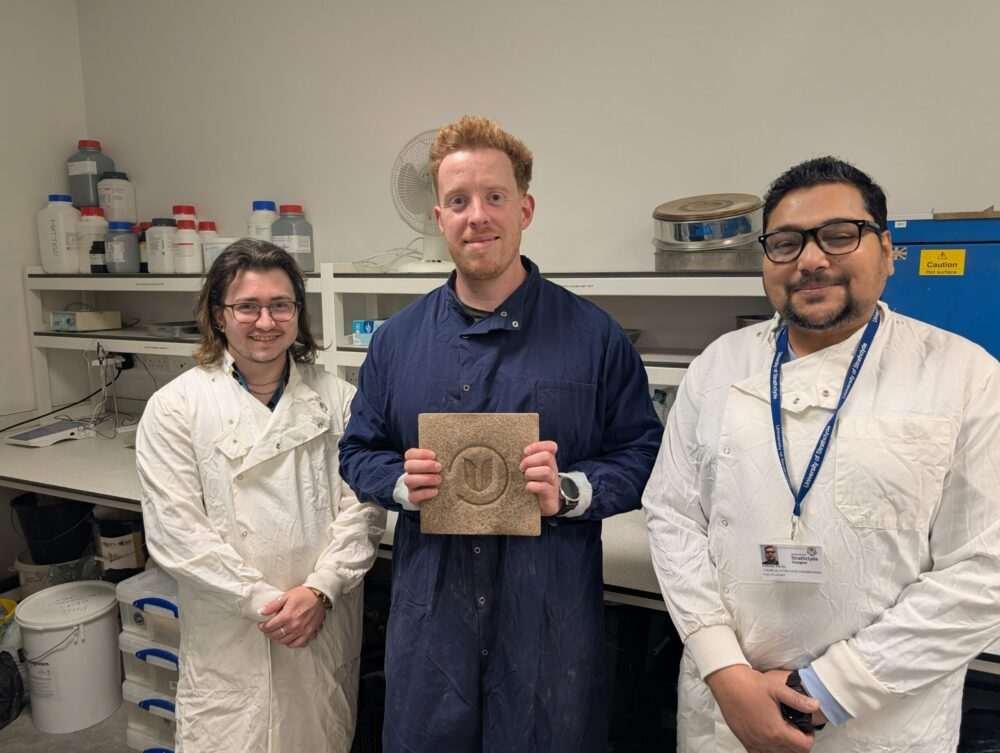
A University of Strathclyde spinout is tackling one of construction’s toughest emissions problems. Ureaka converts low-value mineral waste into a carbon-negative cement replacement.
Cement and concrete production cause roughly 8% of global CO2 emissions. Most comes from the manufacturing process and underlying chemistry, not just energy use. That makes the sector hard to decarbonise, even with cleaner electricity.
Founded by scientist Dr Philip Salter, Ureaka takes a different approach. It combines circular chemistry with mineral processing to create supplementary cementitious materials (SCMs) from waste streams, including demolished concrete. The process recovers calcium and silica from the waste. It then uses captured CO2 to form stable carbonate minerals. The carbon gets locked in permanently.
The result is a drop-in powder. Manufacturers can mix it into standard concrete to cut cement use, without changing production lines. Built from waste rather than virgin materials, it could also lower input costs.
The project has support from the Industrial Biotechnology Innovation Centre (IBioIC) Spin Out Fund, working alongside Strathclyde researchers. It has moved from lab research into factory-scale modelling. Product testing and validation are now underway.
Ureaka’s earlier work in biocementation points to further uses. The same chemistry could strengthen soil for construction projects or repair existing concrete structures.
“Ureaka is taking a fundamentally different approach: starting with the mineral value already present in waste concrete, reacting it with captured CO2, and turning it into a cement-replacement material that can work within existing supply chains,” said Dr Philip Salter, founder and chief executive of Ureaka.
Caroline Kewney, senior impact manager at IBioIC, said the project shows how industrial biotechnology can turn waste into new materials while supporting carbon capture and more circular manufacturing.
The post Glasgow turns cement waste into carbon-negative building material appeared first on World Bio Market Insights.