

A research group at Delft University of Technology in the Netherlands has extended and improved light-simulation workflows for agrivoltaics (agri-PV) applications, with a focus on more realistic and computationally efficient representations of atmospheric conditions and crop geometry. This advancement is important because more accurate and scalable simulations improve the reliability of predictions for both crop yield and solar energy production in shared land-use systems, thereby reducing design uncertainty and supporting more effective optimization of sustainable food–energy integration.
“Our Python framework fills two gaps,” corresponding author Odysseas Alexandros Katsikogiannis told pv magazine. “First, Radiance’s spectral handling was primarily limited to the visible band, whereas we add site-specific sun and sky spectra across the entire solar spectrum—which matters for PV performance. Second, most simulations treat the sun as a single point, producing sharp-edged shadows; instead, we render soft shadows (penumbra) efficiently, which matters for crops below semi-transparent PV modules.”
Katsikogiannis further explained that, although the impact of penumbra is limited under conventional PV modules, half-cell modules and, prospectively, narrower cells can help soften light extremes. “This design opportunity redistributes light by reducing peaks and raising minima, which can mitigate sunburn risk or help maintain sufficient light for photosynthesis,” he said. “We are currently validating the framework against on-site light measurements in agri-PV conditions.”
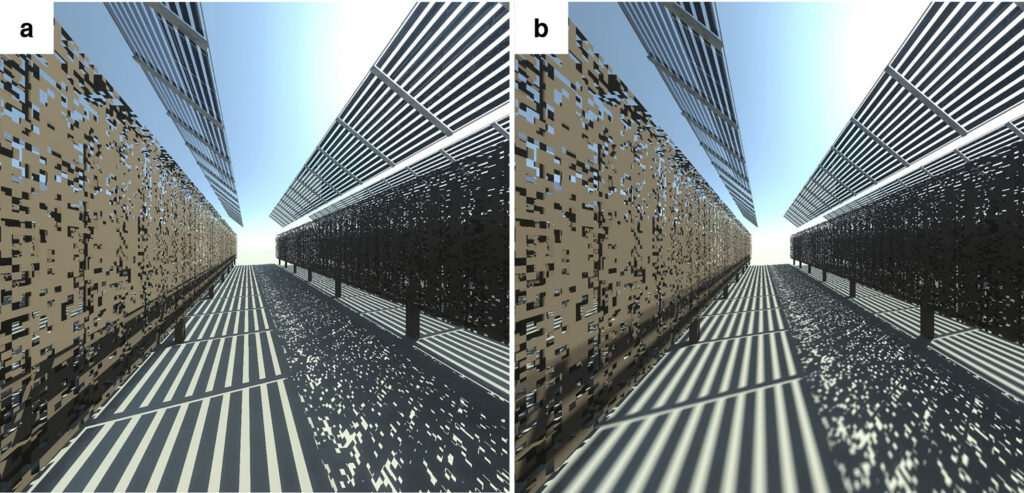
The team’s methodology consisted of three main steps. First, the researchers generated realistic lighting conditions using local weather and atmospheric data. They employed the SMARTS radiative transfer model to compute the spectral composition of direct sunlight and diffuse sky radiation, integrating these results into Radiance’s sky generation tools. In addition, they represented the solar disk using multiple proxy suns arranged on a Fibonacci lattice, enabling more accurate simulation of soft shadows (penumbra effects). Furthermore, they developed a dynamic orchard canopy model that adapts to seasonal growth patterns, capturing sunflecks and temporal changes in light transmission through the canopy.
After developing the framework, the researchers applied it to a narrow-trained agrivoltaic apple orchard in Bolzano, Italy. The simulated canopy measured 0.4 m × 3 m × 2.6 m and was modeled with a final gap fraction of 40%, incorporating seasonal leaf growth and daily updates in foliage density. Orchard rows were spaced 2.5 m apart and oriented at 110°/290° azimuth. The agrivoltaic configuration included half-cell PV modules with 18.2 cm × 9.1 cm cells mounted on trackers with a hub height of 4 m and row spacing of 3.25 m. Weather and atmospheric data were combined with hourly ray-tracing simulations using 18 spectral bands spanning 300–1200 nm to evaluate photosynthetically active radiation throughout the canopy.
“The canopy model parameterizes porosity and seasonal development on a daily basis,” the group concluded. “Canopy representation matters: opaque, static models—common in agri-PV simulations—systematically underestimate light levels and fail to capture the spatiotemporal patterns needed to diagnose suboptimal conditions. By contrast, a porous, dynamic model led to approximately 26% higher seasonal light levels, with gains reaching nearly 100% early in the season and converging to around 16% once foliage matured.”
The new model was described in “Tracing rays from leaves to sky: Multispectral, penumbra-aware irradiance modeling for agrivoltaic orchards,” published in Applied Energy.
The post Penumbra-aware irradiance modeling for agrivoltaic orchards appeared first on pv magazine Global.


