
A Saskatchewan ag tech company is tackling one of grain marketing’s oldest frustrations: inconsistent grain grades.
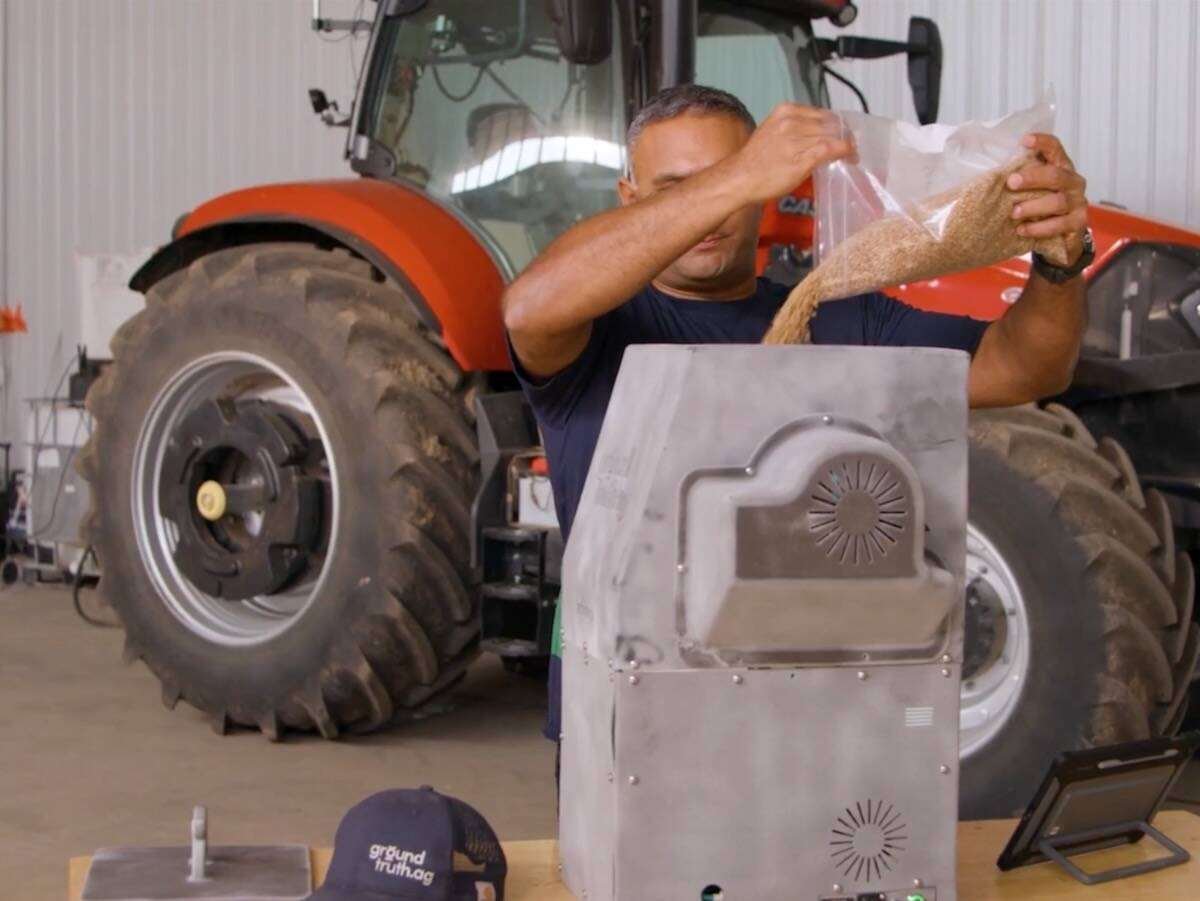
Ground Truth Agriculture, a Regina-based startup founded by serial entrepreneur Kyle Folk, has developed an automated grain grading system that combines artificial intelligence, machine vision and near-infrared spectroscopy (NIRS) to assess grain quality in minutes.
The technology provides farmers, grain companies and processors with more consistent grading information while reducing the subjectivity that can occur when grain is assessed by people.
For Folk, the idea grew out of his own experiences on the family grain farm in Saskatchewan.
“We’d send samples away for grading and sometimes you’d get different answers on the same grain,” he said. “There wasn’t a lot of insight into why.”
That uncertainty becomes especially important when farmers have already committed grain to forward contracts before harvest, and don’t know if what’s coming off the combine is the quality they committed to delivering.
“If you’re hauling grain right away, are you giving away grade value or not? Those are real decisions farmers deal with,” he added.
Ground Truth Agriculture was founded in 2021 after Folk’s first ag tech venture, the Bin-Sense grain monitoring system, was acquired. While his first company focused on protecting grain after it entered storage, he’s now working to better understand grain quality itself.
“We realized pretty quickly that if this was going to become mainstream, it couldn’t just be a protein tester,” Folk said. “It needed to provide enough information to help determine grade and explain why.”
Hard red spring wheat grading can involve dozens of characteristics and defects, so that’s a significant challenge. The company’s benchtop system analyzes grain samples using cameras and NIRS technology. The system can evaluate visual and non-visual grading factors, like insect damage, fungal disease, protein, oil content and moisture, and generate results in about three minutes.
Its hard red spring model is in the final steps of commercialization and is currently being validated with grain industry partners. Models for corn, canola, soybeans, red lentils, yellow peas, oats, faba beans and amber durum wheat are in development; future plans include barley, large green lentils, and hard red winter and Canadian prairie spring wheat.
Combine option in development
The company is also testing a version of the technology mounted directly on combines. Rather than collecting a single pail sample from each truckload, the on-combine system is designed to generate hundreds of georeferenced quality measurements across a field during harvest.
“If you sprayed for a disease or used a particular management practice, we can start connecting quality outcomes back to where they originated in the field,” Folk said. “Instead of one average sample, you’re getting a much deeper understanding of what’s happening across the quarter section.”
Long term, Folk believes grain quality data could eventually move through the supply chain digitally, with grain samples becoming less important as the data itself follows the grain.
Ground Truth Agriculture is working with commercial grain companies, researchers and farmers to refine its models, and partnered with Saskatchewan Polytechnic’s Digital Integration Centre of Excellence on machine-learning and artificial intelligence development. The start-up has received support through various innovation programs, including from Protein Industries Canada, and raised $4 million from investors such as Conexus Venture Capital’s Emmertech Fund, SaskWorks Venture Fund and Tall Grass Ventures.
More recently, Ground Truth was selected as part of the Canada V Thrive Accelerator cohort, an international program focused on scaling promising agri-food technologies.
Folk said industry interest has exceeded expectations, particularly among grain companies facing labour shortages and increasing pressure to maintain grading consistency.
“Watching an industry that has graded grain essentially the same way for more than 100 years begin to adopt new technology is pretty exciting. ,” Folk said. “That’s the next milestone — becoming part of the normal way grain is evaluated.”
The post Farm-level tech aims to bring more consistency to grain grading appeared first on Farmtario.


