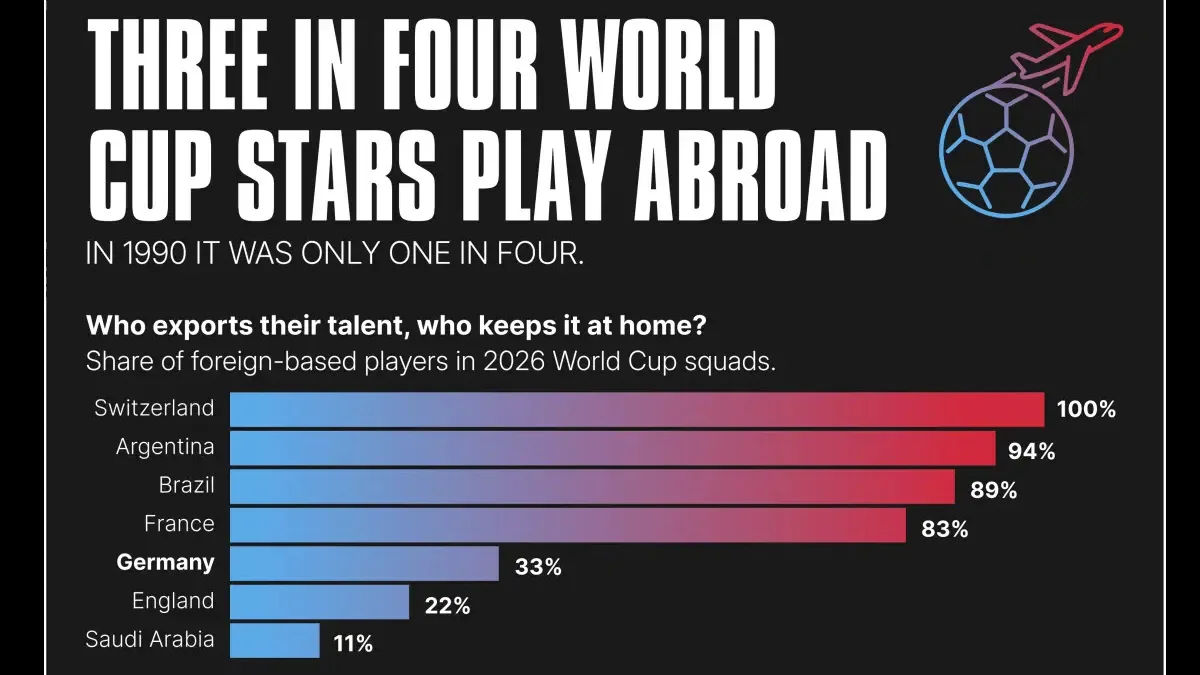
Charted: Three in Four World Cup Stars Play Abroad
This was originally posted on our Voronoi app. Download the app for free on iOS or Android and discover incredible data-driven charts from a variety of trusted sources.
Key Takeaways:
- Roughly three in four World Cup players compete for clubs outside the country they represent internationally
- Several national teams source more than 90% of their squads from foreign leagues, while others rely heavily on domestic competitions.
- Europe’s biggest leagues have become the world’s primary destination for elite football talent.
International football is played between nations, but the players themselves increasingly build their careers abroad.
Today, roughly 75% of World Cup players compete for clubs outside the country they represent, compared with about one in four in 1990. Europe’s biggest leagues have become the sport’s global talent hub, attracting elite players from nearly every continent.
This visualization, created by DataPulse using data from FinAlarm and Transfermarkt, shows which World Cup nations export the most football talent and which continue to rely primarily on domestic leagues.
Why Football Talent Moves Abroad
The biggest reason players move abroad is simple: the world’s richest leagues offer higher salaries, stronger competition, and better development opportunities. England’s Premier League, Spain’s La Liga, Germany’s Bundesliga, Italy’s Serie A, and France’s Ligue 1 attract elite talent from nearly every footballing nation.
The table below shows the share of World Cup players competing abroad.
| World Cup Teams | % of Abroad Players |
|---|---|
 Cape Verde Cape Verde |
100% |
 Curaçao Curaçao |
100% |
 DR Congo DR Congo |
100% |
 Ivory Coast Ivory Coast |
100% |
 Senegal Senegal |
100% |
 Uruguay Uruguay |
100% |
 Bosnia & Herz. Bosnia & Herz. |
96.2% |
 Colombia Colombia |
96.2% |
 Ghana Ghana |
96.2% |
 Haiti Haiti |
96.2% |
 Argentina Argentina |
92.3% |
 Croatia Croatia |
92.3% |
 Ecuador Ecuador |
92.3% |
 Morocco Morocco |
92.3% |
 Netherlands Netherlands |
92.3% |
 Panama Panama |
92.3% |
 Switzerland Switzerland |
92.3% |
 Canada Canada |
92.0% |
 Algeria Algeria |
88.5% |
 Belgium Belgium |
88.5% |
 Japan Japan |
88.5% |
 Paraguay Paraguay |
88.5% |
 Sweden Sweden |
88.5% |
 Austria Austria |
88.0% |
 Norway Norway |
84.6% |
 Australia Australia |
80.8% |
 Portugal Portugal |
80.8% |
 Tunisia Tunisia |
76.9% |
 Brazil Brazil |
73.1% |
 South Korea South Korea |
73.1% |
 USA USA |
73.1% |
 France France |
69.2% |
 New Zealand New Zealand |
69.2% |
 Scotland Scotland |
69.2% |
 Iraq Iraq |
61.5% |
 Jordan Jordan |
57.7% |
 Mexico Mexico |
53.8% |
 Türkiye Türkiye |
42.3% |
 Uzbekistan Uzbekistan |
42.3% |
 Czechia Czechia |
34.6% |
 Egypt Egypt |
34.6% |
 Iran Iran |
34.6% |
 Spain Spain |
34.6% |
 Germany Germany |
26.9% |
 South Africa South Africa |
26.9% |
| England |
19.2% |
 Qatar Qatar |
3.8% |
 Saudi Arabia Saudi Arabia |
3.8% |
The data highlights just how international modern football has become. While some countries retain a larger share of players in domestic leagues, many squads rely overwhelmingly on athletes who compete overseas, particularly in Europe’s top divisions.
National Teams, Global Careers
The World Cup creates an unusual contrast. While players unite under their national flags during major tournaments, many spend the rest of their careers alongside teammates from dozens of other countries.
Studies from both Phys.org and Oxford University’s COMPAS Migration Observatory suggest that countries with greater access to international football networks often benefit from enhanced player development and broader talent pipelines. Researchers examining international football migration have found that player mobility can strengthen national teams by exposing athletes to higher levels of competition and tactical diversity.
The European Magnet Effect
European football clubs sit at the center of the global talent market. The continent’s leading leagues generate billions in broadcasting revenue and consistently attract top players from Africa, Asia, the Americas, and Oceania.
This concentration of talent creates a powerful feedback loop. Players move abroad to improve their careers, while clubs gain access to deeper talent pools. National teams then benefit when these players return for international competition with experience gained at some of the world’s strongest clubs.
A Surprising Contrast
One of the clearest patterns in the data is how differently countries develop elite football talent. African nations such as Senegal, Morocco, and Cameroon have some of the highest shares of national team players competing abroad, with many stars building their careers in Europe’s top leagues.
By contrast, countries including Saudi Arabia, Qatar, and the United Arab Emirates retain a much larger share of their talent in domestic competitions after investing heavily in local leagues.
The result is two distinct development models: one that exports elite players to stronger overseas competitions, and another that prioritizes building competitive domestic leagues while keeping more national team players at home.
The modern World Cup is both a competition between nations and a showcase of football’s highly interconnected global labor market.
Learn More on the Voronoi App 
Football’s globalization extends beyond players to the clubs themselves. See which organizations command the greatest brand value in The World’s Most Valuable Football Club Brands on the Voronoi app.