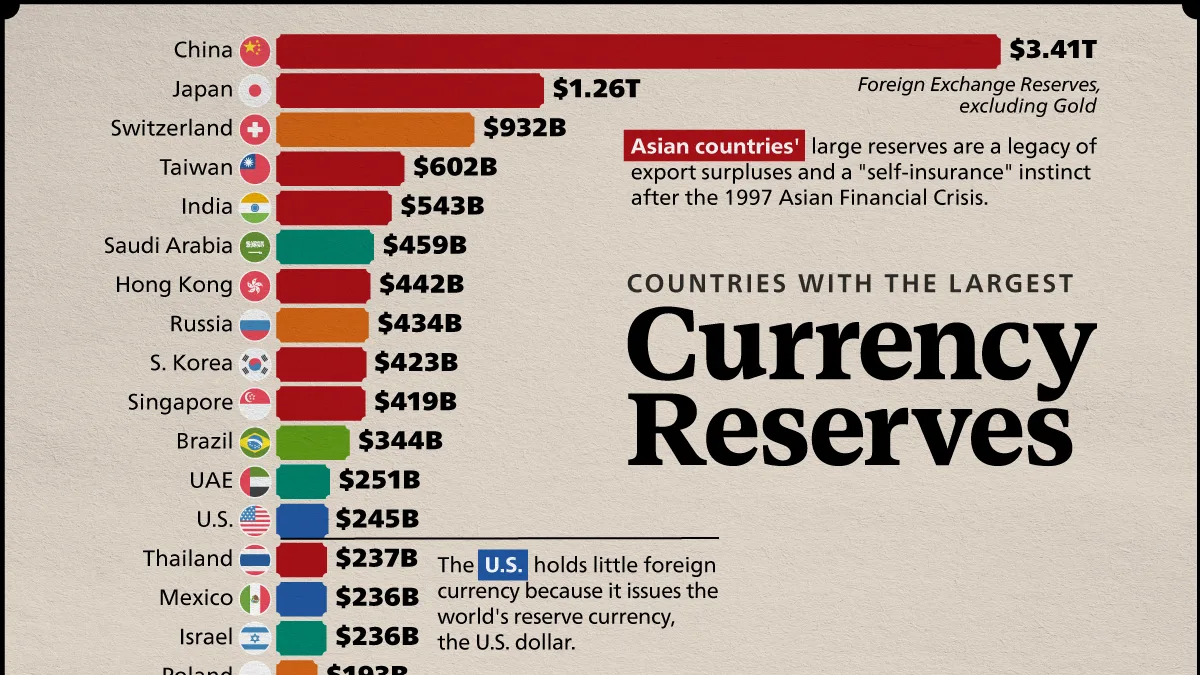
Ranked: Countries with the Largest Currency Reserves
See visuals like this from many other data creators on our Voronoi app. Download the app for free on iOS or Android and discover incredible data-driven charts from a variety of trusted sources.
Key Takeaways:
- China holds over $3.4 trillion in foreign exchange reserves, nearly 3x more than Japan.
- Seven of the world’s 10 largest reserve holders are in Asia, reflecting decades of export-led growth.
- Despite being the world’s largest economy, the U.S. ranks only 13th because the dollar is the world’s primary reserve currency.
Today’s largest reserve holders were shaped by a crisis that happened nearly three decades ago.
After the 1997 Asian Financial Crisis exposed the risks of relying on foreign capital during market turmoil, many governments began building massive foreign exchange reserves as a form of economic self-insurance.
Using data from the IMF’s International Reserves and Foreign Currency Liquidity (IRFCL) database, this visualization ranks countries by their foreign exchange reserves excluding gold, based on the latest available reporting periods from mid-2025 through Q2 2026.
The Countries Holding the Most Reserves
The table below shows the countries with the largest foreign exchange reserve holdings.
| Rank | Country | Foreign Exchange Reserves ($B) | Region |
|---|---|---|---|
| 1 |  China China |
3,410.5 | Asia |
| 2 |  Japan Japan |
1,259.2 | Asia |
| 3 |  Switzerland Switzerland |
932.3 | Europe |
| 4 |  Taiwan Taiwan |
602.5 | Asia |
| 5 |  India India |
543.0 | Asia |
| 6 |  Saudi Arabia Saudi Arabia |
458.6 | Middle East |
| 7 |  Hong Kong Hong Kong |
442.1 | Asia |
| 8 |  Russia Russia |
434.5 | Europe/Eurasia |
| 9 |  South Korea South Korea |
423.1 | Asia |
| 10 |  Singapore Singapore |
419.3 | Asia |
| 11 |  Brazil Brazil |
344.2 | Latin America |
| 12 |  United Arab Emirates United Arab Emirates |
251.4 | Middle East |
| 13 |  United States United States |
244.6 | North America |
| 14 |  Thailand Thailand |
237.1 | Asia |
| 15 |  Mexico Mexico |
236.2 | Latin America |
| 16 |  Israel Israel |
235.7 | Middle East |
| 17 |  Poland Poland |
193.2 | Europe |
| 18 |  United Kingdom United Kingdom |
162.9 | Europe |
| 19 |  Czechia Czechia |
154.5 | Europe |
| 20 |  Indonesia Indonesia |
146.2 | Asia |
| 21 |  Malaysia Malaysia |
117.2 | Asia |
| 22 |  Germany Germany |
102.8 | Europe |
| 23 |  Philippines Philippines |
91.5 | Asia |
| 24 |  Italy Italy |
88.6 | Europe |
| 25 |  Denmark Denmark |
88.5 | Europe |
| 26 |  Spain Spain |
87.3 | Europe |
| 27 |  France France |
86.0 | Europe |
| 28 |  Iraq Iraq |
85.0 | Middle East |
| 29 |  Romania Romania |
78.2 | Europe |
| 30 |  Turkey Turkey |
76.6 | Europe/Eurasia |
One clear pattern stands out in the rankings: Asia dominates.
Seven of the world’s 10 largest reserve holders are located in the region, together accounting for roughly two-thirds of global foreign exchange reserves. This concentration reflects decades of export-led growth, persistent trade surpluses, and a policy focus on maintaining large financial buffers.
Why the U.S. Ranks So Low
One of the most surprising aspects of the rankings is the relatively low position of the United States. Although it remains the world’s largest economy, the U.S. holds far fewer foreign exchange reserves than many Asian economies and ranks only 13th globally.
The explanation lies in the unique role of the U.S. dollar. Because the dollar serves as the world’s primary reserve currency and dominates global trade, the United States generally does not need to accumulate large quantities of foreign currencies.
Countries around the world demand dollars for trade, investment, and central bank reserves, allowing the U.S. to settle obligations in its own currency.
As a result, U.S. policymakers allow the dollar to float freely rather than actively managing its exchange rate through large-scale reserve interventions. This contrasts with many export-oriented economies that maintain substantial reserve stockpiles to support financial stability and manage currency fluctuations.
Why Countries Build Massive Currency Reserves
Foreign exchange reserves act as a country’s emergency fund. Central banks can use them to stabilize currencies during market turmoil, pay for essential imports, service foreign debt, or reassure investors during periods of capital flight.
The larger the reserve buffer, the greater a country’s ability to respond to external economic shocks without relying on foreign assistance.
The importance of reserve accumulation became especially clear after the 1997 Asian Financial Crisis. Many Asian economies experienced severe currency collapses and were forced to seek external assistance. In the years that followed, governments across the region adopted a strategy of building substantial reserve buffers as a form of economic self-insurance.
What Large Reserves Mean for the Global Economy
Large reserve holdings can provide important benefits. Countries with substantial reserves are often better positioned to weather external shocks and maintain investor confidence during periods of market stress.
However, reserves also come with costs. Funds invested in reserve assets are typically held in low-yield government securities rather than being deployed elsewhere in the economy. Policymakers must therefore balance the security provided by reserves against the opportunity cost of holding them.
The rankings illustrate how global financial influence extends beyond the size of an economy alone. While the U.S. remains central to the international monetary system because of the dollar’s dominant role, Asia’s massive reserve holdings underscore the region’s importance in global trade, manufacturing, and cross-border capital flows.
Learn More on the Voronoi App 
Want to explore how currencies have performed against one another in a rapidly changing global economy?
Check out Mapped: How Major Currency Performance Shifted in 2025 on the Voronoi app to see which currencies have strengthened, weakened, and reshaped global markets this year.