Why Are Europeans Leaving Their Own Countries?
This was originally posted on our Voronoi app. Download the app for free on iOS or Android and discover incredible data-driven charts from a variety of trusted sources.
Key Takeaways:
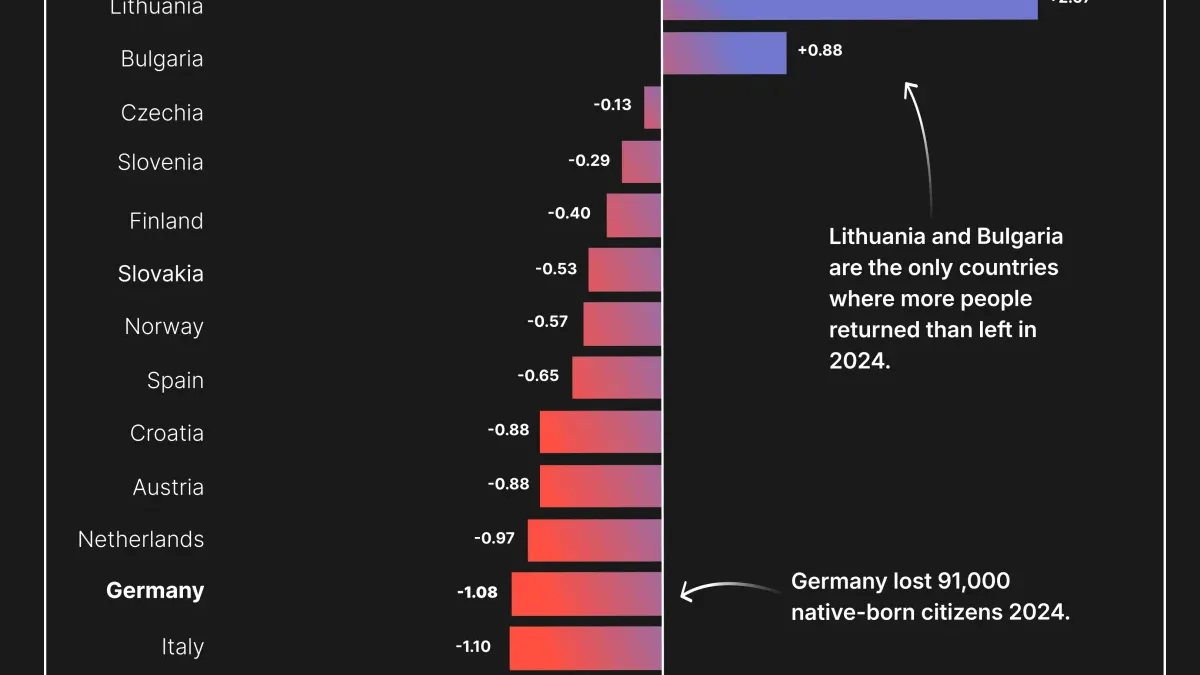
- Lithuania and Bulgaria were the only countries in this dataset where more native-born citizens returned than left in 2024.
- Germany, Italy, the Netherlands, and most other countries recorded net losses of native-born residents, highlighting a broader shift in where Europeans choose to live and work.
While immigration often dominates discussions about Europe’s changing population, another migration trend receives far less attention: many countries are also losing their own native-born citizens.
This visualization, created by DataPulse using Eurostat data, ranks selected European countries by the net migration of native-born residents in 2024. Only Lithuania and Bulgaria recorded net gains, while Germany, Italy, Sweden, and several other major economies saw more locally born citizens leave than return.
The pattern reflects a mix of economic opportunity, housing affordability, demographic change, and labor mobility within Europe, all of which are reshaping where people choose to build their careers and lives.
The Countries Seeing the Biggest Losses
The table below shows net migration of native-born citizens per 1,000 inhabitants across selected European countries.
| Country | Native-Born Net Migration (Per 1,000 inhabitants) |
|---|---|
 Lithuania Lithuania |
2.67 |
 Bulgaria Bulgaria |
0.88 |
 Czechia Czechia |
-0.13 |
 Slovenia Slovenia |
-0.29 |
 Finland Finland |
-0.40 |
 Slovakia Slovakia |
-0.53 |
 Norway Norway |
-0.57 |
 Spain Spain |
-0.65 |
 Croatia Croatia |
-0.88 |
 Austria Austria |
-0.88 |
 Netherlands Netherlands |
-0.97 |
 Germany Germany |
-1.08 |
 Italy Italy |
-1.10 |
 Romania Romania |
-1.15 |
 Estonia Estonia |
-1.20 |
 Sweden Sweden |
-1.23 |
 Belgium Belgium |
-1.27 |
 Luxembourg Luxembourg |
-2.35 |
Lithuania stands out with a positive rate of 2.67 per 1,000 inhabitants, while Bulgaria also records a modest gain. At the opposite end, Luxembourg posted the largest net loss, followed by Belgium, Sweden, Estonia, and Romania.
Notably, several of Europe’s largest economies, including Germany, Italy, and the Netherlands, also show negative balances, indicating that more native-born residents are leaving than returning.
Why Are Native Europeans Leaving?
For many workers, especially younger and highly educated professionals, migration is driven by the search for better wages, stronger career prospects, and improved quality of life. Countries in Eastern and Southern Europe have long experienced outward migration toward larger labor markets in Western Europe.
At the same time, rising housing costs, labor shortages, and demographic pressures are encouraging some workers to look beyond their home countries. Similar dynamics can be seen globally, where migration increasingly plays a role in population growth and workforce sustainability.
A Growing Demographic Challenge
Population researchers increasingly warn that migration alone cannot fully offset Europe’s broader demographic headwinds. Fertility rates remain below replacement levels across much of the continent, while populations continue to age.
When highly skilled workers leave and do not return, the effects can extend beyond population figures. Regions may face slower economic growth, labor shortages, and reduced innovation capacity. As Europe navigates demographic decline, retaining talent may become just as important as attracting newcomers.
Learn More on the Voronoi App 
Migration patterns continue to reshape economies and societies around the world. Explore Visualizing the World’s Busiest Migration Corridors on the Voronoi app to see how people move between countries at a global scale.