The World’s Most and Least Peaceful Countries in 2026
See visuals like this from many other data creators on our Voronoi app. Download it for free on iOS or Android and discover incredible data-driven charts from a variety of trusted sources.
Key Takeaways
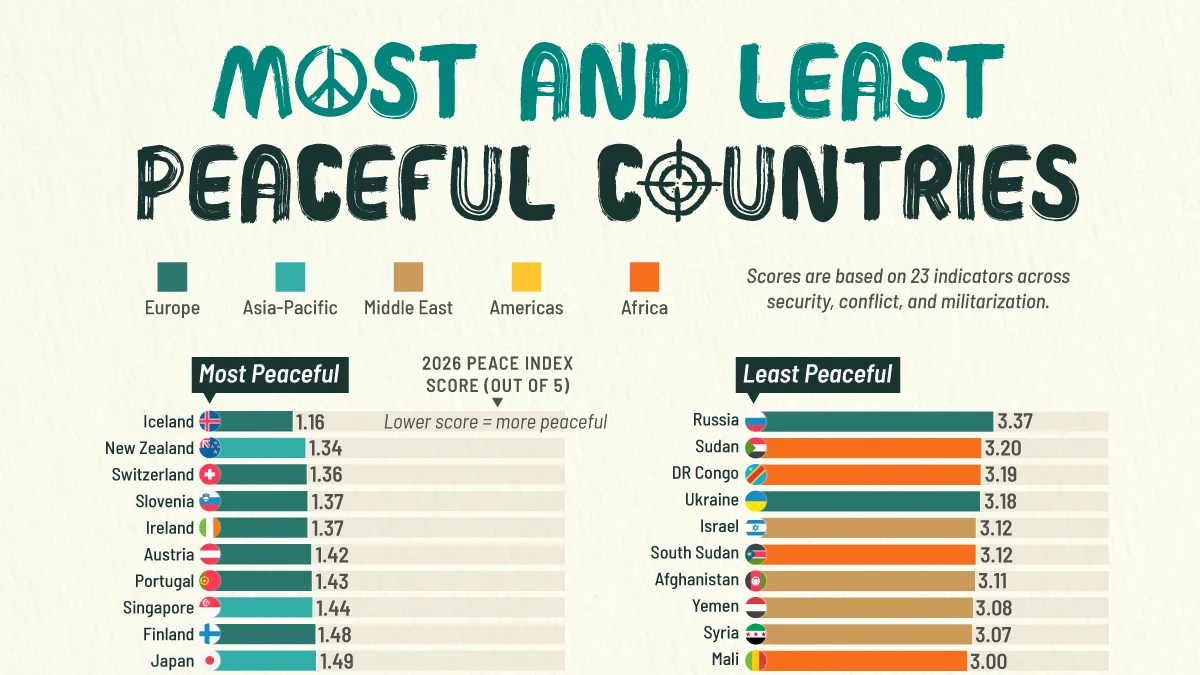
- Iceland remains the world’s most peaceful country, while Russia ranks last in the 2026 Global Peace Index.
- Western Europe dominates the top of the rankings, with seven of the world’s 10 most peaceful countries.
- Global peacefulness declined for a 12th straight year, while the U.S. fell to 134th amid worsening political instability.
The world is becoming less peaceful.
According to the 2026 Global Peace Index by the Institute for Economics and Peace, global peacefulness declined for the 12th consecutive year, as armed conflicts, geopolitical fragmentation, and rising military spending continue to reshape international stability.
This ranking shows the world’s most and least peaceful countries across 163 economies, based on 23 indicators measuring societal safety, conflict, and militarization.
The World’s Most Peaceful Countries
Western Europe continues to dominate the top of the rankings, with Iceland retaining first place for the 19th consecutive year. It is joined by New Zealand, Switzerland, Slovenia, and Ireland as the world’s five most peaceful countries.
The table below shows the world’s 30 most peaceful countries.
| Rank | Country | 2026 Global Peace Index Score (Out of 5) |
Region |
|---|---|---|---|
| 1 |  Iceland Iceland |
1.16 | Europe |
| 2 |  New Zealand New Zealand |
1.34 | Asia-Pacific |
| 3 |  Switzerland Switzerland |
1.36 | Europe |
| 4 |  Slovenia Slovenia |
1.37 | Europe |
| 5 |  Ireland Ireland |
1.37 | Europe |
| 6 |  Austria Austria |
1.42 | Europe |
| 7 |  Portugal Portugal |
1.43 | Europe |
| 8 |  Singapore Singapore |
1.44 | Asia-Pacific |
| 9 |  Finland Finland |
1.48 | Europe |
| 10 |  Japan Japan |
1.49 | Asia-Pacific |
| 11 |  Denmark Denmark |
1.50 | Europe |
| 12 |  Malaysia Malaysia |
1.51 | Asia-Pacific |
| 13 |  Czechia Czechia |
1.52 | Europe |
| 14 |  Canada Canada |
1.53 | Americas |
| 15 |  Hungary Hungary |
1.54 | Europe |
| 16 |  Bhutan Bhutan |
1.55 | Asia-Pacific |
| 17 |  Netherlands Netherlands |
1.57 | Europe |
| 18 |  Mauritius Mauritius |
1.59 | Africa |
| 19 |  Latvia Latvia |
1.59 | Europe |
| 20 |  Australia Australia |
1.60 | Asia-Pacific |
| 21 |  Belgium Belgium |
1.61 | Europe |
| 22 |  Poland Poland |
1.62 | Europe |
| 23 |  Croatia Croatia |
1.62 | Europe |
| 24 |  Lithuania Lithuania |
1.62 | Europe |
| 25 |  Estonia Estonia |
1.62 | Europe |
| 26 |  Bulgaria Bulgaria |
1.63 | Europe |
| 27 |  Spain Spain |
1.65 | Europe |
| 28 |  Germany Germany |
1.66 | Europe |
| 29 |  Slovakia Slovakia |
1.66 | Europe |
| 30 |  Montenegro Montenegro |
1.67 | Europe |
The World’s Least Peaceful Countries
At the opposite end of the index, Russia ranks as the least peaceful country, followed by Sudan, the Democratic Republic of the Congo, Ukraine, and Israel.
| Rank | Country | 2026 Global Peace Index Score (Out of 5) |
Region |
|---|---|---|---|
| 163 |  Russia Russia |
3.37 | Europe |
| 162 |  Sudan Sudan |
3.20 | Africa |
| 161 |  DR Congo DR Congo |
3.19 | Africa |
| 160 |  Ukraine Ukraine |
3.18 | Europe |
| 159 |  Israel Israel |
3.12 | Middle East |
| 158 |  South Sudan South Sudan |
3.12 | Africa |
| 157 |  Afghanistan Afghanistan |
3.11 | Asia-Pacific |
| 156 |  Yemen Yemen |
3.08 | Middle East |
| 155 |  Syria Syria |
3.07 | Middle East |
| 154 |  Mali Mali |
3.00 | Africa |
| 153 |  Somalia Somalia |
2.97 | Africa |
| 152 |  Pakistan Pakistan |
2.92 | Asia-Pacific |
| 151 |  Myanmar Myanmar |
2.91 | Asia-Pacific |
| 150 |  Central African Republic Central African Republic |
2.91 | Africa |
| 149 |  Burkina Faso Burkina Faso |
2.88 | Africa |
| 148 |  Palestine Palestine |
2.88 | Middle East |
| 147 |  North Korea North Korea |
2.85 | Asia-Pacific |
| 146 |  Niger Niger |
2.83 | Africa |
| 145 |  Chad Chad |
2.77 | Africa |
| 144 |  Iran Iran |
2.76 | Middle East |
| 143 |  Haiti Haiti |
2.76 | Americas |
| 142 |  Nigeria Nigeria |
2.76 | Africa |
| 141 |  Colombia Colombia |
2.74 | Americas |
| 140 |  Iraq Iraq |
2.66 | Middle East |
| 139 |  Mexico Mexico |
2.65 | Americas |
| 138 |  Ethiopia Ethiopia |
2.65 | Africa |
| 137 |  Cameroon Cameroon |
2.63 | Africa |
| 136 |  Türkiye Türkiye |
2.61 | Middle East |
| 135 |  Ecuador Ecuador |
2.54 | Americas |
| 134 |  U.S. U.S. |
2.54 | Americas |
The World Is Becoming Less Peaceful
The rankings reflect a world where conflict is becoming both more widespread and more persistent.
Since 2008, 119 countries have become less peaceful, and the trend is continuing. Over the past year alone, 99 countries saw their peace scores deteriorate, compared with just 62 that improved.
A surge in armed conflict is a major reason why. The world is experiencing more active state-based conflicts than at any time since World War II, while the number of countries involved in conflicts beyond their borders is up nearly 75% since 2008.
Meanwhile, governments are continuing to bolster their militaries. Global military spending has now risen for 10 consecutive years, reflecting a world increasingly shaped by geopolitical rivalry and security concerns.
Why the U.S. Fell to 134th
The United States ranked 134th out of 163 countries, falling six places from last year.
The decline was driven primarily by worsening political instability and an increase in violent demonstrations, which contributed to lower scores for societal safety and security. Today, political violence in the U.S. is at its highest level since the 1970s.
While the U.S. remains one of the world’s leading economic and military powers, the Global Peace Index measures a country’s level of peacefulness rather than its economic strength or geopolitical influence.
The report also points to declining trust in institutions as a factor weighing on America’s long-term trajectory. Together, these trends pushed the U.S. into the bottom 30 countries globally for peacefulness in 2026.
Learn More on the Voronoi App 
To learn more about this topic, check out this graphic showing global military spending in 2025.