Mapped: Where Safe Drinking Water Is Still Out of Reach
This was originally posted on our Voronoi app. Download the app for free on iOS or Android and discover incredible data-driven charts from a variety of trusted sources.
Key Takeaways:
- More than 2 billion people still lack access to safely managed drinking water services.
- Access exceeds 99% across much of Europe, North America, and Australia, but remains below 20% in several low-income countries.
- The UN defines safe drinking water as water that is available on premises, free from contamination, and accessible when needed.
Access to safe drinking water has improved dramatically over the past few decades, yet more than 2 billion people still lack safely managed drinking water services at home.
The gap between countries remains enormous, with access approaching universal levels in many wealthy economies while millions elsewhere continue to rely on unsafe or unreliable sources.
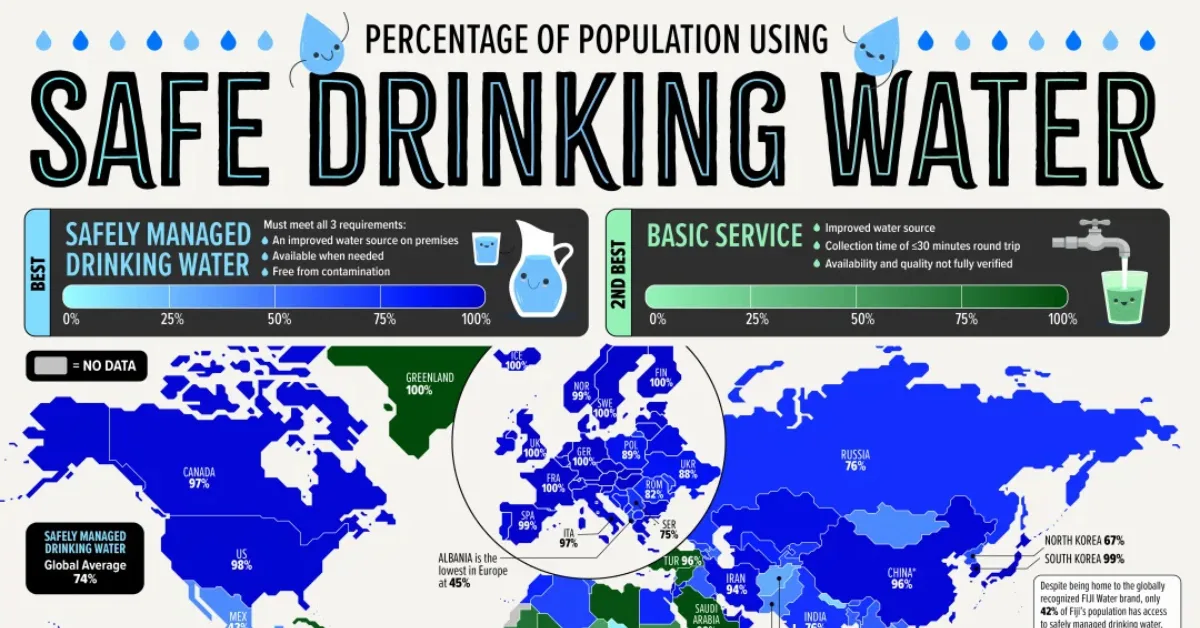
This map by Julie R. Peasley uses data from UN Water and Our World in Data to show the share of each country’s population with access to safely managed drinking water services, highlighting where clean water infrastructure is well established and where major challenges remain.
Which Countries Have the Safest Drinking Water?
The table below shows access to safely managed drinking water services around the world.
| Country | Share of the population using safe drinking water |
Category |
|---|---|---|
 Afghanistan Afghanistan |
31 | Safely managed service |
 Albania Albania |
71 | Safely managed service |
 Algeria Algeria |
69 | Safely managed service |
 Andorra Andorra |
91 | Safely managed service |
 Angola Angola |
68 | Basic service only |
 Antigua and Barbuda Antigua and Barbuda |
99 | Basic service only |
 Argentina Argentina |
100 | Urban only basic service |
 Armenia Armenia |
82 | Safely managed service |
 Australia Australia |
100 | Urban only safely managed service |
 Austria Austria |
99 | Safely managed service |
 Azerbaijan Azerbaijan |
58 | Safely managed service |
 Bahrain Bahrain |
99 | Safely managed service |
 Bangladesh Bangladesh |
59 | Safely managed service |
 Barbados Barbados |
99 | Basic service only |
 Belarus Belarus |
93 | Safely managed service |
 Belgium Belgium |
100 | Safely managed service |
 Belize Belize |
95 | Basic service only |
 Benin Benin |
18 | Safely managed service |
 Bhutan Bhutan |
66 | Safely managed service |
 Bolivia Bolivia |
93 | Basic service only |
 Bosnia and Herzegovina Bosnia and Herzegovina |
86 | Safely managed service |
 Botswana Botswana |
63 | Safely managed service |
 Brazil Brazil |
89 | Safely managed service |
 Brunei Brunei |
100 | Basic service only |
 Bulgaria Bulgaria |
96 | Safely managed service |
 Burkina Faso Burkina Faso |
50 | Basic service only |
 Burundi Burundi |
66 | Basic service only |
 Cambodia Cambodia |
30 | Safely managed service |
 Cameroon Cameroon |
71 | Basic service only |
 Canada Canada |
97 | Safely managed service |
 Central African Republic Central African Republic |
6 | Safely managed service |
 Chad Chad |
6 | Safely managed service |
 Chile Chile |
98 | Safely managed service |
 China China |
96 | Urban only safely managed service |
 Colombia Colombia |
74 | Safely managed service |
 Congo Congo |
46 | Safely managed service |
 Costa Rica Costa Rica |
81 | Safely managed service |
 Cote d’Ivoire Cote d’Ivoire |
36 | Safely managed service |
 Croatia Croatia |
87 | Safely managed service |
 Cuba Cuba |
95 | Basic service only |
 Cyprus Cyprus |
100 | Safely managed service |
 Czechia Czechia |
98 | Safely managed service |
 Democratic Republic of Congo Democratic Republic of Congo |
12 | Safely managed service |
 Denmark Denmark |
100 | Safely managed service |
 Djibouti Djibouti |
80 | Basic service only |
 Dominican Republic Dominican Republic |
45 | Safely managed service |
 Ecuador Ecuador |
70 | Safely managed service |
 Egypt Egypt |
79 | Safely managed service |
 El Salvador El Salvador |
76 | Urban only safely managed service |
 Estonia Estonia |
99 | Safely managed service |
 Eswatini Eswatini |
38 | Safely managed service |
 Ethiopia Ethiopia |
14 | Safely managed service |
 Fiji Fiji |
42 | Safely managed service |
 Finland Finland |
100 | Safely managed service |
 France France |
100 | Safely managed service |
 French Guiana French Guiana |
92 | Safely managed service |
 Gabon Gabon |
89 | Basic service only |
 Gambia Gambia |
48 | Safely managed service |
 Georgia Georgia |
71 | Safely managed service |
 Germany Germany |
100 | Safely managed service |
 Ghana Ghana |
43 | Safely managed service |
 Greece Greece |
97 | Safely managed service |
 Greenland Greenland |
100 | Basic service only |
 Guatemala Guatemala |
49 | Safely managed service |
 Guinea Guinea |
74 | Basic service only |
 Guinea-Bissau Guinea-Bissau |
24 | Safely managed service |
 Guyana Guyana |
67 | Safely managed service |
 Haiti Haiti |
73 | Basic service only |
 Honduras Honduras |
66 | Safely managed service |
 Hungary Hungary |
100 | Safely managed service |
 Iceland Iceland |
100 | Safely managed service |
 India India |
76 | Safely managed service |
 Indonesia Indonesia |
30 | Safely managed service |
 Iran Iran |
94 | Safely managed service |
 Iraq Iraq |
60 | Safely managed service |
 Ireland Ireland |
96 | Safely managed service |
 Israel Israel |
99 | Safely managed service |
 Italy Italy |
97 | Safely managed service |
 Jamaica Jamaica |
88 | Basic service only |
 Japan Japan |
99 | Safely managed service |
 Jordan Jordan |
89 | Safely managed service |
 Kazakhstan Kazakhstan |
92 | Safely managed service |
 Kenya Kenya |
66 | Basic service only |
 Kiribati Kiribati |
15 | Safely managed service |
 Kuwait Kuwait |
100 | Safely managed service |
 Kyrgyzstan Kyrgyzstan |
74 | Safely managed service |
 Laos Laos |
35 | Safely managed service |
 Latvia Latvia |
97 | Safely managed service |
 Lebanon Lebanon |
48 | Safely managed service |
 Lesotho Lesotho |
31 | Safely managed service |
 Liberia Liberia |
79 | Basic service only |
 Libya Libya |
96 | Basic service only |
 Liechtenstein Liechtenstein |
100 | Safely managed service |
 Lithuania Lithuania |
97 | Safely managed service |
 Luxembourg Luxembourg |
100 | Safely managed service |
 Madagascar Madagascar |
22 | Safely managed service |
 Malawi Malawi |
18 | Safely managed service |
 Malaysia Malaysia |
95 | Safely managed service |
 Maldives Maldives |
100 | Basic service only |
 Mali Mali |
86 | Basic service only |
 Malta Malta |
100 | Safely managed service |
 Marshall Islands Marshall Islands |
87 | Basic service only |
 Mauritania Mauritania |
77 | Basic service only |
 Mauritius Mauritius |
100 | Basic service only |
 Mexico Mexico |
43 | Safely managed service |
 Moldova Moldova |
76 | Safely managed service |
 Monaco Monaco |
100 | Safely managed service |
 Mongolia Mongolia |
43 | Safely managed service |
 Montenegro Montenegro |
86 | Safely managed service |
 Morocco Morocco |
80 | Safely managed service |
 Mozambique Mozambique |
28 | Safely managed service |
 Myanmar Myanmar |
60 | Safely managed service |
 Namibia Namibia |
87 | Basic service only |
 Nauru Nauru |
19 | Safely managed service |
 Nepal Nepal |
16 | Safely managed service |
 Netherlands Netherlands |
100 | Safely managed service |
 New Caledonia New Caledonia |
97 | Safely managed service |
 New Zealand New Zealand |
100 | Safely managed service |
 Nicaragua Nicaragua |
56 | Safely managed service |
 Niger Niger |
53 | Basic service only |
 Nigeria Nigeria |
30 | Safely managed service |
 North Korea North Korea |
67 | Safely managed service |
 North Macedonia North Macedonia |
81 | Safely managed service |
 Norway Norway |
99 | Safely managed service |
 Oman Oman |
91 | Safely managed service |
 Pakistan Pakistan |
45 | Safely managed service |
 Palau Palau |
91 | Safely managed service |
 Palestine Palestine |
81 | Safely managed service |
 Panama Panama |
95 | Basic service only |
 Papua New Guinea Papua New Guinea |
53 | Basic service only |
 Paraguay Paraguay |
64 | Safely managed service |
 Peru Peru |
49 | Safely managed service |
 Philippines Philippines |
48 | Safely managed service |
 Poland Poland |
89 | Safely managed service |
 Portugal Portugal |
95 | Safely managed service |
 Puerto Rico Puerto Rico |
99 | Safely managed service |
 Qatar Qatar |
95 | Safely managed service |
 Romania Romania |
82 | Safely managed service |
 Russia Russia |
76 | Safely managed service |
 Rwanda Rwanda |
53 | Urban only safely managed service |
 Saint Lucia Saint Lucia |
98 | Basic service only |
 Samoa Samoa |
63 | Safely managed service |
 San Marino San Marino |
100 | Safely managed service |
 Sao Tome and Principe Sao Tome and Principe |
37 | Safely managed service |
 Saudi Arabia Saudi Arabia |
99 | Basic service only |
 Senegal Senegal |
27 | Safely managed service |
 Serbia Serbia |
75 | Safely managed service |
 Seychelles Seychelles |
65 | Safely managed service |
 Sierra Leone Sierra Leone |
11 | Safely managed service |
 Singapore Singapore |
100 | Safely managed service |
 Slovakia Slovakia |
100 | Safely managed service |
 Slovenia Slovenia |
100 | Safely managed service |
 Solomon Islands Solomon Islands |
72 | Basic service only |
 Somalia Somalia |
75 | Basic service only |
 South Africa South Africa |
68 | Safely managed service |
 South Korea South Korea |
99 | Safely managed service |
 South Sudan South Sudan |
40 | Basic service only |
 Spain Spain |
99 | Safely managed service |
 Sri Lanka Sri Lanka |
47 | Safely managed service |
 Suriname Suriname |
56 | Safely managed service |
 Sweden Sweden |
100 | Safely managed service |
 Switzerland Switzerland |
97 | Safely managed service |
 Syria Syria |
94 | Basic service only |
 Tajikistan Tajikistan |
65 | Safely managed service |
 Tanzania Tanzania |
31 | Safely managed service |
 Thailand Thailand |
100 | Basic service only |
 Togo Togo |
21 | Safely managed service |
 Tonga Tonga |
30 | Safely managed service |
 Trinidad and Tobago Trinidad and Tobago |
69 | Safely managed service |
 Tunisia Tunisia |
65 | Safely managed service |
 Türkiye Türkiye |
96 | Basic service only |
 Turkmenistan Turkmenistan |
95 | Safely managed service |
 Tuvalu Tuvalu |
9 | Safely managed service |
 Uganda Uganda |
18 | Safely managed service |
 Ukraine Ukraine |
88 | Safely managed service |
 United Arab Emirates United Arab Emirates |
99 | Safely managed service |
 United Kingdom United Kingdom |
100 | Safely managed service |
 United States United States |
98 | Safely managed service |
 Uruguay Uruguay |
91 | Safely managed service |
 Uzbekistan Uzbekistan |
82 | Safely managed service |
 Vanuatu Vanuatu |
19 | Safely managed service |
 Venezuela Venezuela |
93 | Basic service only |
 Vietnam Vietnam |
59 | Safely managed service |
 Yemen Yemen |
75 | Basic service only |
 Zambia Zambia |
50 | Urban only safely managed service |
 Zimbabwe Zimbabwe |
25 | Safely managed service |
The global divide is striking. Countries including Australia, Belgium, Finland, and the U.K. report access rates close to or at 100%, while countries such as Chad, the Central African Republic, and Benin remain below 20%. These differences reflect decades of investment in water infrastructure, treatment systems, and public utilities.
Countries with the highest levels of access generally benefit from extensive water treatment systems and reliable utilities. Meanwhile, lower-income countries often face challenges related to funding, rapid population growth, and climate pressures.
What Counts as Safe Drinking Water?
The United Nations tracks progress through a metric known as “safely managed drinking water services.” This goes beyond simply having a water source nearby.
To qualify, drinking water must come from an improved source, be located on premises, be available when needed, and be free from contamination. These standards are part of Sustainable Development Goal 6, which aims to ensure clean water and sanitation for all.
Safe drinking water is closely tied to public health, education, and economic productivity. Reliable water systems reduce exposure to waterborne diseases, improve school attendance, and support broader economic development.
Why Do Some Countries Lag Behind?
In many regions, communities may rely on water sources that are vulnerable to contamination from sewage, industrial waste, or agricultural runoff. Rural populations can face additional challenges when extending water networks becomes prohibitively expensive.
Climate change is also increasing pressure on water systems, while growing populations are placing additional demand on already-stressed supplies. Differences in consumption patterns can also influence water management challenges, particularly in countries with high levels of water use per person.
Despite these obstacles, global progress has been significant. However, recent estimates from WHO and UNICEF indicate that roughly one-quarter of the world’s population still lacks access to safe drinking water services at home, underscoring the scale of the challenge that remains.
The Road to Universal Access
Expanding safe drinking water access requires long-term investments in water treatment, distribution networks, sanitation, and maintenance. International organizations, governments, and development agencies continue to support projects aimed at improving water security and reducing waterborne disease.
While access rates have improved dramatically over the past several decades, achieving universal safe drinking water remains one of the world’s most important development goals.
Learn More on the Voronoi App 
Water shortages can also contribute to political instability and conflict. Check out Water Conflicts Have Risen 13x Since 2010 to see how disputes over water resources have escalated around the world in recent years.