
Green Chem., 2026, Advance Article
DOI: 10.1039/D6GC01047D, Paper
DOI: 10.1039/D6GC01047D, Paper
 Open Access
   This article is licensed under a Creative Commons Attribution-NonCommercial 3.0 Unported Licence.
Alison J. Shapiro, Robyn C. O’Halloran, Devin Tavares, Dat Huynh, Seulki Han, Ruofan Shi, Yagya Gupta, Robert M. O’Dea, Sara G. Haney, Yuichiro Otsuka, Sunitha Sadula, Dionisios G. Vlachos, Marianthi Ierapetritou, Delphis F. Levia, Thomas H. Epps, III
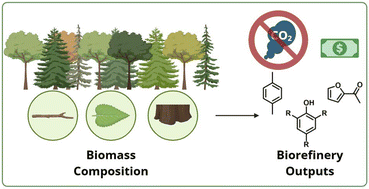
A modeled reductive catalytic fractionation-molten salt hydrolysis integrated process demonstrates that biomass composition dictates the economics and sustainability of forestry residue biorefineries.
To cite this article before page numbers are assigned, use the DOI form of citation above.
The content of this RSS Feed (c) The Royal Society of Chemistry
A modeled reductive catalytic fractionation-molten salt hydrolysis integrated process demonstrates that biomass composition dictates the economics and sustainability of forestry residue biorefineries.
To cite this article before page numbers are assigned, use the DOI form of citation above.
The content of this RSS Feed (c) The Royal Society of Chemistry


