
Livestock farmers have always recognized the value of manure in building soil fertility and supporting crop production. Historically, crop producers without access to this resource have looked on with envy. Today, a wide range of organic amendments – many sourced from outside agriculture – are available. However, not all amendments are created equal. Each product has unique characteristics, and the best choice depends on the specific needs of the field, logistics of application, and, of course, cost.
Guaranteed analysis
Many products currently available in Ontario are registered under the Canadian Food Inspection Agency (CFIA) and carry a label guaranteeing minimum nutrient content. In practice, materials often contain more nutrients than listed, so sampling during application is essential for accurate credits and planning. Although CFIA-registered materials are classified as fertilizers, they are organic amendments and should be managed using the same 4R nutrient stewardship principles as manure. Application of any material containing nutrients should never occur on frozen or snow-covered soils.
Evaluating and comparing options
In the current economic environment, where fertilizer prices are high, a producer may explore organic amendments to supplement fertilizer. Examples of current options include livestock or municipal compost, pelleted, ashed or pH-enhancing biosolids (i.e., N-Viro/N-Rich), and anaerobic digestate. Table 1: Comparing various organic amendments for nutrients, composition and value, compares various products available to non-livestock farms. The comparison is meant to provide an example of how products can be compared to assess the best fit for a particular farm. Excluding the compost products, each of the compared products are CFIA registered fertilizers. The target, in this example, is to fulfill P needs for a planned corn crop while enhancing overall nutrient balance and soil organic matter.
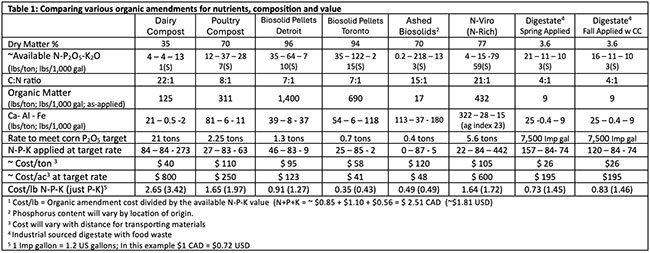
The cost/lb of estimated available N, P and K provides a comparison for fertility value, based on 2026 fertilizer prices. Although fertilizer value of organic amendments may increase, so likely will the fuel prices that transport the amendments. The micronutrient value of these amendments has not been included since not every field requires micronutrients. Similarly, organic matter provides greater value to fields with poor soil health than ones with regular application.
Each of these products can supply the phosphorus needs for the corn crop, but their differences matter. How important in the N component and how will application timing affect the value? Consider other goals based on soil test levels – extra organic matter to build soil, or a product that adds micronutrients or helps raise pH.
Observe nutrient balance too. Biosolids often have very little potassium, potentially requiring supplementing with commercial fertilizer. Some biosolids also contain high levels of calcium, aluminum, or iron, which can tie up phosphorus and make it less available, especially in low or high soil pH conditions. As a rule of thumb with biosolids containing high iron and/or aluminum, assume only about 20 percent of the phosphorus is available in the first year, and use a starter fertilizer to make sure the crop gets what it needs. Over time, the rest will become available, however, this can take months or even years depending on soil characteristics.
Cost and logistics can also influence product choice. The dairy compost in this example can’t economically meet P needs, but reducing application to five ton/ac would provide similar soil health benefits, and can be complemented with fertilizer to match crop nutrient needs. Ashed biosolids would economically build P, but with limited benefit for overall soil health.
With so many choices, focus on farm needs, what each product adds (or lacks), and the cost and logistics. The best option will provide the best returns.


