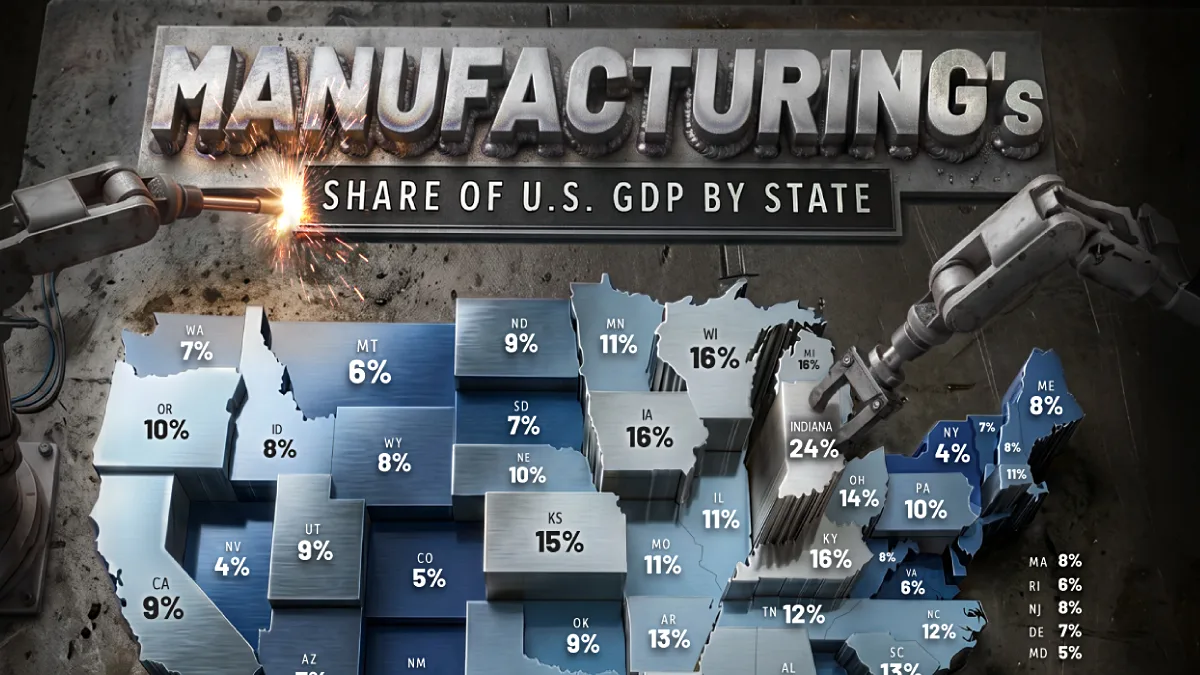
Which U.S. States Depend Most on Manufacturing?
See visuals like this from many other data creators on our Voronoi app. Download it for free on iOS or Android and discover incredible data-driven charts from a variety of trusted sources.
Key Takeaways
- Indiana generates nearly one-quarter of its GDP from manufacturing, the highest share of any U.S. state.
- Manufacturing makes up at least 15% of GDP across much of the Midwest, highlighting the region’s industrial strength.
- Alaska has the smallest manufacturing footprint, with the sector accounting for just 2% of state GDP.
The U.S. is the world’s second-largest manufacturing economy, yet only one state gets more than one-fifth of its GDP from the sector.
This map ranks every U.S. state by manufacturing’s share of GDP using 2025 data from the U.S. Bureau of Economic Analysis (BEA).
Indiana: Manufacturing Center of the U.S.
No state in the country relies more on manufacturing than Indiana (24%). Louisiana, the runner-up, falls seven percentage points lower at 17% of GDP.
The Hoosier State has long been a hub for heavy industry, aided by its central location, plentiful land, and relatively lower wages. Natural gas deposits in the northeast of the state, along with heavy European immigration, helped develop Indiana’s early manufacturing sector at the turn of the 20th century.
This table ranks U.S. states based on the share of GDP concentrated in manufacturing.
| Rank | State | Manufacturing share of Total GDP in 2025 (%) |
|---|---|---|
| 1 | Indiana | 24.0 |
| 2 | Louisiana | 17.3 |
| 3 | Kentucky | 15.9 |
| 4 | Iowa | 15.9 |
| 5 | Wisconsin | 15.6 |
| 6 | Michigan | 15.6 |
| 7 | Kansas | 15.1 |
| 8 | Alabama | 15.0 |
| 9 | Mississippi | 14.7 |
| 10 | Ohio | 13.7 |
| 11 | Arkansas | 12.9 |
| 12 | South Carolina | 12.8 |
| 13 | Tennessee | 11.7 |
| 14 | North Carolina | 11.6 |
| 15 | Minnesota | 11.5 |
| 16 | Texas | 11.4 |
| 17 | Connecticut | 11.2 |
| 18 | Illinois | 11.0 |
| 19 | Missouri | 11.0 |
| 20 | Oregon | 10.4 |
| 21 | Pennsylvania | 10.3 |
| 22 | Nebraska | 10.2 |
| 23 | Utah | 9.4 |
| 24 | Georgia | 9.3 |
| 25 | California | 9.1 |
| 26 | Oklahoma | 8.7 |
| 27 | North Dakota | 8.5 |
| 28 | Idaho | 8.4 |
| 29 | Maine | 8.3 |
| 30 | New Jersey | 8.2 |
| 31 | New Hampshire | 8.2 |
| 32 | West Virginia | 8.1 |
| 33 | Wyoming | 7.7 |
| 34 | Massachusetts | 7.7 |
| 35 | Arizona | 7.5 |
| 36 | Washington | 7.3 |
| 37 | Vermont | 7.0 |
| 38 | South Dakota | 6.9 |
| 39 | Delaware | 6.9 |
| 40 | Rhode Island | 6.5 |
| 41 | Virginia | 6.4 |
| 42 | Montana | 5.5 |
| 43 | Maryland | 5.1 |
| 44 | Colorado | 5.1 |
| 45 | Florida | 4.7 |
| 46 | Nevada | 4.2 |
| 47 | New York | 3.7 |
| 48 | New Mexico | 3.1 |
| 49 | Alaska | 2.2 |
Indiana’s manufacturing base spans a number of sectors, including the auto, steel, and pharmaceutical industries. Multinational pharmaceutical company Eli Lilly, the state’s largest corporation, is headquartered in Indianapolis.
Meanwhile, the state’s northwest region, centered around the cities of Gary and East Chicago, is home to some of the largest steel mills and oil refineries in North America. Indiana has been the top steel-producing state in the nation since 1975. Today, the state produces over a quarter of all U.S. steel output.
Manufacturing in the Midwest
The Midwest dominates the rankings, with nearly every Great Lakes state generating at least 10% of GDP from manufacturing. Together, these states form the country’s largest industrial corridor, anchored by automotive production, machinery, food processing, metals, and chemicals.
Michigan (16%) has long been famous for its auto industry. The state is home to both Ford and General Motors, and Stellantis also has its North American headquarters in Auburn Hills.
Neighboring Wisconsin (16%), meanwhile, is the nation’s top producer of paper products, as well as a major producer of beer and processed foods. Over one in every 10 working-age Wisconsinites is employed in manufacturing.
Deindustrialization and the Future of U.S. Manufacturing
While the Midwest remains the manufacturing center of the United States, the region has undergone major changes over the last half-century.
Deindustrialization and the outsourcing of manufacturing jobs to lower-cost markets such as China, Mexico, and Southeast Asia have led to the shuttering of hundreds of factories. The greater region has even come to be referred to as the Rust Belt in recent decades.
Despite decades of factory closures and offshoring, manufacturing remains a cornerstone of many state economies. Recent investments in semiconductors, electric vehicles, batteries, and reshoring initiatives are helping revive industrial activity in parts of the Midwest and South, although employment remains well below its historical peak.
Learn More on the Voronoi App 
Want to see the loss in U.S. manufacturing supremacy visualized? Check out The Shift in Global Manufacturing Exports: U.S., Germany, and Japan Decline as China Rises on Voronoi, the new app from Visual Capitalist.