
Ontario corn and soybean acreage was similar to last year, according to Statistics Canada’s June acreage survey. The U.S. Department of Agriculture’s June acreage data confirmed a year-over-year decrease in U.S. corn acres and year-over-year increase in the soybean area.
The USDA lowered the winter wheat seeded and harvested acreage. World wheat fundamentals continue to tighten. Europe is contending with drought-like conditions resulting yield drag on all crops. This is especially bullish for the Ontario corn market.
Quick look:
- Soybeans: Optimal growing conditions across Ontario boost yields.
- Corn: Average corn yields are predicted in 2026.
- Wheat: Winter wheat crops decline compared to last year.
Soybeans
Ontario farmers seeded 2.9 million acres of soybeans this spring according to Statistics Canada. Growing conditions have been optimal. Our Ontario contacts confirm a yield estimate of 52 bu./acre, up from 45.7 bu./acre last year. This would result in a crop size of four million tonnes, up from the 2025 output of 3.6 million.
Ontario on-farm soybean stocks will drop to historical lows at the end of the 2025-26 crop year. The tighter stocks have caused domestic crushers to switch over from soybeans to canola. The crush margins also favour canola due to the stronger vegetable oil values. Keep in mind that domestic crushers take their downtime for upgrades and maintenance in the summer months.
The Ontario soybean market continues to ration demand for old-crop positions by trading above world values. European crushes are starting to step forward for new-crop positions. Chinese buyers tend to extend ownership of Ontario soybeans in August and September. The Ontario soybean market will make seasonal lows in late July or early August.
U.S. farmers seeded 85.4 million acres of soybeans, according to USDA. Using an average yield of 53 bu./acre, production has potential to finish near 122 million tonnes, up from the 2025 crop of 116 million tonnes. Despite the larger production, the industry is factoring in a year-over-year increase in U.S. domestic crush and exports. Despite the year-over-year increase in production, the fundamentals will tighten in the 2026-27 crop year.
We’ve advised farmers to be 100 per cent sold on their 2025 crop. Earlier in spring, we recommended that farmers sell 10-15 per cent of their expected new-crop production. In a normal year, Ontario famers sell about 85 per cent of the crop from Sept. 1 through Dec. 1. Our strategy is to sell regular increments throughout the crop year. Statistically, this has been proven to increase the overall average price in the long-term.
Corn
Ontario farmers seeded 2.256 million acres of corn this spring, according to Statistics Canada. We’re projecting an average corn yield of 180 bu./acre. This would result in an Ontario corn crop of 10 million tonnes, up from the 2025 production of 9.5 million tonnes.
U.S. farmers seeded 95.3 million acres of corn, down 3.5 million acres from last year. At this stage, the industry feels comfortable with an average yield of 183 bu./acre. This would result in a crop size of 406 million tonnes, down from our previous forecast of 415 million tonnes and down from the 2025 crop of 432 million tonnes.
At the time of writing this article, the eight- to 14-day forecast called for above-normal temperatures and below-normal precipitation for Iowa, Nebraska, Missouri and Wisconsin. We’re expecting minor yield drag on the U.S. corn crop through pollination. During July, the corn market is expected to incorporate a risk premium due to U.S. production uncertainty.
The European corn crop is in serious trouble and prices have jumped sharply. The European wheat crop will also be smaller than expected. Nearly 40 per cent of Europe’s wheat crop moves into domestic feed channels. A smaller European corn and wheat crop will enhance demand for Ontario corn. Currently, Ontario corn is competitive for both old- and new-crop positions. We’re factoring in a significant year-over-year increase in Ontario corn exports to Europe which will tighten the fundamental structure for the 2026-27 crop year.
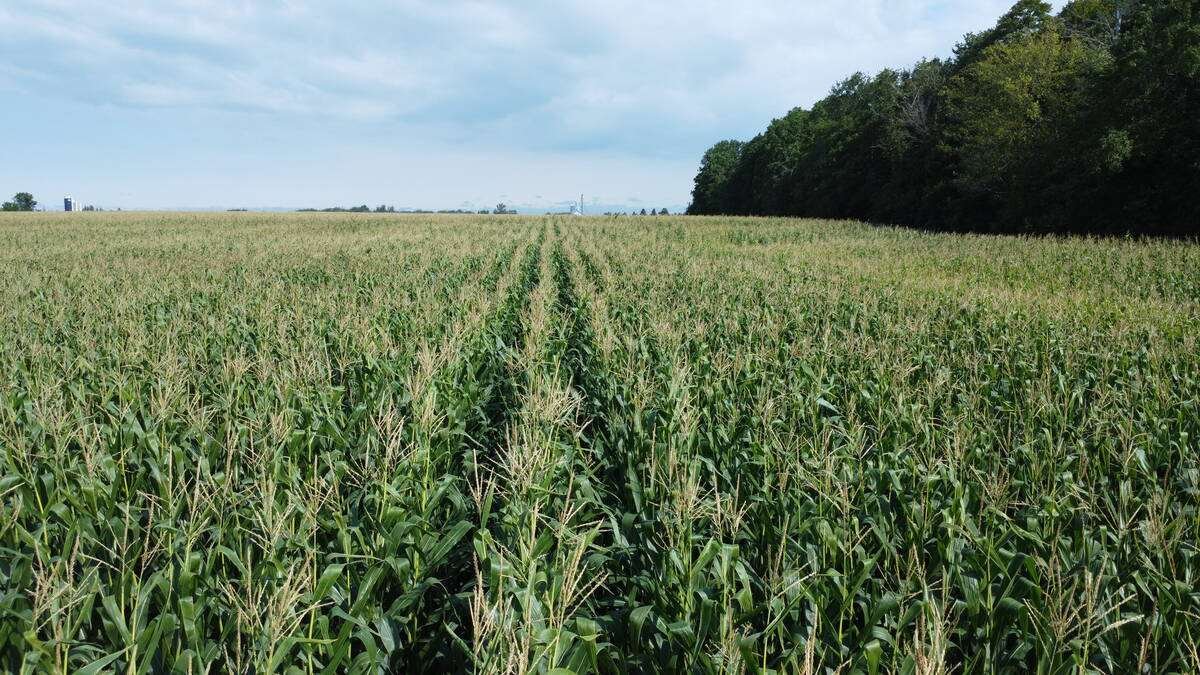
Ontario has put 2.256 million acres to corn for 2026. Photo: File
The Ontario corn market has likely made the seasonal low and producers can expect higher prices moving forward. We’ve advised farmers to be 100 per cent sold on their 2025 production. We’re planning on making our first new-crop corn sale once harvest begins.
Wheat
We’re projecting an Ontario winter wheat crop of 2.7 million tonnes, down from the 2025 crop of 2.9 million tonnes. Ontario spring wheat production is estimated at 100,000 tonnes, up only 6,000 tonnes from last year. Ontario flour millers have significant open demand for August forward. The export pace has slowed for the time being but we’re anticipating larger U.S. imports of Ontario soft red winter wheat. We believe the Ontario wheat market is also in the process of making seasonal lows. The spring wheat crop for all of Canada is estimated at 28.7 million tonnes, down marginally from 2025 output of 29.3 million tonnes.
The USDA’s June acreage survey showed the U.S. seeded area for winter wheat was lower than earlier anticipated. We’re now forecasting a U.S. soft red winter wheat crop of 8.4 million tonnes, down from the year-ago crop of 9.6 million tonnes. Quality is also uncertain due to adverse rains. The U.S. hard red winter crop is estimated at 15 million tonnes, down from the 2025 production of 21.9 million tonnes. The function of the U.S. winter wheat markets is to ration demand by trading at a premium to world values. Secondly, the U.S. soft red winter market needs to trade high enough to attract Ontario imports.
The larger European wheat carryout from the 2025-26 crop year has cushioned the year-over-year decrease in production for 2026-27. The market has been slow to adjust to the lower yield prospects from France and Germany.
The Russian war on Ukraine has taken a major turn over the past couple of weeks, with Ukrainian drones attacking Russian oil facilities close to Moscow. Secondly, Ukrainian drone and missile strikes have targeted Russian Black Sea port and energy infrastructure. There has been significant damage to grain terminals, storage silos and export facilities.
We continue to forecast a sharp year-over-year decrease in Australian and Argentine production. Heavy rains have occurred on China’s winter wheat crop as harvest moves into the early stages. Ideas are that China will be fairly aggressive on milling wheat purchases come fall.
This wheat market is sleeping, given crop problems in Europe and the U.S. along with the geopolitical issues in Russia and the Middle East. We’re expecting a significant rally of $1.50-$2/bu. come October. Don’t sell your wheat at harvest. This is one crop that you need to store. We’re planning our first sale during the first or second week of October. We’re looking for Ontario basis levels to strengthen as well. Domestic millers will need to pay premiums to secure milling quality.
The post Ontario corn and soybean acreage on track with 2025 appeared first on Farmtario.


