Germany Quit Nuclear. So Why Is It Importing More?
This was originally posted on our Voronoi app. Download the app for free on iOS or Android and discover incredible data-driven charts from a variety of trusted sources.
Key Takeaways:
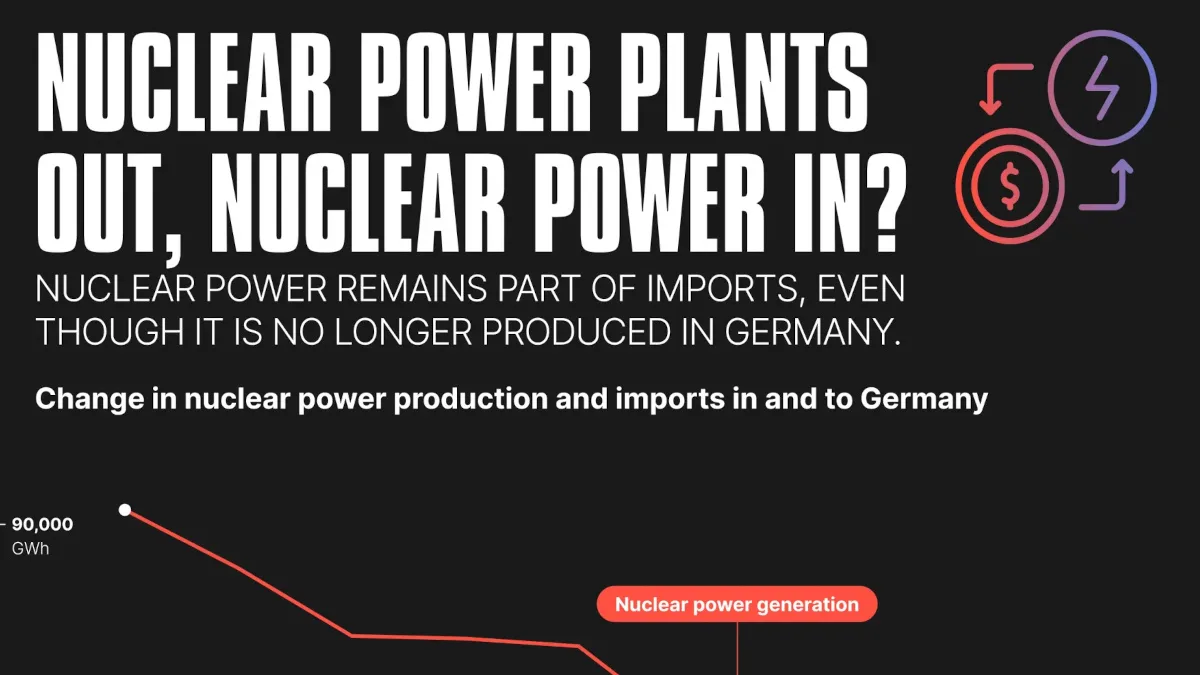
- Germany generated 91,790 GWh of nuclear electricity in 2015, but none in 2024 after completing its reactor phaseout.
- Estimated nuclear-generated electricity imports more than tripled over the same period, reaching 18,313 GWh in 2024.
- Ending domestic nuclear generation does not necessarily eliminate nuclear electricity from an interconnected power system.
Germany’s decision to phase out nuclear power has become one of the world’s most closely watched energy policy experiments. While the country’s last reactors shut down in 2023, Germany remains deeply connected to Europe’s integrated electricity market, where power moves across national borders.
The visualization above, created by DataPulse Research using data from SMARD, estimates how much of Germany’s imported electricity originated from nuclear generation between 2015 and 2024.
Germany’s Nuclear Generation Falls to Zero
Germany’s nuclear generation and estimated nuclear electricity imports are shown below.
| Year | Nuclear Power Generated Domestically (GWh) |
Nuclear Power Imported (GWh) |
|---|---|---|
| 2015 | 91,790 | 5,830 |
| 2016 | 84,630 | 4,363 |
| 2017 | 76,320 | 3,979 |
| 2018 | 76,000 | 6,407 |
| 2019 | 75,070 | 9,211 |
| 2020 | 64,380 | 8,757 |
| 2021 | 69,130 | 7,235 |
| 2022 | 34,710 | 4,542 |
| 2023 | 7,220 | 11,778 |
| 2024 | 0 | 18,313 |
As domestic generation steadily declined, estimated nuclear electricity imports followed a different trajectory, reaching their highest level in 2024.
Germany’s nuclear phaseout was shaped by decades of political debate and accelerated after the Fukushima disaster in 2011.
As reactors closed, the country expanded renewable energy while continuing to trade electricity across Europe’s interconnected grid. Domestic nuclear generation fell by more than 90,000 GWh between 2015 and 2024.
Why Nuclear Power Still Crosses Borders
Once electricity enters Europe’s interconnected grid, it flows according to supply, demand, and market prices rather than national energy policies. As a result, electricity imported into Germany can include nuclear-generated power from neighboring countries even though Germany no longer operates nuclear reactors.
The nuclear share of Germany’s imports may rise when nuclear generation is abundant and competitively priced in connected markets. According to DataPulse Research’s estimates, these imports increased sharply after Germany’s final reactors closed, highlighting the difference between where electricity is produced and where it is consumed.
Why Some Countries Are Ramping Up Nuclear Investment
Germany’s experience stands in contrast to countries that continue expanding nuclear capacity. Nuclear power can provide reliable, low-carbon electricity with high capacity factors while reducing dependence on imported fossil fuels. Countries with rapidly growing electricity demand or limited domestic energy resources may therefore include it in a diversified energy strategy.
Nuclear power remains one of the energy sector’s most debated technologies. Supporters emphasize its ability to generate large amounts of low-carbon electricity around the clock, while critics point to construction costs, radioactive waste, project delays, and safety concerns. The broader nuclear debate continues to shape energy policy around the world.
The U.S., France, China, Russia, and South Korea maintain extensive reactor fleets because of decades of investment, energy security priorities, and long-term industrial policy. Several are also planning additional reactors. Meanwhile, Germany belongs to a relatively small group of countries that have fully phased out nuclear generation.
Learn More on the Voronoi App 
Want to explore more data-driven stories on global security and energy? Check out Mapped: Countries With the Most Nuclear Missiles on the Voronoi app.