

When energy professionals think of Finland, they typically picture snowy winters, vast forests, and a heavy reliance on nuclear power and bioenergy. Solar PV rarely comes to mind as a cornerstone of a Nordic nation’s energy strategy. A stream of energy transition research from LUT University reveals a different future perspective: Solar PV is not just viable in Finland; it can lead the country’s cost-optimal path to a highly renewable energy system by 2050.
Far from being a marginal player, solar PV is projected to become the dominant technology by installed capacity. Across multiple scenarios, Finland’s solar PV capacity is set to expand from nearly 2 GW today to 68 GW by 2050, representing 62% of the nation’s total installed electrical capacity and 30% of the generated electricity.
The different research studies are centered on the main study entitled Energy and industry transition to carbon-neutrality in Nordic conditions via local renewable sources, electrification, sector coupling and Power-to-X and complemented by studies featuring the value of heat pumps, the role of biogenic CO2 and point-source capture, the role of nuclear power, high energy-intensive industry dominance on the case of Southeast Finland, and on the Arctic energy opportunities in Lapland. This recent research stream links to earlier research considering prosumers, electric vehicles flexibility, and fundamental screening for system options.
Tackling this transformation from geographic, economic, and industrial perspectives reveals why solar PV is the unexpected hero of the Nordic energy transition and cements the dominance of solar PV.
Nightless Night
One of the most persistent myths in the energy sector is that high-latitude regions cannot rely on solar PV. The research flips this assumption on its head by highlighting the phenomenon of the “Nightless Night”. In regions like Lapland, situated largely within the Arctic Circle, solar irradiation during the summer months can be available around the clock.
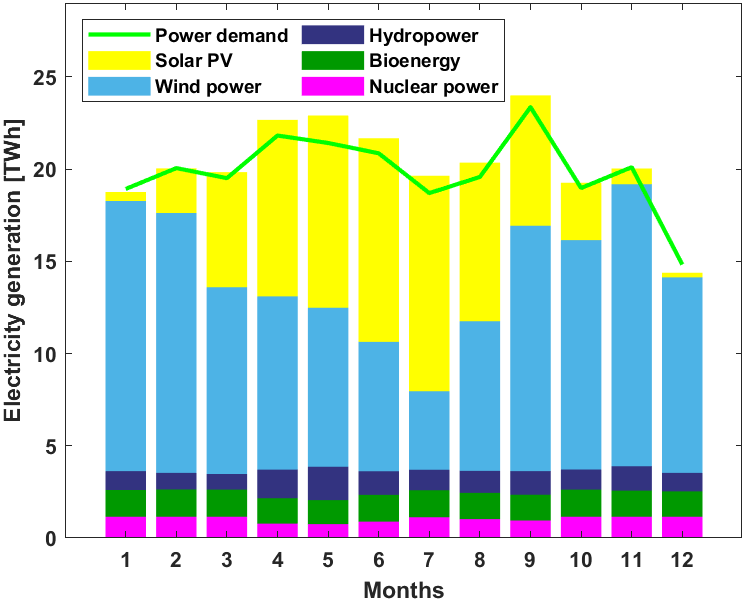
This midnight sun creates a seasonal complementarity with Finland’s wind energy resources. While onshore wind power dominates the winter months, solar PV surges in the spring and summer, filling the electricity generation gap when wind speeds drop. This seasonal synergy maximizes the utilization of the grid infrastructure and reduces the need for expensive, long-term inter-seasonal energy storage. The lesson here is clear: solar PV’s value is not just in its annual yield, but in its seasonal timing. By dominating the summer, PV allows harvesting wind energy from fall to spring and using bioenergy as a flexibility provider, creating a robust, year-round renewable base supply.
Excellent solar PV yield across the entire Arctic and sub-Arctic region can be observed during the summer months. Solar PV as part of a least-cost energy system solution has also been found for Iceland, Greenland, and Alaska and North Canada.
The role of nuclear power
Finland pledged to triple global nuclear capacity by 2050 at the COP28 climate summit, with strong political support for nuclear power. However, the research shows a severe economic reality: when pitted against solar PV and wind power in a free-market cost optimization, new nuclear power cannot compete, including small modular nuclear reactors (SMR).
“Nuclear tripling” results in annualized system costs that are 71% to 84% higher than a renewables-driven system. Even when applying extremely optimistic financing assumptions with a favorable cost of capital for nuclear power, the heavily solar PV and wind power-based system remains 37% cheaper. Thanks to the precipitous drop in solar PV capital expenditures, the levelized cost of electricity (LCOE) in Finland’s near 100% renewable energy scenarios plummets to roughly €33 /MWh by 2050.
For policymakers and energy investors, the opportunity cost is glaring. Prioritizing unproven, expensive SMRs diverts crucial capital away from rapidly deployable solar PV projects that offer a faster and significantly cheaper route to defossilization.
Other research supports such results for Nordic countries, such as Sweden and Denmark. Research also highlights the limited contribution potential of nuclear power for climate change mitigation and the overall societal risk associated with it. Studies that position nuclear power as part of climate change mitigation are typically flawed in oversimplified simulations, overly optimistic assumptions for nuclear power, and outdated cost assumptions for renewable energy technologies.
Energy-intensive industry
Heavy, energy-intensive industries such as pulp and paper, cement, steel, and some chemicals dominate Finland’s energy landscape. These industries are hard-to-electrify and belong to the challenging industry segments of the transition. In Southeast Finland alone, industry accounts for 80% of the final energy demand. The answer for the role of variable solar PV in baseload industries lies in deep sector coupling, power-to-X, and overall flexibility in the energy-industry system.
During the summer, solar PV electricity is used to power water electrolyzers. These electrolyzers operate at maximum capacity during the sunny months, generating vast quantities of green hydrogen. This hydrogen is fed directly into green steel manufacturing or buffered in underground storage to run e-fuel and e-chemical synthesis plants continuously throughout the year.
Finland’s large pulp and paper mills emit millions of tonnes of biogenic CO2. Point source capture (PSC) of this biogenic CO2 provides a large economic advantage over extracting CO2 directly from the air (direct air capture, or DAC). The research reveals that when PSC is utilized, the energy system sources its CO2 almost exclusively from these point sources, completely marginalizing DAC. In fact, biomass-fueled power plants and pulp and paper mills become the primary CO2 suppliers, contributing 93.8% of the total CO2 required for e-fuel and e-chemical synthesis. By combining cheap solar PV and wind electricity with PSC, Finland is positioned to become a major European hub for sustainable e-methanol, e-ammonia, and Fischer-Tropsch liquids. Solar PV and wind power essentially act as the primary engine converting industrial waste CO2 into high-value, exportable green fuels. Co-allocating low-cost solar PV and wind power with sustainable CO2 point sources can support the uptake of e-fuels and e-chemicals, potentially circumventing infrastructure challenges.
The system perspective
In a freezing climate, heating is a matter of survival. Traditionally, solar PV and winter heating seem incompatible. Yet, the research reveals a dynamic where solar PV pairs exceptionally well with direct electric heating and thermal energy storage to support the use of wind electricity for heat supply.
As solar PV pushes electricity prices toward zero during sunny periods, electric boilers convert electricity into heat, which is stored in district heating thermal energy storage tanks. Interestingly, the models often select simple, low-cost resistive electric heaters over highly efficient heat pumps for industrial and district heating. Because solar PV provides such abundant and cheap electricity in the summer, the low upfront cost of electric boilers outweighs the efficiency gains of expensive heat pumps. In the residential heating environment where no district heating systems are available, heat pumps are the primary solution, and research shows that even very cold temperatures in the winter do not block heat pumps as a core residential solution.
This deep-dive research into Finland’s energy transition offers several takeaways for the global solar PV industry.
Latitude is not a limit: If solar PV can become the backbone of a Nordic nation’s energy system, its viability in temperate and equatorial regions is unquestionable. The “Nightless Night” proves that extreme summer generation can offset winter deficits when paired with wind power.
Solar PV is the low-cost enabler of sector coupling: The true value of solar PV extends far beyond the power grid. It is the catalyst for the Power-to-X Economy. By oversizing PV to run electrolyzers and electric boilers during peak sun, industries can store energy as molecules (hydrogen/e-fuels) and thermal energy, bridging the gap between summer sun and winter demand.
Economics trump tradition: Despite Finland’s historical reliance on nuclear baseload power, the sheer cost-efficiency of solar PV and wind power renders new nuclear power projects economically obsolete. The data provides counterarguments to nations considering expensive SMRs over rapid PV deployment.
Authors: Rasul Satymov, Dominik Keiner, and Christian Breyer
This article is part of a monthly column by LUT University.
Research at LUT University encompasses various analyses related to power, heat, transport, industry, desalination, and carbon dioxide removal options. Power-to-X research is a core topic at the university, integrated into the focus areas of Planetary Resources, Business and Society, Digital Revolution, and Energy Transition. Solar energy plays a key role in all research aspects.
The post Solar PV offers significant untapped potential for Finland appeared first on pv magazine Global.


